CEED 2026 Entrance Exam: The Ultimate Guide for Engineering Students to Master Design
- Sairam Joshi
- 6 days ago
- 6 min read

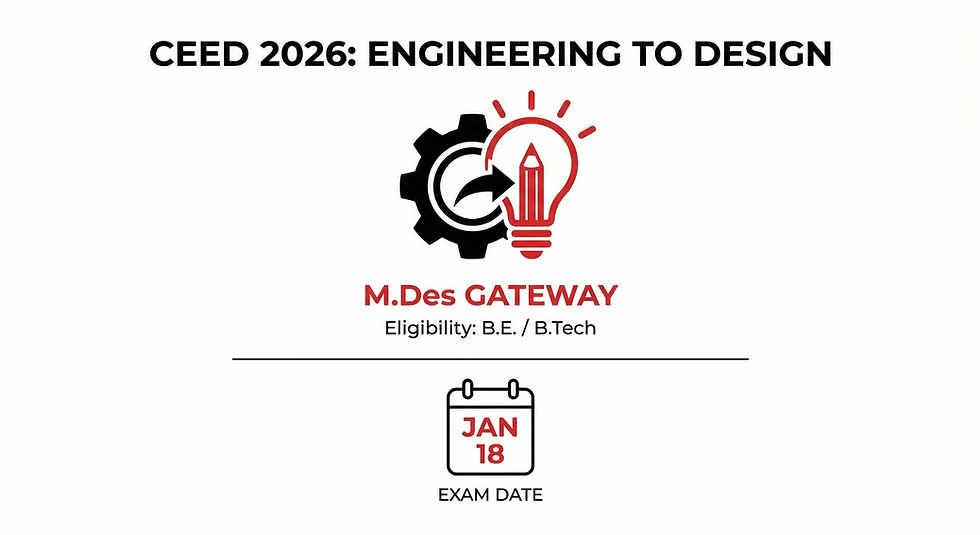
The intersection of engineering and design is where the world’s most impactful innovations are born. For many B.E. and B.Tech students, the traditional software or core engineering path is no longer the only "golden" route. As we approach the CEED 2026 Entrance Exam, more engineering graduates than ever are looking toward the Master of Design (M.Des) as a way to combine their technical analytical skills with creative problem-solving.
In this comprehensive guide, we will break down everything you need to know about the Common Entrance Examination for Design (CEED) for the 2026 cycle. From eligibility and exam patterns to ROI analysis and placement statistics, this is your blueprint for transitioning from a "builder" to a "designer."
What is the CEED 2026 Entrance Exam?
The CEED 2026 Entrance Exam is a national-level competitive test conducted by the Indian Institute of Technology (IIT) Bombay on behalf of the Ministry of Education. Its primary purpose is to assess a candidate’s aptitude for design—specifically their visual perception, drawing skills, logical reasoning, and creative thinking.
Qualifying for CEED is the gateway to some of India’s most prestigious postgraduate programs, including the Master of Design (M.Des) and Ph.D. in Design at IITs and IISc Bangalore. For engineers, this exam represents a pivot point into high-growth industries like UI/UX design, Product Management, and Industrial Design.
Why Should Engineers Opt for CEED 2026?
You might wonder why an engineer would choose design over an M.Tech or an MBA. The answer lies in the evolving job market of 2026.
1. The High ROI of M.Des
Unlike many generic master’s programs, an M.Des from an IIT offers an exceptional Return on Investment (ROI). With tuition fees often lower than private design schools and starting salaries for Product Designers ranging from ₹12 LPA to ₹25 LPA, the financial upside is significant.
2. Bridging the Gap between Logic and Aesthetics
Engineers are naturally good at "How things work." Designers focus on "How people use things." By mastering both, you become a "Full-Stack Creator." Companies like Google, Microsoft, and Tesla actively seek engineers with design degrees because they can talk to the developers while empathizing with the users.
3. Career Versatility
In 2026, roles like XR (Extended Reality) Designer, Interaction Designer, and Sustainability Consultant are booming. These roles require the technical foundation of an engineering degree coupled with the human-centric approach of a design degree.
CEED 2026 Eligibility Criteria for Engineers
One of the most common myths is that you need a background in Fine Arts to take the CEED. This is false.
Educational Qualification: Candidates must have completed a degree/diploma/postgraduate program of at least 3 years (after 10+2). This explicitly includes all B.E., B.Tech, and B.Arch graduates.
Final Year Students: If you are in your final year of engineering and will complete your degree by July 2026, you are fully eligible to apply.
Age Limit: There is no age limit to appear for CEED 2026.
Number of Attempts: You can attempt the exam as many times as you wish.
CEED 2026 Important Dates (Official Schedule)
Staying on top of the timeline is crucial for your preparation. Based on the latest updates from IIT Bombay, here is the projected schedule for the CEED 2026 Entrance Exam:
Event | Tentative Date |
Online Registration Starts | October 01, 2025 |
Last Date for Registration (Regular Fee) | October 31, 2025 |
Registration with Late Fee | November 07, 2025 |
Admit Card Release | January 02, 2026 |
CEED 2026 Exam Date | January 18, 2026 |
Release of Draft Answer Key (Part A) | January 20, 2026 |
Announcement of Cut-off for Part A | February 05, 2026 |
Declaration of Results | March 04, 2026 |
Scorecard Availability | March 10, 2026 |
Deciphering the CEED 2026 Exam Pattern
The exam is divided into two parts, both held on the same day. Understanding the weightage of each is the key to a high rank.
Part A: The Computer-Based Gatekeeper
Duration: 1 Hour
Total Marks: 150
Question Types:
NAT (Numerical Answer Type): No negative marking.
MSQ (Multiple Select Questions): Multiple correct options.
MCQ (Multiple Choice Questions): Negative marking applies.
Important Note for Engineers: Part A is purely a screening test. If you don't clear the Part A cutoff, your Part B will not even be evaluated. Your engineering background in logical reasoning and spatial visualization will give you a massive edge here.
Part B: The Creative Arena
Duration: 2 Hours
Total Marks: 100
Evaluation: Manually graded by experts.
Sections: 1. Sketching (20 Marks)
2. Creativity (20 Marks)
3. Form Sensitivity (20 Marks)
4. Visual Sensitivity (20 Marks)
5. Problem Identification (20 Marks)
CEED 2026 Syllabus: What to Focus On?
The syllabus for the CEED 2026 Entrance Exam is intentionally broad. However, for engineering students, the focus should be split into "Strengths" and "Skills to Build."
Part A Focus Areas:
Visualization and Spatial Ability: Understanding 2D and 3D transformations.
Environmental and Social Awareness: Sustainability, pollution, and climate change impacts on design.
Analytical and Logical Reasoning: This is where engineers typically score highest.
Design Sensitivity: Identifying details and inconsistencies in everyday objects.
Part B Focus Areas:
Problem Identification: Can you look at a chaotic railway station and identify five specific design flaws?
Form Sensitivity: Can you sketch a combination of a toaster and a radio that looks aesthetically balanced?
Sketching: Mastering 1-point and 2-point perspective is non-negotiable.
Top Participating Institutes and Seat Intake
Securing a high rank in the CEED 2026 Entrance Exam allows you to apply to the following elite institutions:
Institute | Popular Specializations | Total M.Des Seats (Approx) |
IIT Bombay (IDC) | Industrial Design, Communication, Interaction | 78 |
IISc Bangalore | Product Design and Engineering | 18 |
IIT Delhi | Industrial Design | 20 |
IIT Guwahati | Design (User Experience) | 33 |
IIT Hyderabad | Visual Design, Product Design | 30 |
IIT Kanpur | Multi-disciplinary Design | 78 |
IIT Roorkee | Industrial Design | 20 |
Career Opportunities and Placements
The demand for "Design-Engineers" has skyrocketed. Here is a look at what the placement landscape looks like for CEED graduates in 2026:
Product Designer: Managing the end-to-end lifecycle of a product (Physical or Digital).
UX/UI Designer: Creating seamless interfaces for apps like Uber, Zomato, or banking software.
Mobility Designer: Working on the next generation of Electric Vehicles (EVs) at Tata Motors or Tesla.
Interaction Designer: Crafting how humans interact with AI-driven systems.
Top Recruiters: Microsoft, Google, Samsung, Adobe, Tata Motors, Whirlpool, and high-growth startups like Ather Energy and Razorpay.
Preparation Strategy for Engineering Students
As an engineer, your "Drawing" might be rusty, but your "Logic" is sharp. Use this 3-month strategy:
Month 1 (Part A Dominance): Solve previous year papers to master NAT and MSQ questions. Brush up on General Knowledge related to Indian Art, Architecture, and Design History.
Month 2 (Sketching Fundamentals): Don't aim for "Art." Aim for "Communication." Learn to draw basic shapes, human proportions, and perspectives.
Month 3 (Mock Tests & Problem Solving): Practice identifying design problems in your house or college. For example, "How can the design of a water bottle be improved for elderly users?"
Frequently Asked Questions (FAQ)
1. Is the CEED 2026 Entrance Exam difficult for engineers?
While the sketching part can be challenging, engineers often find the analytical and visualization sections of the CEED 2026 Entrance Exam easier than other candidates. With 3-4 months of consistent sketching practice, an engineer can easily crack the exam.
2. What is the validity of the CEED score?
The CEED score is valid for a period of one year from the date of declaration of the result.
3. Can I apply for CEED if I have a low CGPA in B.Tech?
Yes. IIT Bombay does not set a minimum CGPA for appearing in the exam. However, individual institutes (like IIT Delhi or IISc) might have their own CGPA cutoffs during the admission interview stage.
4. Do I need to bring my own drawing materials?
Yes, for Part B, you must bring your own pencils, pens, and colors. However, use of sketch pens or oil pastels is usually discouraged as they might smudge.
Conclusion: Your Design Journey Starts Here
The CEED 2026 Entrance Exam is more than just a test; it is an invitation to redefine your career. For an engineer, adding design to your toolkit is like adding a superpower. It allows you to not just build the world, but to make it more usable, beautiful, and human.
If you are ready to make the leap, start by downloading the official syllabus and practicing your first perspective sketch today!
Explore More Design Resources
CEED 2026 Official Website: Visit ceed.iitb.ac.in – The primary source for all notifications and official updates.
Official Registration Portal: Access the Application Dashboard – Use this link to register, upload documents, and check your application status.
Download CEED 2026 Brochure: Official Information Brochure (PDF) – Read this carefully for the detailed syllabus and eligibility rules.
Previous Year Question Papers: Download Papers & Answer Keys – Essential for mastering the Part A and Part B patterns.


Comments