NEET 2026 Reservation Policy Explained: A Complete Guide for Medical & Engineering Aspirants
- Jan 30
- 5 min read
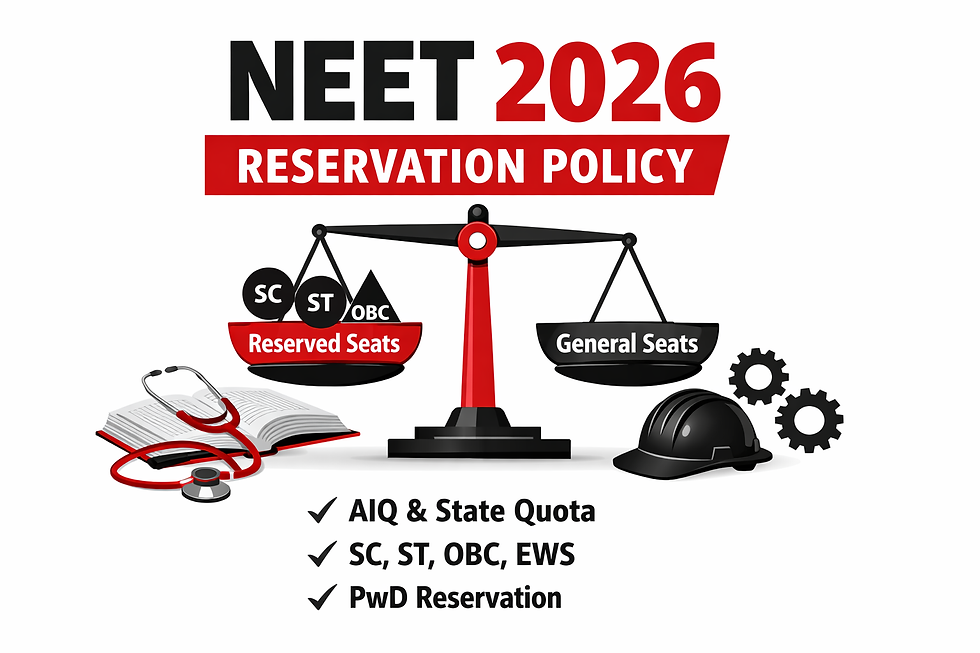
NEET 2026 Reservation Policy Explained: A Complete Guide for Medical & Engineering Aspirants
INTRODUCTION
The NEET 2026 reservation policy remains one of the most important aspects for students planning undergraduate medical education (MBBS/BDS) in India. With thousands of aspirants appearing each year, understanding how seats are allocated under different reservation categories is essential for planning your strategy and setting realistic expectations.
This detailed 1200-word guide simplifies the latest reservation norms, explains how seats are divided under the All India Quota (AIQ) and State Quota, and gives you up-to-date data relevant for 2026 aspirants — with additional context for students worried about engineering admissions as well.
NEET 2026 Reservation Policy Explained: A Complete Guide for Medical & Engineering Aspirants
What Is the NEET 2026 Reservation Policy?
In simple terms, the NEET 2026 reservation policy refers to rules that determine how many seats in medical and dental colleges are set aside for candidates from specific social and economic categories. The policy exists to promote equitable access to professional education for historically underrepresented communities in India.
The National Testing Agency (NTA) conducts the NEET UG exam, while the Medical Counselling Committee (MCC) implements reservation policy and seat allocation for the All India Quota (AIQ) counselling. (Collegedunia)
Why Reservation Matters in NEET
Reservation affects:
Seat allotment chances: Candidates from SC/ST, OBC-NCL, and EWS categories get a certain percentage of seats reserved, improving chances against the massive competition.
Cut-off and rank dynamics: The qualifying cutoff and competitive ranks vary for reserved versus unreserved categories.
Counselling strategy: Understanding reservation helps aspirants choose colleges wisely during the MCC and state counselling rounds.
While this policy directly applies to medical courses like MBBS and BDS, many engineering aspirants closely watch NEET policies to compare reservation trends in other national level exams like JEE Main and advanced engineering seats (though engineering admissions have a separate reservation framework under the Government of India). This article emphasizes the medical entrance domain but provides insights relevant to the broader competitive exam ecosystem.
Reservation Breakdown: All India Quota (AIQ) Seats
A key aspect of the NEET 2026 reservation policy is how 15% of government medical seats are handled under the All India Quota (AIQ). These AIQ seats open opportunities nationwide, irrespective of state domicile. (Collegedunia)
Here’s how AIQ seats are reserved:
Category | Reservation Percentage |
Other Backward Classes – Non-Creamy Layer (OBC-NCL) | 27% |
Scheduled Caste (SC) | 15% |
Scheduled Tribe (ST) | 7.5% |
Economically Weaker Sections (EWS) | 10% |
Persons with Disabilities (PwD) | 5% (horizontal across all categories) |
Note: General (unreserved) category has no reservation quota within AIQ seats. (Collegedunia)
Horizontal Reservation: PwD Seats
The horizontal reservation for Persons with Disabilities (PwD) means that 5% of the seats in all categories (General, OBC, SC, ST, and EWS) are available to PwD candidates. To claim these, candidates must hold valid PwD certificates issued by designated authorities. (Careers360)
PwD candidates also receive certain exam accommodations such as extra time and scribe assistance during NEET. (Careers360)
85% State Quota Seats
Beyond the 15% AIQ seats, 85% of seats in government colleges are allocated under State Quota. These seats are governed by state governments, and reservation varies according to individual state rules. Generally, states follow similar percentages for SC, ST, OBC, and EWS categories, with additional considerations like domicile requirements or local resident quotas. (TestprepKart)
For example:
In many states, domicile candidates often receive preference under the state quota.
Each state’s counselling authority conducts separate counselling for these seats.
Deemed & Private Universities
Reservation rules for deemed and private colleges included in NEET counselling (through MCC) differ from AIQ/State Quota:
Deemed Universities: Typically, there is no reservation for SC/OBC/SC/ST/EWS under their counsellings. (Careers360)
Private colleges often follow their own fee structure and may have different reservation norms, influenced by state policy and Supreme Court judgements.
Eligibility Criteria for Reserved Categories
To benefit from reservation under the NEET 2026 reservation policy, candidates must present valid certificates issued by competent authorities. These include:
SC/ST certificates: Issued by state/central authorities confirming scheduled caste or tribe status.
OBC-NCL certificate: Must be non-creamy layer as per central lists.
EWS certificate: Annual family income below ₹8 lakh and compliance with property norms. (Narayana Junior Colleges)
PwD certificate: As per NMC and MCC guidelines with specific disability criteria. (Careers360)
Always ensure your certificates are within the validity period and properly issued before NEET counselling begins.
Cut Off & Reservation: What Aspirants Should Know
Reservation can influence admission cut-offs and counselling ranks. While qualifying for NEET requires meeting cut-off percentiles, final seat allotment considers both rank and reservation category. Recent years have shown adjustments to cut-offs to ensure seats are filled, but the merit ranking remains the key determinant for allotment. (PW Live)
For example, fulfilling the eligibility percentile (e.g., 50th for General, 40th for OBC/SC/ST, etc.) makes you eligible, but actual seat allotment still depends on rank compared to other candidates. (Affinity Education)
Engineering Aspirants: Reservation in Comparison
While NEET is exclusive to medical admissions, engineering entrance exams like JEE Main also follow reservation policies under central and state governments:
Category | Reservation in Engineering (Central) |
OBC-NCL | 27% |
SC | 15% |
ST | 7.5% |
EWS | 10% |
PwD | 5% (horizontal) |
These reservation frameworks are similar to NEET and reflect consistent policy across professional education, although specifics are managed by respective entrance authorities.
Frequently Asked Questions (FAQ)
What is the NEET 2026 reservation policy for AIQ seats?
The NEET 2026 reservation policy for AIQ seats includes 27% for OBC-NCL, 15% for SC, 7.5% for ST, 10% for EWS, and 5% horizontal reservation for PwD candidates. (Collegedunia)
Do state quota seats follow the same NEET 2026 reservation policy?
State quota seats follow the state’s own reservation laws, though they often mirror the central reservations (SC, ST, OBC, EWS, PwD) and may include domicile requirements. (TestprepKart)
Is reservation available in deemed medical colleges under NEET 2026?
Most deemed medical colleges do not provide reservation under NEET counselling for categories like SC/OBC/EWS; these are merit-based seats, but rules can vary per institution. (Careers360)
Can a candidate with a PwD certificate get horizontal reservation in NEET 2026 admissions?
Yes, candidates with a valid PwD certificate receive 5% horizontal reservation across all categories provided they meet eligibility criteria. (Careers360)
How does the NEET 2026 reservation policy affect cut-offs?
Reservation affects eligibility cut-offs and category ranks during counselling, but admission is still primarily rank-based. Meeting your category cutoff doesn't guarantee a seat; the allotment depends on your relative position among applicants. (Affinity Education)
Final Thoughts
Understanding the NEET 2026 reservation policy is crucial for aspirants and their families. It not only clarifies how seats are distributed but also helps you plan your preparation and counselling strategy effectively. Always keep updated with official notifications from MCC, NTA, and respective state counselling authorities as policies may evolve.
Stay focused on your NEET preparation, know your category rules, and approach counselling with clarity and confidence.
CTA
more related topic


Comments