JEE Main 2027 Session 1 Exam Dates Announced: January Schedule and Complete Student Guide

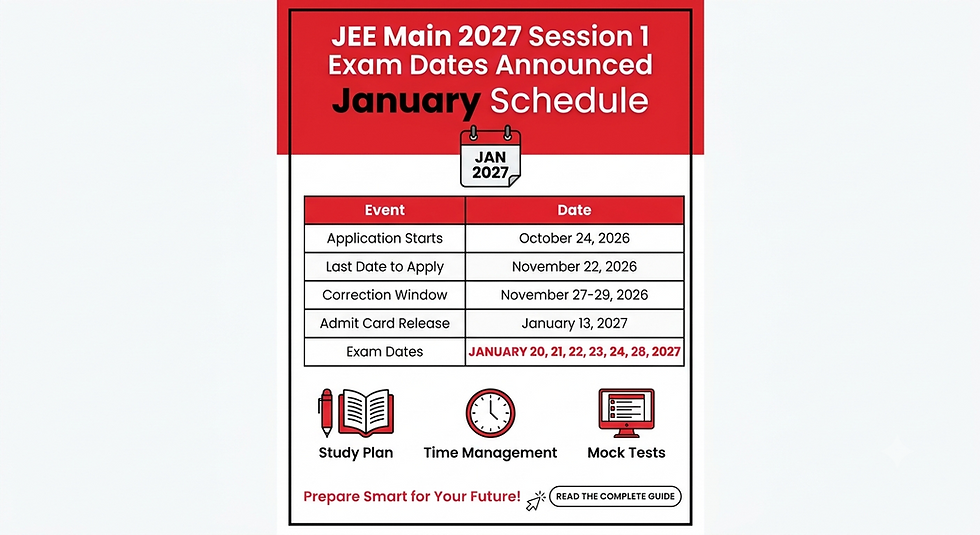
The National Testing Agency (NTA) has officially released the detailed notification and schedule for the Joint Entrance Examination (JEE Main 2027). Every year, lakhs of aspiring engineers across India gear up to crack this competitive examination to secure a seat in top-tier institutions such as the National Institutes of Technology (NITs), Indian Institutes of Information Technology (IIITs), and other Centrally Funded Technical Institutions (CFTIs). Additionally, performance in JEE Main serves as the qualifying gateway to JEE Advanced for admission into the prestigious Indian Institutes of Technology (IITs).
With the official release of the JEE Main 2027 Session 1 Exam Dates, candidates now have a clear timeline to fine-tune their revision strategies, practice mock tests, and complete their application forms well before the deadlines. Session 1 of JEE Main 2027 will be conducted in January 2027, followed by Session 2 in April 2027.
In this comprehensive student guide, we cover every detail you need to know about the JEE Main 2027 Session 1 Exam Dates, the application timeline, eligibility criteria, exam pattern, subject-wise weightage, syllabus highlights, and preparation strategies.
Official JEE Main 2027 Session 1 Exam Dates & Timeline
The NTA has published the complete examination schedule for both January and April sessions on its official portal (jeemain.nta.nic.in). Below is the detailed event-wise breakdown for the upcoming examination cycle.
JEE Main 2027 Session 1 (January Session) Complete Schedule
Event | Official Date / Deadline |
Official Notification Release | October 24, 2026 |
Online Application Form Submission Starts | October 24, 2026 |
Last Date to Submit Application Form (Without Late Fee) | November 22, 2026 (up to 11:50 PM) |
Fee Payment Deadline (Without Late Fee) | November 22, 2026 (up to 11:50 PM) |
Application Submission Window with Late Fee (₹500) | November 23 to 26, 2026 (up to 11:50 PM) |
Application Form Correction Window | November 27 to 29, 2026 (up to 11:50 PM) |
Announcement of Examination City (City Intimation Slip) | December 30, 2026 |
Downloading of Admit Cards from NTA Website | January 13, 2027 (3 days before exam) |
JEE Main 2027 Session 1 Exam Dates | January 20, 21, 22, 23, 24, and 28, 2027 |
Display of Provisional Answer Keys & Response Sheets | First Week of February 2027 |
Declaration of Session 1 Results | Second Week of February 2027 |
JEE Main 2027 Session 2 (April Session) Timeline Preview
Event | Tentative / Official Date |
Online Application Form Submission Starts | January 5, 2027 |
Last Date to Apply for Session 2 (Without Late Fee) | February 3, 2027 (up to 11:50 PM) |
Application Window with Late Fee (₹500) | February 4 to 7, 2027 (up to 11:50 PM) |
Application Correction Window | February 8 to 10, 2027 |
Release of City Intimation Slip | March 12, 2027 |
Admit Card Downloading | March 25, 2027 |
JEE Main 2027 Session 2 Exam Dates | April 2, 3, 4, 5, 6, and 7, 2027 |
Declaration of Final NTA Scores & All India Ranks (AIR) | Fourth Week of April 2027 |
Key Highlights of JEE Main 2027 Session 1 Examination
The National Testing Agency continues to conduct the exam across hundreds of cities in India and abroad. Candidates must keep the following essential points in mind:
Two Sessions Advantage: Students can choose to appear in either Session 1 (January), Session 2 (April), or both. If a candidate appears in both sessions, the best of the two NTA percentile scores will be considered for compiling the final All India Rank (AIR) list.
Computer-Based Test (CBT) Mode: Paper 1 (B.E./B.Tech.) is conducted entirely in Computer-Based Test mode. Paper 2A (B.Arch.) features CBT for Mathematics and Aptitude sections, while the Drawing section is held in offline pen-and-paper mode on an A4 sheet.
Multi-Lingual Exam Options: In accordance with the National Education Policy (NEP), JEE Main 2027 is conducted in 13 regional languages: English, Hindi, Assamese, Bengali, Gujarati, Kannada, Malayalam, Marathi, Odia, Punjabi, Tamil, Telugu, and Urdu.
Strict Identity Verification: NTA has integrated Single Sign-On (SSO) via Meri Pehchaan and DigiLocker/Aadhaar verification to streamline registration and eliminate fraudulent registrations. During live form filling, candidates are required to capture and upload a real-time live photograph alongside a passport-sized image.
Eligibility Criteria for JEE Main 2027
Before filling out the online application form, candidates must carefully verify their eligibility. The detailed criteria prescribed by NTA are as follows:
1. Age Limit
There is no upper age limit for candidates appearing in JEE Main 2027.
Candidates who have passed Class 12 or equivalent examinations, or are appearing in 2027, can apply regardless of age.
2. Qualifying Examination & Year of Passing
Candidates who passed their Class 12 (or equivalent) in 2025, 2026, or those appearing in 2027 are eligible.
Students who completed Class 12 in 2024 or earlier are not eligible to attempt JEE Main 2027.
3. Mandatory Subjects in Class 12
For B.E./B.Tech. (Paper 1): Must have passed Class 12 with Physics and Mathematics as compulsory subjects along with one of Chemistry, Biotechnology, Biology, or Technical Vocational subjects.
For B.Arch. (Paper 2A): Must have passed Class 12 with Physics, Chemistry, and Mathematics.
For B.Planning (Paper 2B): Must have passed Class 12 with Mathematics as a compulsory subject.
4. 75% Marks Rule for Admission to NITs, IIITs, and CFTIs
While appearing for JEE Main does not require a minimum percentage, securing admission into participating institutions (NITs, IIITs, CFTIs) requires:
At least 75% aggregate marks in Class 12 board examinations (or equivalent).
65% aggregate marks for SC/ST candidates.
Alternatively, the candidate must fall within the top 20 percentile of their respective state board examination.
Detailed JEE Main 2027 Exam Pattern (Paper 1 - B.E./B.Tech)
Understanding the paper structure and marking scheme is vital for effective time management during the exam.
Paper Structure & Distribution of Marks
Subject | Section A (MCQs) | Section B (Numerical Value) | Total Questions | Total Marks |
Mathematics | 20 | 5 | 25 | 100 |
Physics | 20 | 5 | 25 | 100 |
Chemistry | 20 | 5 | 25 | 100 |
Total | 60 Questions | 15 Questions | 75 Questions | 300 Marks |
Shift Timings and Test Duration
Total Exam Duration: 3 hours (180 minutes) for non-PwD candidates. 4 hours for PwD candidates eligible for compensatory time.
Shift 1 (Morning): 09:00 AM to 12:00 PM (IST)
Shift 2 (Afternoon): 03:00 PM to 06:00 PM (IST)
Marking Scheme
Correct Answer: +4 Marks
Incorrect Answer: -1 Mark (Negative marking applies to both Section A and Section B)
Unanswered / Marked for Review: 0 Marks
Subject-Wise Syllabus Highlights & Important Topics
The JEE Main 2027 syllabus continues to strictly align with the rationalized NCERT Class 11 and Class 12 curriculum. Below are the key topics in each subject based on weightage analysis from recent examination papers.
1. Mathematics
Mathematics is historically considered the lengthiest section in JEE Main. Prioritize speed and practice in the following areas:
Algebra: Matrices and Determinants, Complex Numbers, Quadratic Equations, Sequences and Series, Permutations and Combinations, Binomial Theorem, Probability.
Calculus: Limits, Continuity and Differentiability, Application of Derivatives, Definite and Indefinite Integrals, Differential Equations.
Coordinate Geometry: Straight Lines, Circles, Parabola, Ellipse, Hyperbola.
Vectors & 3D Geometry: Vector Algebra, 3D Coordinate Geometry (Line and Plane equations).
Trigonometry: Trigonometric Ratios, Equations, and Inverse Trigonometric Functions.
2. Physics
Physics tests a candidate’s fundamental clarity and problem-solving application. Focus on numerical mastery across these chapters:
Mechanics: Kinematics, Laws of Motion, Work, Power & Energy, Rotational Motion, Gravitation, System of Particles.
Electrodynamics: Electrostatics, Current Electricity, Magnetic Effects of Current & Magnetism, Electromagnetic Induction (EMI), Alternating Current (AC).
Thermal Physics: Thermodynamics, Kinetic Theory of Gases (KTG), Heat Transfer.
Optics & Modern Physics: Ray Optics, Wave Optics, Dual Nature of Matter and Radiation, Atoms & Nuclei, Semiconductor Devices.
Oscillations & Waves: Simple Harmonic Motion (SHM), Wave Motion.
3. Chemistry
Chemistry is often the highest-scoring section and requires rigorous NCERT line-by-line reading.
Physical Chemistry: Mole Concept, Atomic Structure, Chemical Thermodynamics, Solutions, Electrochemistry, Chemical Kinetics, Equilibrium (Chemical & Ionic).
Inorganic Chemistry: Periodic Table & Periodicity, Chemical Bonding & Molecular Structure, Coordination Compounds, p-Block, d-Block and f-Block Elements.
Organic Chemistry: Basic Principles of Organic Chemistry (GOC), Hydrocarbons, Haloalkanes and Haloarenes, Oxygen-containing compounds (Alcohols, Phenols, Ethers, Aldehydes, Ketones, Carboxylic Acids), Amines, Biomolecules.
Step-by-Step Guide to Apply Online for JEE Main 2027
To prevent registration mistakes or form rejections, follow this step-by-step procedure:
Visit the Official Website: Go to jeemain.nta.nic.in.
New Candidate Registration: Click on "Register for JEE Main 2027". Authenticate identity using Aadhaar, DigiLocker, or Passport.
Fill Personal Details: Enter basic information, including candidate name, parents' names, mobile number, email ID, and permanent address.
Fill Academic Details & Exam Preferences: Enter Class 10 and Class 12 roll numbers/marks, select preferred exam cities (up to 4 options), and choose the language medium.
Upload Documents:
Live Photograph: Captured directly via webcam during registration.
Scanned Passport Photo: Clear color photo against a white background (80% face visible).
Signature: Scanned clear signature on white paper.
Category / PwD Certificate: PDF format (if applicable).
Pay the Application Fee: Pay using Net Banking, Credit Card, Debit Card, or UPI.
Download Confirmation Page: Keep multiple printed copies of the generated Confirmation Page for future reference during counselling.
Category-Wise Application Fee Structure
Candidate Category | Examination Fee (India Exam Centres) | Examination Fee (Outside India) |
General / Gen-EWS / OBC-NCL (Male) | ₹1,000 | ₹5,000 |
General / Gen-EWS / OBC-NCL (Female) | ₹800 | ₹4,000 |
SC / ST / PwD / Third Gender | ₹500 | ₹2,500 |
Late Fee Surcharge (All Categories) | Additional ₹500 | Additional ₹500 |
Expert Preparation Strategy for JEE Main 2027 Session 1
With Session 1 scheduled for late January 2027, systematic planning is essential to maximize your NTA percentile.
               +-------------------------------------------+
               |  Phase 1: Concept & NCERT Master Class    |
               |  Target: 100% Syllabus Coverage by Nov    |
               +---------------------+---------------------+
                                     |
                                     v
               +-------------------------------------------+
               |  Phase 2: PYQ Solving & Topic Revisions   |
               |  Solve 2018-2026 JEE Main Question Papers  |
               +---------------------+---------------------+
                                     |
                                     v
               +-------------------------------------------+
               |  Phase 3: Full-Length CBT Mock Tests      |
               |  Analysing Weak Areas & Time Allocation   |
               +---------------------+---------------------+
                                     |
                                     v
               +-------------------------------------------+
               |  Phase 4: Final Sprint & Revision         |
               |  Short Notes, Formulas & Exam Mindset     |
               +-------------------------------------------+
1. Master NCERT for Chemistry and Concepts
Over 80% of Inorganic and Organic Chemistry questions in JEE Main come directly from NCERT textbooks. Dedicate daily time to reading NCERT line-by-line and memorizing chemical reactions, reagents, and trends.
2. Solve Past Years' Question Papers (PYQs 2018–2026)
Practicing recent previous years' questions gives exact insights into pattern changes, difficulty trends, and frequently repeated question structures. Aim to solve at least the last 8 years of JEE Main session papers under timed conditions.
3. Take Proctored Full-Length Mock Tests
Simulate real exam conditions by attempting full 3-hour Computer-Based Tests (CBT) at identical shift times (9:00 AM - 12:00 PM or 3:00 PM - 6:00 PM). Analyze each test thoroughly to identify conceptual gaps, calculation errors, and improper time distribution across subjects.
4. Optimize Subject Time Split
A proven strategy for attempting JEE Main Paper 1:
Chemistry: 40 to 45 minutes (High accuracy, fast retrieval)
Physics: 55 to 60 minutes (Moderate numerical work)
Mathematics: 75 to 80 minutes (Requires intensive calculations)
Frequently Asked Questions (FAQs)
Q1. What are the confirmed JEE Main 2027 Session 1 Exam Dates?
A: The confirmed JEE Main 2027 Session 1 Exam Dates announced by NTA are January 20, 21, 22, 23, 24, and 28, 2027.
Q2. Is it mandatory to attempt both Session 1 and Session 2 of JEE Main 2027?
A: No, appearing in both sessions is optional. However, attempting both gives candidates two chances to improve their scores, and NTA considers the best percentile out of the two for the final All India Rank (AIR).
Q3. What is the last date to register for JEE Main 2027 Session 1 without a late fee?
A: The last date to submit the online application form without a late fee is November 22, 2026, up to 11:50 PM.
Q4. Can candidates make corrections to their application form after submission?
A: Yes, NTA opens an online application correction window for Session 1 from November 27 to 29, 2026 (up to 11:50 PM).
Q5. What is the minimum score required to qualify for JEE Advanced 2027?
A: Qualifying percentile cutoffs vary each year depending on paper difficulty and applicant pool size. Generally, the top 2,50,000 rank holders across all categories in JEE Main qualify for JEE Advanced.


Comments