South Africa vs Australia Analysis: Trans-Hemispheric Comparison

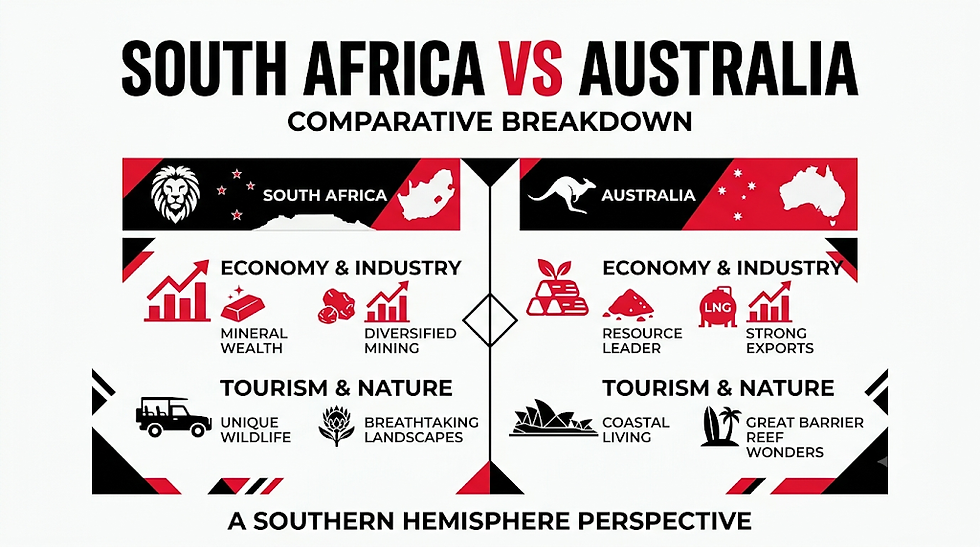
The trans-hemispheric dynamic between Southern Africa and Australasia represents one of the most compelling narratives in the Southern Hemisphere. While separated by thousands of miles of the Indian Ocean, South Africa and Australia share rich natural resources, deeply rooted sports rivalries, complex migration networks, and evolving economic models.
Whether evaluating athletic dominance in rugby union and international cricket or analyzing fiscal trajectories, trade flows, and labor markets, examining this cross-ocean relationship offers critical insights into two pivotal economic and cultural powerhouses.
1. Sports Rivalries: High-Stakes Hemispheric Battles
When South African and Australian teams collide on the field, historical friendship gives way to high-intensity athletic competition. Across rugby union and international cricket, these two nations regularly contest top rankings and global titles.
Rugby Union: The Clash of Styles
In rugby union, the rivalry between the Springboks and the Wallabies remains a cornerstone of international competition.
South Africa: Leverages physical forward play, intense tactical kicking, and dominant set-piece execution.
Australia: Focuses on dynamic ball movement, phase play, and fast-paced backline execution to unpick rigid defensive lines.
In the Rugby Championship and individual Test series, matches between these two sides are routinely decided by minimal point margins, keeping both fan bases closely engaged.
Cricket: Test, ODI, and T20 Rivalries
Across all three formats of international cricket, Australia and South Africa have crafted legendary contests.
Test Match Performance: Australia holds an overall historical edge in Test victories, though South Africa has consistently achieved memorable away-series victories in Australian conditions.
Limited-Overs Encounters: T20 and One Day Internationals between the two sides produce high-scoring encounters, characterized by elite fast bowling and aggressive power-hitting.
2. Macroeconomic Framework: Growth, Trade, and Policy Dynamics
Analyzing the economic performance of both nations reveals distinct structural frameworks, currency dynamics, and growth profiles.
Real GDP Growth and Size Comparison
The macroeconomic scale differs significantly between the two countries, influenced by domestic policy, infrastructure readiness, and global market integration.
Australia: Possesses a nominal GDP exceeding $1.8 trillion, driven by massive mineral exports (iron ore, lithium, LNG), advanced services, and steady domestic consumption. Annual growth fluctuates between 1.8% and 2.2%, supported by stable public institutions and high per-capita income.
South Africa: Maintains a GDP of approximately $489 billion, making it one of Africa's largest economies. Economic growth projects between 1.4% and 1.6%, underpinned by ongoing energy grid stabilization, logistics reforms, and private investment in renewable infrastructure.
Inflation and Central Bank Strategies
Monetary authorities in Pretoria (South African Reserve Bank - SARB) and Sydney/Canberra (Reserve Bank of Australia - RBA) navigate different inflationary landscapes:
SARB Strategy: Focuses on tight monetary control to anchor inflation expectations, maintain exchange rate stability for the Rand (ZAR), and manage foreign capital flows.
RBA Strategy: Balances inflation targets with domestic housing affordability and employment metrics to keep the Australian Dollar (AUD) competitive in Asian trading corridors.
3. Labor Markets, Migration, and Lifestyle Comparison
Movement between South Africa and Australia has built deep cultural and economic links across the Indian Ocean.
Skilled Migration Trends
Australia remains a major destination for South African professionals seeking opportunities in engineering, healthcare, finance, and technology. Strong language alignment, shared sporting culture, and skilled visa pathways facilitate smooth professional transitions into Australian urban centers.
Cost of Living and Quality of Life
South Africa: Offers a favorable local purchasing power for middle-and-upper-income brackets, featuring low housing costs relative to international standards, high-quality private healthcare, and a strong outdoor lifestyle.
Australia: Features higher average purchasing power and robust public infrastructure, though primary capital cities encounter elevated housing and living expenses.
4. Key Strengths: South Africa vs Australia Analysis
Examining the strategic advantages of each country highlights where each nation holds competitive leverage:
South Africa Strategic Advantages
Regional Gateway: Serves as a major financial, industrial, and legal hub for commerce across Sub-Saharan Africa.
Mineral Wealth: World-leading reserves of platinum group metals (PGMs), manganese, and critical battery minerals required for global clean energy transitions.
Financial Markets: Highly sophisticated banking sector and capital markets represented by the Johannesburg Stock Exchange (JSE).
Australia Strategic Advantages
High Institutional Stability: AAA sovereign credit ratings, transparent regulatory environments, and strong investor protections.
Proximity to Asian Growth: Strategic location providing direct access to expanding manufacturing and industrial markets in Asia.
High Standard of Living: Consistently ranks among top global nations for human development, safety, education, and public health systems.
Frequently Asked Questions (FAQs)
Q1: What does the south africa vs australia macroeconomic comparison show regarding economic size?
A: Australia maintains a significantly larger economy with a GDP of over $1.8 trillion, compared to South Africa's GDP of $489 billion. Australia benefits from high per-capita output, while South Africa serves as a critical economic engine for the African continent.
Q2: How do South Africa and Australia perform against each other in rugby?
A: South Africa (Springboks) and Australia (Wallabies) maintain one of rugby union's closest rivalries. Matches are contested regularly in the Rugby Championship, with South Africa leveraging a dominant forward pack and Australia relying on speed and tactical versatility.
Q3: What are the primary export industries for both countries?
A: Australia's primary exports include iron ore, lithium, coal, LNG, and agricultural products. South Africa's main export sectors center around platinum group metals, gold, coal, iron ore, citrus, and wine.
Q4: Is it easy for skilled workers to move from South Africa to Australia?
A: Australia offers several points-based skilled migration visa programs that attract qualified South African professionals in sectors such as healthcare, engineering, IT, and specialized trades.
Take Your Next Step: Explore Hemispheric Insights
Whether you are evaluating cross-border investments, tracking commodity market movements, or exploring international career opportunities, having direct access to verified data sources is essential.
Explore Trade & Investment: Review business entry opportunities on the Brand South Africa Official Portal and Austrade Market Insights.
Analyze Monetary Policy: Access official financial indicators via the South African Reserve Bank and the Reserve Bank of Australia.
Check Migration Guidelines: Stay informed on official visa frameworks via the Australian Department of Home Affairs and the South African Department of Home Affairs.


Comments