Accuracy vs Speed: What Matters More in MHT CET 2026?
- Dec 16, 2025
- 6 min read
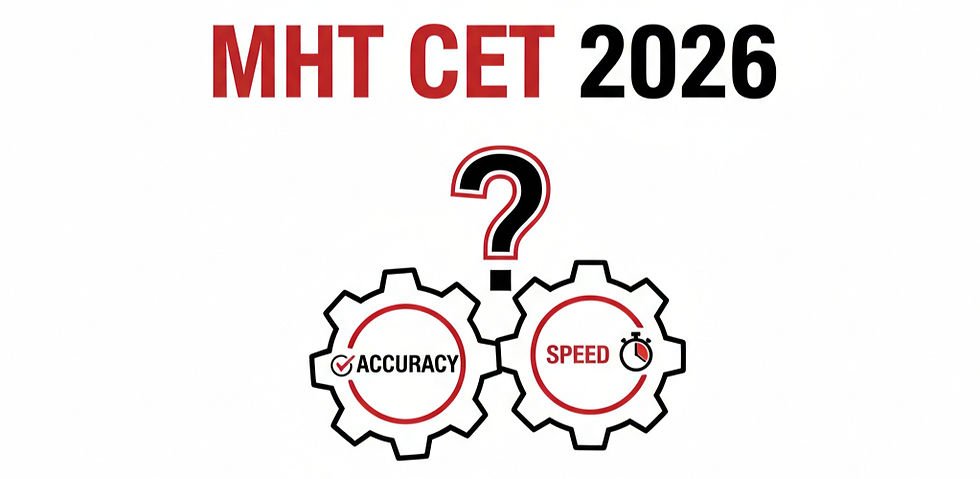
For every engineering aspirant in Maharashtra, the State Common Entrance Test (MHT CET) is the golden gateway to prestigious institutions like COEP Pune, VJTI Mumbai, and ICT Mumbai. As you gear up for the MHT CET 2026, a classic dilemma often haunts your preparation: should you focus on solving questions as fast as possible, or should you ensure every answer is 100% correct?
In an exam where 150 questions must be tackled in 180 minutes, the debate of Accuracy vs Speed: What Matters More in MHT CET becomes central to your success strategy. Unlike JEE Main, which penalizes you for wrong guesses, MHT CET has a unique personality. To crack it, you need a specialized "battle plan" that balances these two pillars.
In this comprehensive guide, we will break down the latest 2026 exam trends, provide a subject-wise breakdown for the engineering (PCM) domain, and help you decide how to allocate your precious minutes on D-day.
The Core Debate: Accuracy vs Speed
To understand Accuracy vs Speed: What Matters More in MHT CET, we must first look at the exam's DNA.
Accuracy is your ability to reach the right solution without "silly mistakes." It ensures that the effort you put into a question actually translates into marks.
Speed is your ability to navigate through the 150-question landscape within the 180-minute window. In MHT CET, speed is often the "X-factor" because the average time per question is significantly lower than in JEE.
The "No Negative Marking" Factor
The most critical piece of data for 2026 is that there is no negative marking in MHT CET. This shifts the "Accuracy vs Speed" dynamic significantly. In JEE, a lack of accuracy results in a "score deduction." In MHT CET, a lack of accuracy only results in "zero gain."
However, don't let this fool you. High speed without accuracy leads to a poor score, while high accuracy without speed means you leave too many high-weightage questions unattempted.
MHT CET 2026: Engineering (PCM) Exam Pattern & Timing
Before deciding what matters more, let's look at the latest 2026 engineering domain data.
Subject | Questions | Marks per Question | Total Marks | Time Allotted |
Physics | 50 | 1 | 50 | 90 Minutes (Combined with Chem) |
Chemistry | 50 | 1 | 50 | 90 Minutes (Combined with Physics) |
Mathematics | 50 | 2 | 100 | 90 Minutes |
Total | 150 | -- | 200 | 180 Minutes |
Analyzing the Time Pressure
Physics & Chemistry: You have 90 minutes for 100 questions. That is roughly 54 seconds per question.
Mathematics: You have 90 minutes for 50 questions. That is 1.8 minutes (108 seconds) per question.
The time pressure in the Physics and Chemistry section is immense. Here, speed is not just an advantage; it is a necessity. In Mathematics, the questions are often "JEE Main level" in terms of length, making accuracy and methodical solving more important.
Why Speed Often Takes the Lead in MHT CET
In many competitive exams, experts say "Accuracy is King." But for MHT CET 2026, Speed is the King's most trusted General. Here is why:
1. The 150-Question Sprint
MHT CET is a race against the clock. Unlike JEE, where you might aim to solve 40-50 high-quality questions perfectly, MHT CET requires you to touch almost every question. If your speed is low, you might miss out on "Easy" or "Formula-based" questions tucked away at the end of the paper.
2. High Percentile Competition
In recent years (2024-2025), the competition has skyrocketed. To get into the 99th percentile, you typically need a score of 160+ out of 200. You cannot reach 160 marks by being slow, even if you are 100% accurate. You simply won't have the time to solve enough questions to reach that threshold.
3. The "Educated Guessing" Window
Since there is no negative marking, the last 10 minutes of your exam should be a "Speed Burst" where you mark the remaining questions using elimination or logic. This is where speed creates a safety net.
Why Accuracy is Still the Foundation
While speed gets you to the finish line, accuracy ensures you aren't carrying an empty bucket.
Mathematics Weightage: Each Math question is worth 2 marks. A single "silly mistake" in a Calculus or Vector problem costs you double what a mistake in Chemistry would.
The Trap of "Rushed Solving": Many students, in an attempt to be fast, misread "not correct" as "correct" in Chemistry MCQs. This is where high speed backfires.
Pro Tip for 2026: Your goal should be "Optimal Speed"—the maximum speed at which you can maintain at least 85-90% accuracy on the questions you know how to solve.
Subject-Wise Strategy: Balancing the Scales
Physics: The Conceptual Bridge
Physics in MHT CET 2026 is expected to be "Moderate." It requires a mix of formula application and conceptual understanding.
Strategy: Don't get stuck on one lengthy numerical. If a calculation looks like it will take more than 2 minutes, mark it for review and move on.
Chemistry: The Speed Booster
This is where you win the "Accuracy vs Speed" battle. Most Chemistry questions are theoretical or involve direct formulas.
Strategy: Aim to finish 50 Chemistry questions in 35-40 minutes. This saves an extra 10-15 minutes for the tougher Physics numericals within the same 90-minute slot.
Mathematics: The Accuracy Anchor
Since the difficulty level is at par with JEE Main, and each question is 2 marks, your focus here shifts slightly toward accuracy.
Strategy: Since you have nearly 2 minutes per question, don't rush the steps. Ensure your integration or 3D Geometry calculations are precise.
Data Insights: Marks vs Percentile Trends (Engineering 2026)
Based on 2024-2025 data, here is what your speed and accuracy need to achieve for top colleges:
Target Percentile | Required Marks (Approx) | Required "Correct" Questions | Ideal Strategy |
99.5+ (COEP/VJTI) | 165 - 175 | 130+ | Extreme Speed + High Accuracy |
98+ (SPIT/PICT) | 145 - 155 | 115+ | High Speed + Moderate Accuracy |
95+ (Tier 2 Colleges) | 120 - 135 | 95+ | Moderate Speed + High Accuracy |
Common Mistakes to Avoid in 2026
Over-calculating: Using long methods when short-tricks (like substituting options) could work.
Ego-Solving: Spending 5 minutes on a difficult Rotation Physics question just to prove you can solve it.
Ignoring Class 11: Remember, 20% of the paper comes from Class 11. These are often "easy" marks—don't lose them due to a lack of revision.
Conclusion: What Matters More?
So, in the battle of Accuracy vs Speed: What Matters More in MHT CET, the answer is: Speed gets you the opportunity, but Accuracy gets you the seat.
For the first 80 minutes of each section, prioritize Accuracy. For the final 10 minutes, shift gears into Speed mode to ensure no question is left un-bubbled. In the context of the 2026 engineering domain, think of MHT CET as a T20 cricket match—you need to score fast, but if you lose all your wickets (make too many mistakes), you won't reach the target.
Frequently Asked Questions (FAQs)
Q1. Is speed more important than accuracy for the MHT CET 2026 engineering exam?
In the context of Accuracy vs Speed: What Matters More in MHT CET, speed is slightly more critical because of the high question-to-minute ratio (150 questions in 180 minutes) and the lack of negative marking. However, you must maintain a baseline accuracy of 80%+ to secure a 99+ percentile.
Q2. How can I improve my speed for MHT CET without losing accuracy?
The best way is to memorize all formulas and reactions (especially Organic Chemistry) so you don't spend time "deriving" them during the exam. Practicing 2026-pattern mock tests is also essential.
Q3. Will there be any negative marking in MHT CET 2026 for Engineering?
No, the State CET Cell has confirmed that there will be no negative marking for MHT CET 2026. This allows you to attempt all 150 questions freely.
Q4. What is a "safe" score for COEP Pune in 2026?
For the CS/IT branch at COEP, you should aim for a score of 170+, which typically corresponds to a 99.8+ percentile.
Next Steps for Aspirants
Analyze Your Mocks: Are you losing marks because you ran out of time (Speed issue) or because you made calculation errors (Accuracy issue)?
Formula Sheets: Create a "cheat sheet" of all Physics and Math formulas to reduce retrieval time.
Join a Test Series: Simulate the 3-hour window to build stamina.
Ready to boost your score?
Engineering College Cut-offs: Research previous years' closing ranks to set realistic targets for your accuracy goals.
Chapter-wise Weightage & Analysis: A detailed breakdown of high-scoring topics like Calculus and Chemical Thermodynamics for 2026.
Careers360 MHT CET Mock Test Series: Features full-length model papers and chapter-wise tests designed specifically for the 2026 pattern.



Comments