AI Impact on Campus Placements in 2026
- Feb 13
- 4 min read
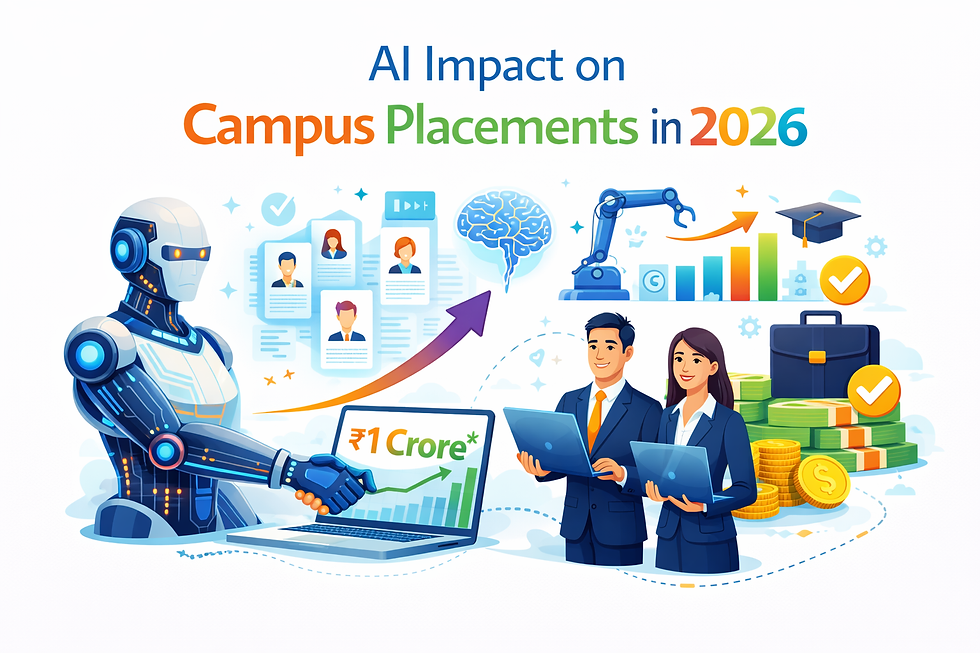
The traditional "placement season" has undergone a seismic shift. As we navigate through 2026, the arrival of companies on campus is no longer just about resume shortlisting and group discussions. Artificial Intelligence has woven itself into the very fabric of the recruitment lifecycle, changing not only how students are hired but who gets hired.
In 2026, the AI impact on campus placements is visible in every step—from the AI-driven aptitude tests to the virtual "digital twin" interviewers that never tire. For students, the message is clear: the degree is your entry ticket, but your "AI Fluency" is your boarding pass.
Focus Keyword: AI impact on campus placements
The Evolution of the Hiring Funnel: 2026 Statistics
Recruitment in 2026 is a data-driven science. Companies are no longer willing to spend weeks manually screening thousands of applications. Instead, they leverage autonomous agents to identify high-potential talent in milliseconds.
1. AI-Powered Screening: Beyond the Resume
By early 2026, over 75% of resumes are rejected by an AI-based Applicant Tracking System (ATS) before a human eye even sees them. However, the modern ATS is more sophisticated than its predecessors. It doesn't just look for keywords; it analyzes "skill clusters" and project impact.
The "Digital Twin" Trend: 10% of top-tier employers have replaced traditional resumes with "scenario-driven assessments" where an AI observes how you solve a real-world problem in a sandbox environment.
2. The Rise of the AI Interviewer
One of the most striking aspects of the AI impact on campus placements this year is the mainstream adoption of AI-led video interviews.
Consistency over Fatigue: According to 2026 hiring reports, 78% of candidates actually prefer AI interviewers because they provide a consistent, bias-free experience regardless of the time of day.
Performance Gains: Candidates selected through AI-led processes show a 16–17% higher retention rate in their first 90 days, proving that the machines are getting better at matching "culture fit."
How AI is Redefining Job Roles and Salaries in 2026
The job descriptions posted on placement portals today look vastly different from those in 2023. We are seeing the death of "pure" roles and the birth of "hybrid" roles.
The "AI Skill Premium"
In the 2026 job market, specialized AI skills command a massive wage premium.
Wage Hike: Freshers with documented skills in Prompt Engineering, MLOps, or AI Governance earn, on average, 23% more than their peers without these skills.
The Degree vs. Skill Debate: For the first time, 54% of employers state that specific AI certifications or project portfolios carry more weight than the name of the university on the degree.
Shift in High-Demand Roles
Traditional Role (Pre-2024) | 2026 AI-Enhanced Role | Demand Growth |
Software Developer | AI-Augmented Engineer (Agentic Workflows) | +75% |
Data Analyst | Real-time Predictive Pipeline Architect | +51% |
HR Associate | AI Talent Scientist / Bias Auditor | +18% |
Marketing Exec | Hyper-personalization Specialist | +40% |
The Strategic Edge: How Colleges are Adapting
Universities that ignored the AI impact on campus placements are seeing a decline in their "Employer Reputation" scores. The leaders of 2026 are those who have automated their placement cells.
Placement Automation: Smart placement cells now use AI to map student certifications to job roles in real-time, sending automated "skill-gap" alerts to students six months before companies arrive.
Democratic Hiring: AI tools are democratizing placements. A student from a Tier-3 city in India now has the same chance to clear an AI-led screening for a global firm as a student from an IIT, provided their "digital skill signature" is strong.
Frequently Asked Questions (FAQs)
Q1: What is the most significant AI impact on campus placements in 2026?
A: The most significant AI impact on campus placements is the shift from "pedigree-based hiring" to "skills-based hiring." AI tools now allow recruiters to evaluate a student's actual problem-solving capability through simulations rather than relying on the brand name of their college.
Q2: Is AI making it harder for freshers to get jobs?
A: It is making "entry-level routine roles" (like basic data entry or manual testing) scarcer. However, it is creating millions of "Hybrid Roles" that combine domain knowledge with AI tool proficiency. Freshers who adapt are finding higher-paying opportunities than ever before.
Q3: How should I prepare for an AI-led interview?
A: Focus on "Digital Fluency." Practice speaking clearly on video, use structured frameworks like STAR (Situation, Task, Action, Result), and ensure your LinkedIn and GitHub show "Proof of Work" in AI-integrated projects.
Conclusion: Embracing the "Robo-Colleague" Era
By the end of 2026, the concept of a "human-only" hiring process will be a thing of the past. The AI impact on campus placements has effectively turned recruitment into a merit-driven ecosystem. While 22% of students express fear over job loss, the data suggests a net gain in opportunities—specifically for those who view AI as a "power tool" rather than a competitor.
As you prepare for the upcoming placement season, remember: the AI is not just screening you; it’s looking for a partner.
Essential 2026 Career Resources
[Download the 2026 Global Employability & AI Report]
[Free Course: Prompt Engineering for Engineering Students]
[Check AI-Integrated Job Vacancies for 2026 Graduates]
[Official India Skills Report 2026 Summary]


Comments