AI Skills & Free Learning Resources 2026: What to Learn, Why It Matters, and Where to Start for Free
- Jan 29
- 5 min read
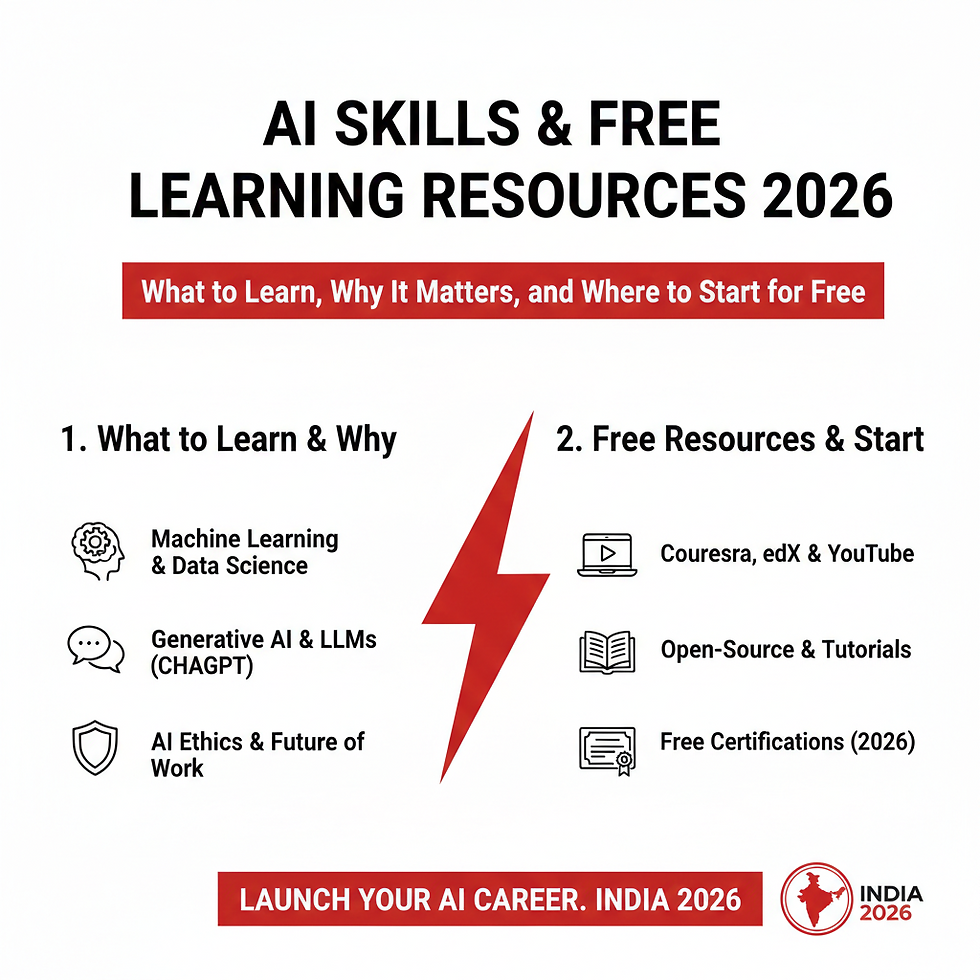
Artificial Intelligence is no longer a future skill—it is a core career requirement. In 2026, AI skills are influencing hiring decisions across technology, healthcare, finance, education, marketing, manufacturing, and even government sectors. Companies are not just looking for AI researchers; they want professionals who can work with AI tools, interpret data, and apply AI responsibly.
The growing demand has also led to a surge in free, high-quality AI learning resources from global tech companies, universities, and open platforms. This guide breaks down the most important AI skills in 2026, explains why they matter, and lists the best free learning resources available today.
Why AI Skills Matter More Than Ever in 2026
According to global workforce trends:
Over 70% of digital job roles now require at least basic AI or data literacy
AI-related job postings grew by 35% between 2024 and 2026
Employers prioritize applied AI skills over purely theoretical knowledge
AI is no longer limited to data scientists. Business analysts, marketers, software developers, healthcare professionals, and even non-technical roles are expected to understand and use AI-powered systems.
What’s Changed in AI Skills Demand in 2026
In 2026, the focus has shifted from “learning AI theory” to practical, job-ready skills:
Using AI tools responsibly
Working with large language models (LLMs)
Applying AI to real business problems
Understanding AI ethics and governance
Combining AI with domain knowledge
This is why AI skills & free learning resources 2026 are becoming essential for students and professionals alike.
Core AI Skills You Should Learn in 2026
1. AI Literacy & Fundamentals
This is the starting point for everyone, including non-technical learners.
What it includes:
Understanding what AI, ML, and deep learning are
Knowing how AI systems are trained
Recognizing AI limitations and risks
Who needs it:Students, managers, educators, marketers, policymakers
2. Machine Learning Basics
Machine learning remains the backbone of AI systems.
Key concepts to learn:
Supervised vs unsupervised learning
Model training and evaluation
Overfitting and bias
You don’t need to build models from scratch, but you should understand how they work.
3. Generative AI & Large Language Models (LLMs)
Generative AI is one of the fastest-growing skill areas in 2026.
Applications include:
Content generation
Code assistance
Customer support automation
Data summarization
Understanding how LLMs behave, their strengths, and their risks is now a must-have skill.
4. Data Skills for AI
AI runs on data.
Data Skill | Why It Matters |
Data cleaning | Improves AI accuracy |
Data analysis | Supports better decisions |
Visualization | Explains AI insights clearly |
Even basic data literacy gives professionals a competitive edge.
5. AI Tools & Platforms
In 2026, companies expect candidates to work with AI tools, not just study them.
Examples include:
AI writing and analysis tools
Automation platforms
AI-powered analytics dashboards
Tool familiarity often matters more than advanced coding.
6. Prompt Engineering & AI Interaction
Prompting has become a recognized skill.
Why it matters:
Better prompts = better AI output
Saves time and reduces errors
Improves productivity across roles
This skill is especially valuable for non-technical professionals.
7. AI Ethics, Bias & Responsible Use
With increased regulation, ethical AI knowledge is critical.
Key topics:
Bias in AI models
Data privacy
Transparency and explainability
Responsible AI use in workplaces
Many employers now assess ethical awareness during hiring.
Top Free AI Learning Resources in 2026
One of the biggest advantages in 2026 is access to high-quality free learning platforms.
Google – AI & Machine Learning Courses
Google offers free introductory and intermediate AI courses.
Best for:
AI fundamentals
Applied ML concepts
Beginners and career switchers
Microsoft – AI Skills Initiative
Microsoft provides free learning paths focused on real-world AI use.
Covers:
AI fundamentals
Responsible AI
AI for business and developers
IBM – AI & Data Science Learning
IBM’s free courses focus on practical, industry-ready skills.
Highlights:
AI concepts explained simply
Hands-on examples
Strong focus on ethics
Coursera (Free Audit Mode)
Many top university AI courses can be audited for free.
Subjects available:
Machine learning
AI for everyone
Data science basics
Certificates are paid, but learning is free.
edX
edX offers free AI courses from leading universities.
Best for:
Academic credibility
Structured learning
Beginners to intermediate learners
Kaggle
Kaggle is ideal for hands-on learners.
What you get:
Free micro-courses
Real datasets
Practical AI and ML practice
OpenAI Learning Resources
OpenAI provides documentation and guides to understand modern AI systems.
Useful for:
Understanding generative AI
Learning responsible usage
Exploring real-world AI applications
Comparison Table: Free AI Learning Resources (2026)
Platform | Best For | Skill Level |
AI basics & ML | Beginner | |
Microsoft | Applied AI & ethics | Beginner–Intermediate |
IBM | Industry AI skills | Beginner–Intermediate |
Coursera | University-level AI | All levels |
edX | Academic foundations | Beginner–Intermediate |
Kaggle | Practical ML | Intermediate |
OpenAI | Generative AI understanding | All levels |
How to Build AI Skills Step-by-Step in 2026
Start with AI fundamentals
Learn basic data handling
Explore generative AI tools
Practice with real examples
Understand ethics and limitations
Apply AI skills to your domain
Consistency matters more than speed.
Who Should Learn AI Skills in 2026?
Students preparing for future jobs
Working professionals upskilling
Career switchers entering tech roles
Business owners and entrepreneurs
Educators and researchers
AI is becoming a universal skill, not a niche one.
Career Impact of AI Skills in 2026
Professionals with AI literacy:
Earn 15–30% higher salaries on average
Access a wider range of job roles
Adapt faster to automation
Stay relevant despite rapid tech change
AI skills increase both employability and career security.
FAQs – AI Skills & Free Learning Resources 2026
Q1. What are the most important AI skills & free learning resources 2026 offers?
The most important AI skills & free learning resources 2026 offers include AI fundamentals, generative AI, data literacy, prompt engineering, and ethical AI, available through platforms like Google, Microsoft, Coursera, edX, and Kaggle.
Q2. Can I learn AI for free in 2026 without a technical background?
Yes. Many free AI courses in 2026 are designed for beginners and non-technical learners, focusing on practical understanding rather than coding.
Q3. Are free AI courses enough for jobs?
Free courses build strong foundations. Combined with practice and domain knowledge, they are sufficient for many entry-level and AI-enabled roles.
Q4. How long does it take to learn basic AI skills?
With consistent effort, basic AI literacy can be developed in 6–8 weeks using free resources.
Final Thoughts
In 2026, AI skills are no longer optional—they are essential. The good news is that high-quality free learning resources make AI education accessible to everyone. Whether you are a student, professional, or career switcher, investing time in AI skills today will shape your career opportunities tomorrow.
AI skills & free learning resources 2026 give you the chance to stay competitive without financial barriers.
Call to Action (CTA)
🚀 Ready to start learning AI in 2026?Get guidance on the right skills, learning paths, and career applications.
👉 Explore Free AI Learning Resources
https://www.yourwebsite.com/ai-learning
👉 Career Guidance for Tech Skills
https://www.yourwebsite.com/career-guidance
👉 Book a Free Skill Consultation


Comments