B.Sc Nursing Eligibility Criteria 2026
- Dec 22, 2025
- 6 min read
The healthcare landscape in India is evolving rapidly, and with it, the demand for highly skilled medical professionals is reaching an all-time high. As we look toward the 2026 academic session, pursuing a Bachelor of Science (B.Sc) in Nursing has become one of the most stable and respected career paths in the medical domain. However, the first step to becoming a frontline healthcare hero is understanding the B.Sc Nursing Eligibility Criteria 2026.
In this comprehensive guide, we break down everything you need to know—from age limits and academic requirements to the significant shifts in national entrance exams like NEET and AIIMS.
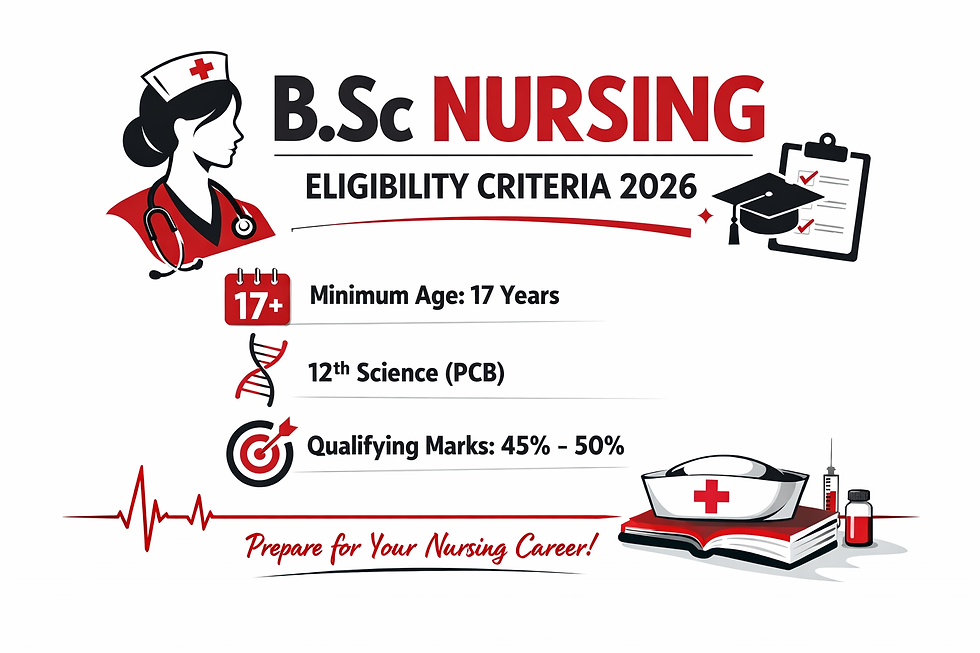
B.Sc Nursing Eligibility Criteria 2026
The eligibility framework for B.Sc Nursing in India is primarily governed by the Indian Nursing Council (INC). For the 2026 session, while the core standards remain consistent, there are specific nuances depending on whether you are applying for a National, State, or Institute-level seat.
1. General Age Requirements
To apply for a B.Sc Nursing program in 2026, candidates must meet the following age brackets:
Minimum Age:
You must be at least 17 years old as of December 31, 2026.
Maximum Age:
The general upper age limit is 35 years. However, specific state boards like the Rajasthan University of Health Sciences (RUHS) may enforce a tighter limit (often between 25–28 years).
2. Academic Qualifications
Educational standards are the most critical part of the B.Sc Nursing Eligibility Criteria 2026.
Education Level:
Completion of 10+2 (Higher Secondary) from a recognized board (CBSE, ICSE, or State Board).
Mandatory Subjects:
You must have passed in Physics, Chemistry, Biology (PCB), and English individually.
Minimum Aggregate:
General/OBC: 45% to 50% aggregate in PCB subjects.
SC/ST: 40% to 45% aggregate (5% relaxation).
3. Medical Fitness
Since nursing involves intensive clinical practice and physical stamina, candidates must provide a Medical Fitness Certificate from a registered medical practitioner.
Institute-Specific Eligibility for 2026
Not all institutions follow the same rulebook. Major medical hubs like AIIMS and the Indian Army have unique prerequisites.
Institution / Exam | Gender Restriction | Additional Requirements |
|---|---|---|
AIIMS (B.Sc Hons) | Female Only | Min 55% in PCB+English (Gen/OBC); 50% (SC/ST). |
Indian Army (MNS) | Female Only | NEET-UG 2026 is mandatory. Height: 152 cm (147 cm for NE states). |
State CETs | Male & Female | Domicile Certificate often required for state quota seats. |
The Role of NEET in Nursing Admissions
One of the most significant updates for 2026 is the mandatory implementation of NEET-UG for several nursing programs. According to recent notifications by the National Commission for Allied and Healthcare Professions (NCAHP), many top-tier universities and state boards have transitioned from independent exams to NEET-based selection to ensure a uniform standard of excellence.
Compulsory NEET:
Institutions like BHU (Banaras Hindu University), JIPMER, and the Indian Army (MNS) now strictly require a valid NEET score.
Optional NEET:
Many private colleges and specific state CETs (like Maharashtra or West Bengal) may still conduct their own entrance tests.
B.Sc Nursing (Post-Basic) Eligibility
If you already hold a nursing diploma and wish to upgrade your credentials to a degree, the B.Sc Nursing Eligibility Criteria 2026 for the Post-Basic track is as follows:
Academic:
Passed 10+2 or equivalent.
Professional:
Must have a General Nursing and Midwifery (GNM) diploma.
Registration:
Must be registered as a Registered Nurse (RN) or Registered Midwife (RM) with a State Nursing Council.
Gender:
Open to both male and female candidates at most institutions (including AIIMS).
Required Documents for Application 2026
Ensure you have these documents scanned and ready before the application window opens (typically between March and June 2026):
Class 10 & 12 Mark sheets and Certificates.
Valid Government Photo ID (Aadhaar Card, Voter ID, or Passport).
Category/Caste Certificate (if applicable for relaxation).
Medical Fitness Certificate.
Recent Passport-size photographs and scanned signature.
Career Scope After B.Sc Nursing in 2026
The career scope after B.Sc Nursing in 2026 has widened far beyond traditional bedside roles. With advancements in healthcare infrastructure, digital health, and global workforce shortages, nursing graduates today have access to diverse and well-defined career pathways.
1. Clinical & Specialized Nursing Roles
Clinical nursing remains the backbone of healthcare delivery, but specialization has become the key differentiator in 2026.
ICU Nurse – Handles critical patients in intensive care units, working closely with ventilators, monitors, and life-support systems.
Pediatric Nurse – Specializes in child healthcare, vaccinations, neonatal care, and pediatric emergencies.
OT (Operation Theatre) Nurse – Assists surgeons before, during, and after surgeries, ensuring sterile environments and patient safety.
Emergency & Trauma Nurse – High-demand role in emergency departments and trauma centers.
These roles are available in government hospitals, private multispecialty hospitals, AIIMS, medical colleges, and specialty clinics.
2. Administrative & Management Roles
With experience and additional qualifications, nurses can move into leadership and administrative positions.
Ward Manager / Charge Nurse – Oversees ward operations, staff scheduling, and patient care quality.
Nursing Superintendent – Senior-level role responsible for hospital-wide nursing administration.
Hospital Administrator (with further studies) – Works in healthcare management and policy implementation.
These roles offer higher authority, fixed working hours, and long-term career stability.
3. Global Career Opportunities
In 2026, the global shortage of skilled nurses has created strong international demand.
UK, USA, Canada, Australia, Middle East actively recruit Indian nurses
Opportunities in elder care, clinical hospitals, and community health services
Requires clearing licensing exams such as NCLEX, CBT, OSCE, IELTS/OET
International nursing careers offer better work-life balance, higher salaries, and global exposure.
4. Higher Studies & Alternative Career Paths
B.Sc Nursing graduates can also explore:
M.Sc Nursing (Specializations like Medical-Surgical, Pediatric, Psychiatric Nursing)
Nurse Educator / Lecturer in nursing colleges
Public Health Nurse
Research & Clinical Trials
Healthcare Informatics & Telemedicine
These options are ideal for those interested in academics, research, or policy-based healthcare roles.
Salary Trends After B.Sc Nursing in 2026
Salary prospects for B.Sc Nursing graduates in 2026 reflect the growing importance of skilled nursing professionals in India and abroad.
1. Salary in Government Hospitals
Government jobs continue to be the most secure and respected option.
Entry-level salary: ₹4.5 – ₹7 Lakhs per annum
Includes DA, HRA, medical benefits, pension schemes, and job security
Pay increases with experience, promotions, and 7th Pay Commission revisions
Roles include Staff Nurse, Nursing Officer, and Public Health Nurse.
2. Salary in Private & Corporate Hospitals
Private healthcare offers faster growth and performance-based increments.
Starting salary: ₹3.5 – ₹6 Lakhs per annum
Specialized nurses (ICU, OT, Dialysis) earn more
Multispecialty hospitals offer incentives, night allowances, and bonuses
Career growth is quicker compared to government roles.
3. Salary Abroad (International Nursing Careers)
Indian nurses working overseas earn significantly higher salaries.
UK: ₹30–45 Lakhs per annum (approx.)
USA: ₹55–75 Lakhs per annum (approx.)
Canada & Australia: ₹40–60 Lakhs per annum (approx.)
Salaries depend on country, experience, specialization, and licensing exams.
4. Long-Term Salary Growth
With 5–10 years of experience, specialization, or management roles:
Senior nurses and administrators can earn ₹10–15+ Lakhs per annum in India
Abroad, experienced nurses can cross ₹80 Lakhs annually
This makes B.Sc Nursing one of the most stable and high-growth careers in the medical field by 2026.
Final Thoughts
Securing a seat in a prestigious nursing college requires timely preparation and a clear understanding of the B.Sc Nursing Eligibility Criteria 2026. With the medical sector becoming increasingly digitized and specialized, your eligibility is the gateway to a lifelong career of service and professional growth.
Frequently Asked Questions
Q1: Is NEET mandatory for the B.Sc Nursing Eligibility Criteria 2026?
Yes, NEET 2026 is mandatory for admission to several top institutions such as Military Nursing Service (MNS) and Banaras Hindu University (BHU). However, some states and institutions like All India Institute of Medical Sciences (AIIMS) continue to conduct their own separate entrance examinations. Candidates are strongly advised to check the official prospectus of their target college before applying.
Q2: Can male candidates apply for B.Sc Nursing in 2026?
Yes, under the B.Sc Nursing Eligibility Criteria 2026, most state government colleges and private nursing institutes accept both male and female candidates. However, AIIMS (B.Sc Nursing Hons) and the Military Nursing Service (MNS) remain exclusive to female candidates only.
Q3: What are the minimum marks required for B.Sc Nursing in 2026?
As per the B.Sc Nursing Eligibility Criteria 2026, candidates from the General category typically need 45–50% aggregate marks in Physics, Chemistry, and Biology (PCB) in their Class 12 examinations. Reserved category candidates may receive relaxation as per state or institutional norms.


Comments