BITS Pilani vs Scaler School of Technology: Which Is Better for Software Engineering in 2026?

Choosing the right college after Class 12 can significantly impact your career, especially if you're aiming for software engineering, artificial intelligence, product development, or entrepreneurship. Among the options being discussed by students in 2026, BITS Pilani vs Scaler School of Technology has become a popular comparison.
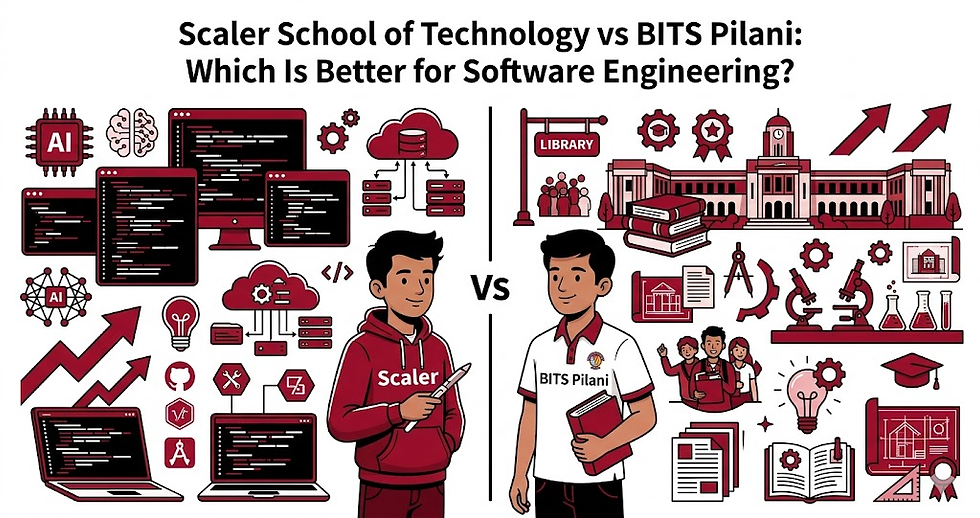
While BITS Pilani is one of India's most established private engineering institutions with decades of legacy, Scaler School of Technology represents a modern software-first approach designed specifically for the technology industry.
This detailed comparison explores BITS Pilani vs Scaler School of Technology across academics, placements, internships, curriculum, campus life, fees, career opportunities, and future prospects.
1.Understanding BITS Pilani vs Scaler School of Technology
Before comparing them, it's important to understand that both institutions have different educational philosophies.
BITS Pilani
BITS Pilani follows a traditional university model with strong academics, research opportunities, campus life, and industry exposure.
Scaler School of Technology
Scaler School focuses heavily on software engineering, coding, project-based learning, and industry readiness from the first year.
The choice between BITS Pilani vs Scaler School of Technology depends largely on your career goals.
Curriculum Comparison
BITS Pilani Curriculum
BITS follows a broad engineering curriculum that includes:
Mathematics
Physics
Engineering Fundamentals
Computer Science
Electives
Research Components
Students gain a strong theoretical foundation alongside technical skill.
Advantages
Comprehensive engineering education
Academic flexibility
Research opportunities
Multiple specializations
Scaler School Curriculum
Scaler School takes a software-first approach.
Students typically focus on:
Programming
Data Structures
Algorithms
System Design
Full Stack Development
Artificial Intelligence
Industry Projects
Advantages
Coding from Year 1
Industry-relevant curriculum
Project-driven learning
Software engineering focus
For software-focused careers, many students find this approach attractive.
2.BITS Pilani vs Scaler School of Technology: Admission Process
BITS Pilani Admission
Admission primarily occurs through:
BITSAT
Students must secure a competitive score to obtain admission.
Scaler School Admission
Admission generally involves:
Aptitude assessment
Interview rounds
Evaluation of problem-solving skills
The admission process focuses heavily on potential rather than traditional entrance exams.
BITS Pilani vs Scaler School of Technology: Coding Culture
BITS Pilani
BITS has a strong coding culture with:
Hackathons
Competitive programming clubs
Technical festivals
Startup activities
Students build strong peer networks.
Scaler School
Coding is deeply integrated into the curriculum.
Students spend substantial time working on:
Coding projects
Product development
Real-world applications
Technical problem-solving
For students primarily interested in software development, this environment can be highly beneficial.
3.BITS Pilani vs Scaler School of Technology: Internships
Internships play a major role in career outcomes.
BITS Pilani
The famous Practice School (PS) program offers:
Industry exposure
Professional experience
Corporate networking opportunities
Many students consider it one of BITS' biggest strengths.
Scaler School
The curriculum emphasizes:
Industry projects
Internship readiness
Professional software development skills
Students often build portfolios early in their academic journey.
BITS Pilani vs Scaler School of Technology: Placements
One of the biggest factors in the BITS Pilani vs Scaler School of Technology debate is placements.
BITS Pilani Placement Strength
BITS has:
Decades of recruiter relationships
Strong alumni network
Diverse hiring opportunities
Global recognition
Recruiters visit for software, consulting, analytics, finance, and core engineering roles.
Scaler School Placement Approach
Scaler focuses on:
Industry-relevant skills
Software engineering preparation
Interview readiness
Portfolio building
Career outcomes depend heavily on student performance, project quality, and technical expertise.
4.BITS Pilani vs Scaler School of Technology: Campus Life
BITS Pilani Campus Experience
Students enjoy:
Residential campus life
Student clubs
Technical festivals
Sports facilities
Cultural events
The campus experience is one of the strongest aspects of BITS.
Scaler School Experience
The focus is more technology oriented.
Students spend significant time on:
Coding
Projects
Technical collaboration
Industry-focused learning
The experience appeals strongly to students who prioritize software engineering.
BITS Pilani vs Scaler School of Technology: Entrepreneurship Opportunities
Entrepreneurship has become increasingly important.
BITS Pilani
BITS has produced numerous founders and startup leaders.
Advantages include:
Alumni network
Startup ecosystem
Investor connections
Scaler School
Students work closely with industry professionals and startup-focused projects.
The software-first approach can be beneficial for aspiring tech founders.
5.BITS Pilani vs Scaler School of Technology: AI and Future Technologies
Future technologies are becoming a major consideration for students.
BITS Pilani
Offers:
AI electives
Research projects
Interdisciplinary opportunities
Scaler School
Focuses strongly on:
AI tools
Machine Learning concepts
Modern software engineering practices
Students interested specifically in technology careers often compare these offerings carefully.
Comparison Table: BITS Pilani vs Scaler School of Technology
Feature | BITS Pilani | Scaler School of Technology |
Legacy | Very Strong | Emerging |
Alumni Network | Extensive | Growing |
Coding Focus | Strong | Very Strong |
Research Opportunities | Excellent | Limited Compared to Traditional Universities |
Campus Life | Extensive | Technology-Centric |
Industry Exposure | Strong | Strong |
Software Engineering Focus | High | Very High |
Entrepreneurship Support | Strong | Growing |
Brand Recognition | Established | Emerging |
6.Who Should Choose BITS Pilani?
BITS Pilani may be ideal if you want:
Traditional university experience
Strong alumni network
Research opportunities
Campus life
Multiple career options
Students seeking a well-rounded engineering education often prefer BITS.
Who Should Choose Scaler School of Technology?
Scaler School may be suitable if you want:
Software-first education
Early coding exposure
Industry-focused curriculum
Project-based learning
Strong focus on technology careers
Students committed to software engineering may find the specialized approach attractive.
Final Verdict
The answer to BITS Pilani vs Scaler School of Technology depends on your goals.
Choose BITS Pilani if you value:
Legacy
Research
Campus life
Broad engineering education
Strong alumni network
Choose Scaler School of Technology if you value:
Software engineering specialization
Coding-first learning
Industry-focused curriculum
Project-driven education
Both paths can lead to successful technology careers when combined with dedication, skill development, internships, and continuous learning.
FAQs
1.Is BITS Pilani better than Scaler School of Technology?
BITS Pilani has a longer history, stronger alumni network, and established reputation. However, Scaler School offers a highly specialized software engineering-focused curriculum.
2.Which is better for software engineering?
Students seeking a software-first learning environment often consider Scaler School, while BITS offers broader engineering education with strong software opportunities.
3.Does BITS Pilani have better placements?
BITS has decades of established recruiter relationships and alumni networks. Placement outcomes vary depending on student performance and market conditions.
4.Is Scaler School recognized?
Students should verify the latest academic partnerships, degree structure, and accreditation information through official sources before applying.
5.Which option is best for startups?
Both institutions can support entrepreneurial ambitions, though they provide different ecosystems and learning experiences.


Comments