GUJCET 2026: The Ultimate Guide for Engineering Aspirants (Exam Dates, Syllabus, and Preparation)
- Dec 22, 2025
- 5 min read
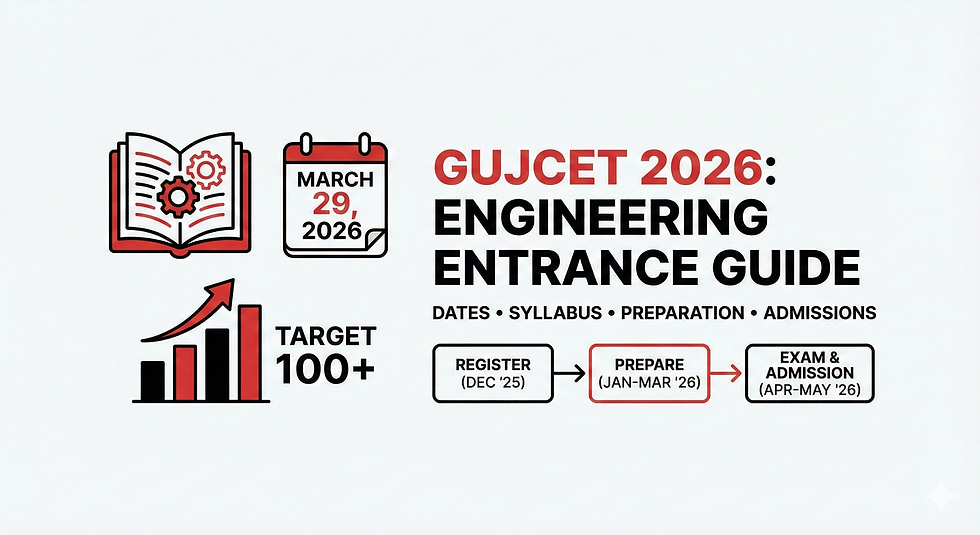
Are you planning to pursue a career in engineering in the vibrant state of Gujarat? If so, the GUJCET 2026 (Gujarat Common Entrance Test) is the most critical milestone on your journey. As one of the most competitive state-level entrance exams in India, GUJCET serves as the gateway to premier government and self-financed engineering institutes across Gujarat.
With the 2025-2026 academic cycle in full swing, it is essential to stay ahead with the most accurate and up-to-date information. This comprehensive guide covers everything from registration deadlines and syllabus weightage to expert preparation tips, ensuring you are fully equipped to ace the exam.
What is GUJCET 2026?
The GUJCET 2026 is a state-level entrance examination conducted by the Gujarat Secondary and Higher Secondary Education Board (GSEB). It is mandatory for students seeking admission into Degree Engineering (B.E./B.Tech) and Pharmacy (B.Pharm/D.Pharm) programs in Gujarat.
While national exams like JEE Main are used for certain quotas and elite institutes like DA-IICT or Nirma University (All India seats), GUJCET remains the primary criterion for the 95% state quota seats managed by the Admission Committee for Professional Courses (ACPC).
GUJCET 2026 Important Dates: Mark Your Calendar
Staying on top of the schedule is the first step toward success. The GSEB has officially announced the exam date for 2026 to ensure students have ample time for preparation.
Event | Tentative/Official Date |
Online Registration Starts | December 16, 2025 |
Last Date to Apply | December 30, 2025 |
Correction Window | January 2026 |
Admit Card Release | 3rd Week of March 2026 |
GUJCET 2026 Exam Date | March 29, 2026 |
Provisional Answer Key | April 2026 |
Result Declaration | 1st Week of May 2026 |
ACPC Counselling Begins | Late May 2026 |
Note: The exam is typically held from 10:00 AM to 4:00 PM in various district-level centers across the state.
Eligibility Criteria for Engineering Aspirants
Before filling out the application form, ensure you meet the following eligibility requirements for the engineering stream:
Nationality: The candidate must be an Indian Citizen.
Domicile: Candidates should be residents of Gujarat or have completed their Class 10 and 12 from a school located in Gujarat.
Educational Qualification: Must have passed or be appearing in the Class 12 (Science Stream) examination from a recognized board (GSEB, CBSE, ICSE, or NIOS).
Subject Requirement: For Engineering, candidates must have studied Physics, Chemistry, and Mathematics (PCM).
Minimum Marks: * General Category: Minimum 45% aggregate in PCM subjects.
Reserved Categories (SC/ST/SEBC/EWS): Minimum 40% aggregate.
Age Limit: There is no specific age limit to appear for the exam.
GUJCET 2026 Exam Pattern & Marking Scheme
Understanding the structure of the paper is vital for effective time management. The exam is conducted in an offline (Pen-and-Paper) format using OMR sheets.
Subject Breakdown
The examination is divided into two main sessions:
Paper 1 (Combined): Physics and Chemistry
Questions: 80 (40 Physics + 40 Chemistry)
Duration: 120 Minutes (2 Hours)
Marks: 80
Paper 2: Mathematics
Questions: 40
Duration: 60 Minutes (1 Hour)
Marks: 40
Marking System
Correct Answer: +1 Mark
Incorrect Answer: -0.25 Marks (Negative Marking)
Unattempted: 0 Marks
The paper is available in three languages: English, Hindi, and Gujarati, ensuring accessibility for all students across different boards.
Comprehensive Syllabus and Chapter Weightage
The GUJCET 2026 syllabus is strictly based on the Class 12 NCERT curriculum as prescribed by the Gujarat Board. However, historical data suggests that about 20% of questions may also touch upon fundamental concepts from Class 11.
1. Physics (40 Questions)
Focus on conceptual clarity and numerical application.
High Weightage Topics: Electrostatics, Current Electricity (15-20%), Optics (12-15%), Semiconductors, and Modern Physics.
Other Key Topics: Magnetism, Electromagnetic Induction, Atoms, and Nuclei.
2. Chemistry (40 Questions)
Chemistry is often the most scoring section if you have mastered the NCERT.
Physical Chemistry: Solutions, Electrochemistry, and Chemical Kinetics (High Weightage).
Organic Chemistry: Haloalkanes, Alcohols, Phenols, Aldehydes, and Biomolecules.
Inorganic Chemistry: P-block elements and Coordination Compounds.
3. Mathematics (40 Questions)
Math requires speed and accuracy.
Crucial Chapters: Calculus (Integration & Differentiation - 35% weightage), Matrices and Determinants, Vectors, and 3D Geometry.
Others: Probability, Inverse Trigonometric Functions, and Relations & Functions.
How to Apply for GUJCET 2026: Step-by-Step
The registration process is entirely online. Follow these steps to ensure a smooth application:
Registration: Visit the official website gseb.org or gujcet.gseb.org. Register using a valid email ID and mobile number.
Payment of Fee: The application fee for all categories is ₹350. You must pay this via SBIePay (Credit Card, Debit Card, or Net Banking) before you can fill out the form.
Filling the Form: Enter personal details, academic qualifications, and select your exam center.
Document Upload: * Photograph: Scanned passport-size photo (JPEG format).
Signature: Scanned signature (Black ink on white paper).
Submission: Review all details carefully and submit the form.
Printout: Download and print the confirmation page for the counselling process.
Preparation Strategies for a 100+ Score
To secure a rank in the top 5,000, you should aim for a score above 90-100 out of 120. Here’s how you can prepare:
1. Stick to NCERT and GSEB Textbooks
GUJCET is heavily derived from state board textbooks. Ensure you read every line of your Chemistry NCERT and solve all Physics and Math examples.
2. Practice Mock Tests Regularly
Since there is a negative marking of 0.25, you must build "exam temperament." Aim to complete 120 questions in 180 minutes. Start taking weekly full-length mocks from January 2026.
3. Analyze Previous Year Papers
Solving papers from the last 10 years (2015–2025) will help you identify repeated patterns. You’ll notice that GUJCET often prioritizes direct application-based questions over the extremely complex theoretical problems seen in JEE Advanced.
4. Master Time Management
Spend no more than 40-45 minutes on Chemistry, as it is mostly theoretical. Use the saved time for Physics numericals and the dedicated 60 minutes for the Mathematics section.
Top Engineering Colleges Accepting GUJCET 2026
Your rank in GUJCET 2026 determines your seat in some of Gujarat's most prestigious institutions:
Institute | Location | Popular Branches |
L.D. College of Engineering (LDCE) | Ahmedabad | CSE, Mechanical, Civil |
Institute of Technology, Nirma University | Ahmedabad | Computer Science, IT |
Vishwakarma Government Engineering College | Gandhinagar | IT, Electronics |
M.S. University (MSU) | Vadodara | Chemical, Mechanical |
Dharmsinh Desai University (DDU) | Nadiad | IT, Computer Engineering |
Pandit Deendayal Energy University (PDEU) | Gandhinagar | ICT, Petroleum |
ACPC Counselling and Admission Process
Once the results are out in May 2026, the Admission Committee for Professional Courses (ACPC) takes over.
Merit List Calculation: ACPC prepares a merit list based on a 60:40 or 50:50 weightage (depending on the latest policy) between your Class 12 Theory Marks and your GUJCET Percentile.
Choice Filling: You will participate in "Mock Rounds" to understand which colleges you might get, followed by actual "Allotment Rounds."
Token Fee: Once a seat is allotted, you must pay a nominal token fee (approx. ₹2,000 for GIA/Govt) to freeze your seat.
Frequently Asked Questions (FAQs)
1. When is the GUJCET 2026 exam scheduled?
The GUJCET 2026 exam is officially scheduled to take place on March 29, 2026, in an offline mode across Gujarat.
2. Is there negative marking in GUJCET 2026?
Yes, there is a negative marking of 0.25 marks for every incorrect answer. Correct answers receive +1 mark, and unattempted questions receive zero marks.
3. Can students from other states apply for GUJCET 2026?
While students from other states can appear for the exam, they are generally eligible only for Management Quota or All India Quota seats in self-financed institutes. The state quota (85-95% seats) is reserved for candidates who have a Gujarat domicile or have studied in Gujarat.
4. Is the syllabus for GUJCET different from JEE Main?
The GUJCET 2026 syllabus is more closely aligned with the NCERT Class 12 curriculum. While the topics overlap with JEE Main, the difficulty level of GUJCET is generally moderate, with a higher focus on speed and textbook-based concepts.
5. What documents are needed for registration?
You need your Class 10 and 12 marksheets (if available), a valid ID proof (Aadhaar Card), a scanned photograph, and a scanned signature.
Conclusion
Securing a high rank in GUJCET 2026 is all about consistency and mastering the fundamentals of the NCERT curriculum. With the registration window opening in December 2025, now is the time to transition from casual reading to intensive practice. Focus on your strengths, manage your time wisely, and stay updated with the official GSEB announcements
.
Are you ready to kickstart your engineering journey?
Apply Now: Official GSEB Registration Portal
Check Seat Matrix: ACPC Official Website
Download Syllabus: GUJCET 2026 Subject-wise PDF


Comments