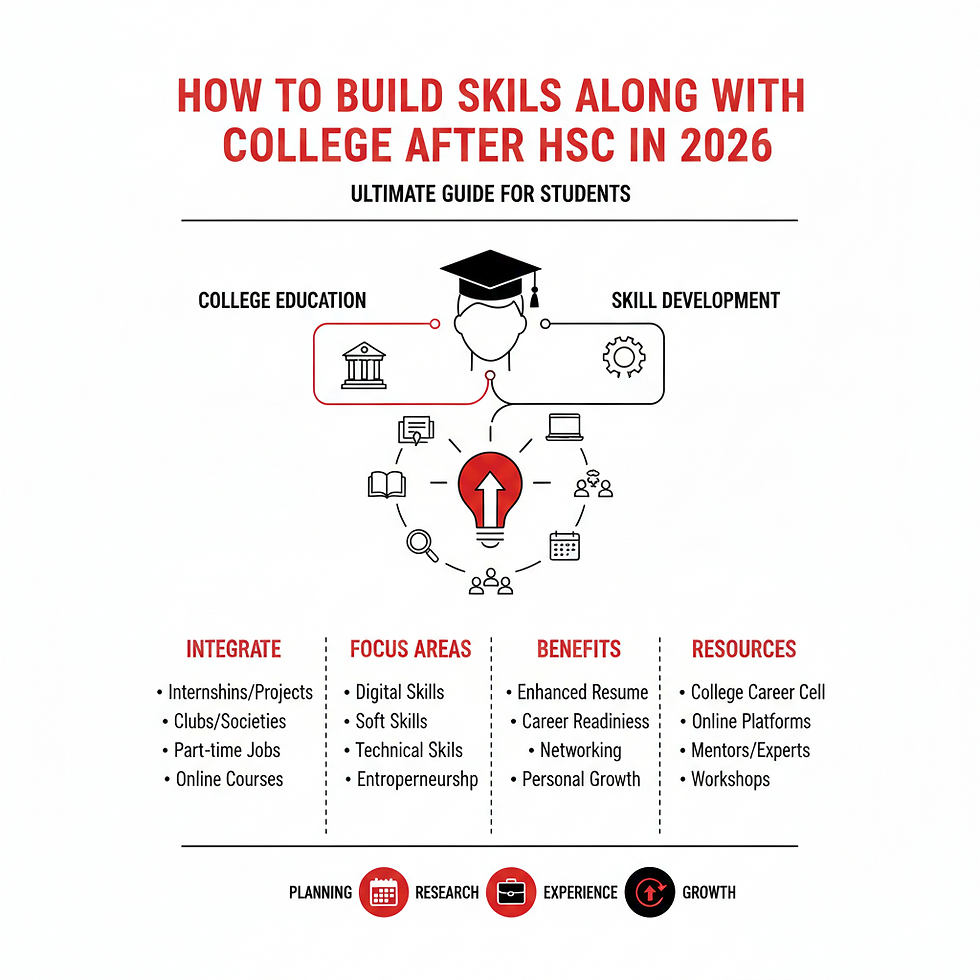
How to Build Skills Along With College After HSC in 2026: Ultimate Guide for Students
- 2 hours ago
- 7 min read
INTRODUCTION
Completing your HSC is a major milestone, but the next step isn’t just about attending college or choosing a degree. In today’s competitive world—especially in 2026—students need more than academic credits. Employers and startups are looking for skills, not just certificates. That’s where how to build skills along with college after HSC becomes essential.
In this detailed guide, we’ll break down why skill development matters, what skills are in demand, practical ways to build them while studying, real strategies for time management, career outcomes, and resources you can use right now.
Whether you’re a first-year student or still deciding your path after HSC, this blog equips you with the roadmap to grow academically and professionally at the same time.
Why Skills Matter After HSC in 2026
Getting into college is a big achievement, but the job market is evolving fast. Traditional degrees are no longer enough to guarantee success. Employers increasingly look for:
Practical abilities
Problem-solving mindset
Project experience
Tech fluency
Communication and teamwork skills
According to recent career trend data, 75% of employers prioritize skills and real-world experience over academic grades alone.* Students who actively build skills along with their college studies dramatically increase their employability, income potential, and career flexibility.
This is why how to build skills along with college after HSC isn’t just a nice idea—it’s a strategy for long-term success in 2026 and beyond.
What Skills Are Most Valuable in 2026?
When planning skill development alongside college, focus on areas that have real demand now and are expected to grow.
1. Digital & Tech Skills
Web Development (HTML, CSS, JavaScript, no-code tools)
Data Analytics
Basic AI and Machine Learning Awareness
Cloud Tools & Platforms
Mobile App Basics
Tech skills are valuable even outside traditional tech careers because digital tools are everywhere.
2. Communication & Soft Skills
Public speaking
Effective writing
Team collaboration
Emotional intelligence
Leadership
These are often the differentiators between good and great professionals.
3. Professional Skills
Project management
Time management
Critical thinking
Customer service
Presentation skills
These help you adapt in any workplace.
4. Creative & Media Skills
Graphic design (Canva, Photoshop, Figma)
Video editing (Premiere Pro, DaVinci Resolve)
Content creation (blogs, social media)
UX/UI basics
Content and visual media are in high demand across industries.
5. Business & Entrepreneurial Skills
Digital marketing
E-commerce fundamentals
Sales and persuasion
Financial literacy
Even if you join a job later, business skills help you grow faster.
How to Build Skills Along With College After HSC: Actionable Strategies
Balancing college with skill building isn’t easy—but it’s doable with the right system.
1. Set Clear Goals First
Before you start any course or activity, define what you want:
Ask yourself:
What skills matter for my dream career?
Which skills can I learn in 3–6 months?
What resources do I need (time, budget, tools)?
Write your goals down and revisit them every few weeks to stay focused.
2. Use Online Courses for Structured Learning
Online platforms have made skill learning accessible to every student.
Start with courses in:
Digital marketing
Web development
Graphic design
Data analytics
Public speaking
Useful platforms include:
Coursera
edX
Udemy
LinkedIn Learning
Google Digital Garage
These platforms often offer certificates that you can add to your resume or LinkedIn profile.
3. Combine Courses With Practice Projects
Learning won’t stick unless you apply it.
For example:
After learning web design, build a personal portfolio website.
After a digital marketing course, create a social media campaign for a real or mock brand.
After video editing training, make YouTube or short-form videos.
Projects become proof of your skill when applying for internships or jobs.
4. Internships and Part-Time Work
Real-world experience accelerates learning faster than classroom theory.
Look for:
College internships
Remote internships
Freelance gigs
Volunteer roles that use your new skills
Many companies today hire student interns for digital roles, content support, design work, and data tasks.
Even a small stipend internship builds confidence and experience.
5. Join College Clubs and Activities
Student clubs are not just fun—they’re skill incubators.
Participating in:
Debate club
Coding club
Media and PR cell
Entrepreneurship cell
Cultural or arts group
develops leadership, teamwork, public speaking, and organizational skills.
Skills learned in student organizations often transfer directly into careers.
6. Build a Portfolio
No matter your field, a strong portfolio sets you apart.
Include:
Projects you built
Assignments with real outcomes
Work samples
Certificates
GitHub links (for tech skills)
Case studies or campaign reports
Portfolios show your capability more than grades ever can.
7. Create a Skill Development Routine
Balance is key.
Here’s a weekly structure many successful students use:
Day | Focus |
Monday | 1 hour online course |
Tuesday | Practice project |
Wednesday | College study + portfolio updates |
Thursday | Internship / part-time work |
Friday | Soft skills / communication training |
Weekend | Deep work on big projects |
This kind of routine ensures steady progress without burnout.
Time Management for Skill Building and College
Balancing academics and skill building requires good time management.
Here are practical tips:
Use Time-Blocking
Create blocks of focused time in your calendar for:
College studies
Skill learning
Personal time
Projects
Internship tasks
This prevents overlap and stress.
Pomodoro Technique
Work in focused 25-minute sprints followed by short breaks.
This boosts productivity and reduces procrastination.
Track Your Progress
Use tools like:
Notion
Trello
Google Calendar
Todoist
These help you see what’s done and what’s next.
How to Build Skills Along With College After HSC: Real-World Examples
Here are real approaches students are using successfully in 2026:
Example 1: Digital Marketing + College
Riya is pursuing BCom and enrolled in digital marketing online courses on Google Digital Garage and Coursera. She took freelance gigs managing social pages for local businesses and now earns while learning.
Outcome: Hands-on experience and income before graduation.
Example 2: Web Development
Rahul is a science student curious about tech. While attending classes, he learned HTML, CSS, and JavaScript through Udemy and built websites for friends and small businesses.
Outcome: A portfolio that helped him earn freelance clients while studying.
Example 3: Creative Design
Sneha joined the college media club, learned Canva and Adobe tools, created event posters, and uploaded them to her portfolio. She later joined a digital design internship.
Outcome: Skill development + real portfolio work + internship experience.
Why Students Should Start Early After HSC
Starting skill development early has big advantages:
You finish college with both academic and professional skills.
You build confidence and industry exposure.
You become more employable than peers who only focus on academics.
You can explore multiple interests and refine career direction.
In 2026, the job market rewards adaptable, skilled learners more than traditional degree holders alone.
Soft Skills Matter as Much as Hard Skills
Hard skills help you do the work—soft skills help you thrive in work.
Important soft skills include:
Communication
Critical thinking
Problem-solving
Teamwork
Leadership
Adaptability
Time management
These skills translate across careers and industries.
How to Find Skill-Building Opportunities
College Placement Cells
Most colleges now have placement or career cells that connect students with skill workshops and internships.
Online Job Platforms
Look for skill-aligned roles on:
Internshala
LinkedIn
Indeed
Upwork and Fiverr (for freelance)
Networking
Networking helps you discover opportunities faster. Attend:
Workshops
Webinars
Conferences
Meetups
Industry events
LinkedIn and professional communities help you connect with mentors and recruiters.
FAQ: How to Build Skills Along With College After HSC
Q1: Why is how to build skills along with college after HSC important?
A1: How to build skills along with college after HSC is important because employers in 2026 value real ability more than grades alone. Skills such as digital literacy, communication, project execution, internships, and tangible portfolios increase your chances of landing meaningful internships and job offers sooner.
Q2: What skills should I focus on alongside college?
A2: Priority skills include digital skills (web design, analytics), communication and soft skills, project management, creative media, and business fundamentals. These areas help you both in academics and future careers.
Q3: How can I manage time for skill building and college?
A3: Manage time by creating a weekly routine that sets aside blocks for learning and practice, using tools like Notion and calendars, employing focus methods like Pomodoro, and tracking progress regularly.
Q4: Do employers care about skills learned outside college?
A4: Yes. Many employers in 2026 prioritize portfolios, project experience, internships, and real skill application over traditional degrees alone. Self-directed learning demonstrates commitment and initiative.
Q5: Can skill building help with internships and early jobs?
A5: Absolutely. Skills give you the confidence and capability to take on internships, freelance work, live projects, and real job tasks while studying, which accelerates your career progress.
Official Resources and Platforms to Help You Build Skills
Here are verified resources you can use to learn, practice, and grow your skills while you’re in college:
Learning & Certification Platforms
Coursera – Certified courses from top universitieshttps://www.coursera.org/
edX – University-level learninghttps://www.edx.org/
Udemy – Affordable practical courseshttps://www.udemy.com/
Google Digital Garage – Free digital skillshttps://learndigital.withgoogle.com/digitalgarage
LinkedIn Learning – Skill courses with LinkedIn integrationhttps://www.linkedin.com/learning/
Career & Skill Support Portals
National Career Service (NCS) – Career planning and skill toolshttps://ncs.gov.in/
Ministry of Skill Development & Entrepreneurship (MSDE) – Skill initiativeshttps://www.msde.gov.in/
NSDC (National Skill Development Corporation) – Skill traininghttps://nsdcindia.org/
Internship and Job Platforms
Internshala – Internships & traininghttps://internshala.com/
LinkedIn Jobs – Professional opportunitieshttps://www.linkedin.com/jobs/
Upwork – Freelance gigshttps://www.upwork.com/
Fiverr – Freelance marketplacehttps://www.fiverr.com/
Final Thoughts: Combine College and Skill Growth
Your years after HSC are some of the most powerful years of learning and growth. When you combine how to build skills along with college after HSC with smart planning and consistency, you set yourself up for opportunities that don’t wait until graduation—they open while you’re still studying.
Choose skills that align with your interests, invest effort in real projects, build a strong portfolio, and approach your learning with curiosity. Skills you build today become your edge tomorrow.


Comments