IELTS Computer vs Paper 2026: Why 80% of Indian Students Are Choosing Computer
- Dec 24, 2025
- 3 min read
Introduction
For decades, the IELTS (International English Language Testing System) meant one thing: a pencil, an eraser, and a silent exam hall filled with the sound of page turning.
In 2026, that reality has changed.
More than 80% of Indian test-takers now choose the Computer-Delivered IELTS, and this number is rising every month.
Why the massive shift?
Is it just because results come faster? Or is the computer-based test genuinely easier and more scoring?
Many students still hesitate. Common fears include:
“My typing speed is slow.”
“I understand better when I underline on paper.”
“What if the computer distracts me?”
These concerns are valid. However, once you understand the practical advantages of the computer-delivered test, especially in Writing and Listening, the decision becomes much clearer.
This guide compares IELTS Computer vs Paper 2026 section by section, so you can choose the format that maximizes your score.
Highlights: The 2026 Comparison Matrix
Feature | Computer-Delivered IELTS | Paper-Based IELTS |
Results Time | 3–5 Days (Very Fast) | 13 Days |
Test Availability | 7 Days a Week, Multiple Slots | Limited Fixed Dates |
Writing Section | Typing (Easy Editing) | Handwriting (Hard to Edit) |
Listening | Personal Headphones | Central Speakers |
One Skill Retake | Available | Usually Not Available |
Test Fee | ₹17,000 (Approx.) | ₹17,000 (Approx.) |
1. Writing Section: Why Computer Wins Clearly
This is the single biggest reason students switch to the computer-based test.
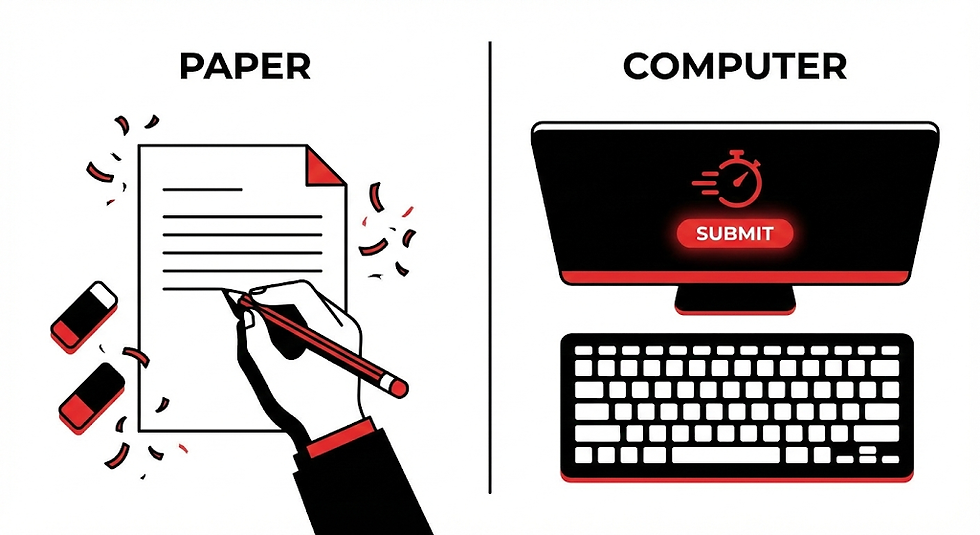
Problems with Paper-Based Writing
Manual word count: You must count words yourself. This wastes time and increases anxiety.
Messy corrections: Mistakes require erasing and rewriting, making the answer sheet untidy.
Handwriting risk: If the examiner struggles to read your letters, your score suffers.
Advantages of Computer-Based Writing
Automatic word counter: You always know how many words you have written.
Easy editing: Cut, copy, paste, and rearrange sentences instantly.
Perfect legibility: No handwriting-related mark loss.
Verdict: Unless you are extremely uncomfortable with typing, the computer mode is far superior for Writing.
2. Listening Section: Focus Matters
Paper-Based Risk
Audio is played through central speakers.
Background noise, coughing, or poor speaker clarity can affect understanding.
Once you miss an answer, it is gone.
Computer-Based Advantage
Personal headphones with adjustable volume.
Better focus and clarity.
Less dependence on exam hall acoustics.
Important Difference:
Paper-based test gives 10 minutes to transfer answers.
Computer-based test gives 2 minutes to check answers (since answers are entered directly).
3. Reading Section: Screen vs Page Flipping
Paper-Based Experience
Constantly flipping pages between passages and questions.
Breaks concentration and rhythm.
Computer-Based Experience
Split screen: Passage on the left, questions on the right.
Highlighting tool: Highlight key lines using the mouse.
Faster navigation, especially for matching headings and locating information.
Verdict: The split-screen layout saves time and reduces mental fatigue.
4. Results Speed and One Skill Retake Advantage
For 2026 applicants, time is critical.
Faster Results
Computer-based results: 3–5 days
Paper-based results: 13 days
If your university deadline is close, the computer test may be your only practical option.
One Skill Retake (OSR)
Available mainly for Computer-Delivered IELTS
Allows you to retake only one section (e.g., Writing)
Example Scenario: You score L-8, R-8, S-7.5, W-6.0
Computer: Retake only Writing
Paper: Retake the full exam
5. Who Should Still Choose Paper-Based IELTS?
The paper test is not completely obsolete. Choose it if:
Typing discomfort: You struggle significantly with keyboard usage.
Screen fatigue: Long screen time causes headaches or eye strain.
Physical note-taking preference: You think better when circling or marking text with a pencil.
Comfort matters. If anxiety outweighs benefits, paper may still work for you.
6. Speaking Test: No Difference at All
A common misconception is that computer IELTS has a “computer speaking test.”
This is false.
In both formats, the Speaking test is:
Face-to-face
With a human examiner
Same format, same scoring
Only the delivery mode of Listening, Reading, and Writing changes.
FAQs: IELTS Computer vs Paper 2026
1. Is computer-based IELTS harder?
No. Difficulty level, questions, and scoring are identical.
2. Can I use Ctrl + F in Reading?
No. The search function is disabled.
3. Does the computer check spelling or grammar?
No. There is no auto-correction. Typos count as errors.
4. Is the test fee different?
No. Fees are the same for both formats.
5. How are Listening answers handled?
You click or drag answers directly. No answer transfer step, reducing mistakes.
Conclusion
In 2026, the IELTS Computer vs Paper debate has a clear winner for most students.
The computer-delivered IELTS offers:
Faster results
Easier Writing correction
Better Listening clarity
Access to One Skill Retake
Unless you have serious typing discomfort or medical reasons, going digital is the smarter choice.
The future of IELTS is computer-based—and adapting early gives you an advantage.
Want to experience the interface before booking? Try a computer-delivered mock test and decide with confidence.


Comments