JEE Main 2026 Exam Day Guidelines: Essential Rules for Every Candidate
- mayuri pawar
- 5 days ago
- 5 min read

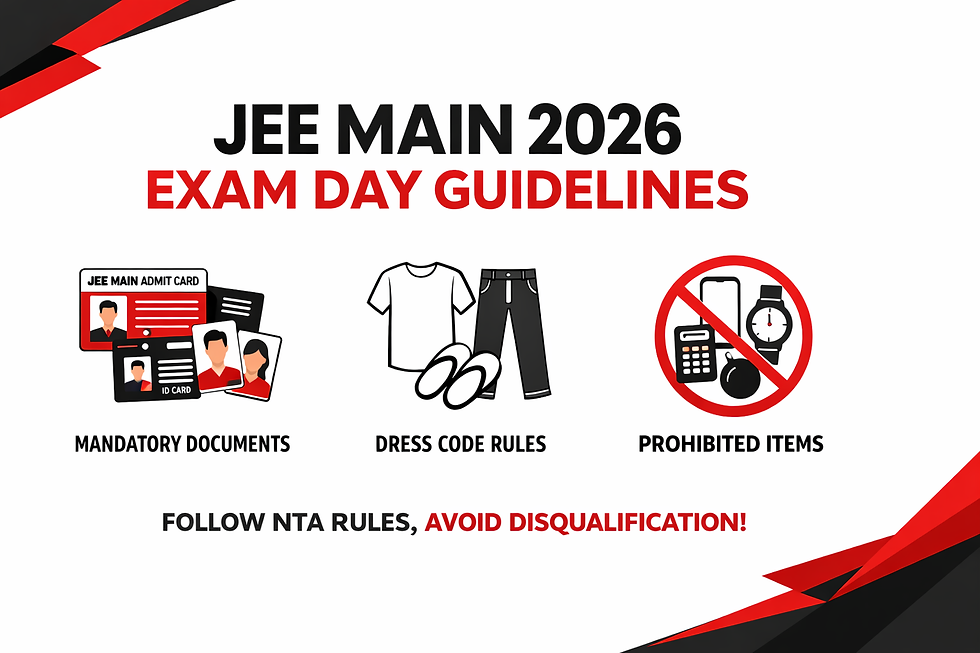
Preparing for one of India’s toughest entrance exams involves more than just mastering Physics, Chemistry, and Mathematics. As the JEE Main 2026 exam day guidelines highlight, administrative discipline is just as crucial as your academic preparation. Every year, several candidates face last-minute hurdles or even disqualification due to a lack of awareness regarding the National Testing Agency's (NTA) strict protocols.
For the academic year 2026, the NTA has further streamlined the entry process, integrating advanced biometric and face authentication systems. This guide provides a comprehensive breakdown of what you must do (and avoid) to ensure your focus remains entirely on the computer screen.
Understanding the JEE Main 2026 Exam Day Guidelines
The JEE Main 2026 exam day guidelines are designed to maintain the integrity and fairness of the examination. Whether you are appearing for the January or April session, these rules apply universally across all CBT (Computer Based Test) centers in India and abroad.
1. Reporting Time and Gate Entry
Punctuality is non-negotiable. The 2026 sessions are divided into two shifts:
Morning Shift: 9:00 AM to 12:00 PM (Reporting starts at 7:30 AM)
Afternoon Shift: 3:00 PM to 6:00 PM (Reporting starts at 2:00 PM)
Important Note: The gates close exactly 30 minutes before the commencement of the exam. If you arrive even one minute late, entry will be strictly denied. Candidates are advised to visit their designated center a day in advance to familiarize themselves with the route.
2. Mandatory Documents to Carry
You will not be allowed to enter the exam hall without the following "Big Three" documents:
JEE Main 2026 Admit Card: A clear, color printout on A4-sized paper. Ensure your photograph and signature are legible.
Valid Photo ID (Original): Aadhaar Card is the most preferred. Other options include PAN Card, Driving License, Voter ID, or Passport.
Passport-Size Photographs: Carry at least two recent photos (identical to the one uploaded during registration) to be pasted on the attendance sheet.
Exploring Specialized Engineering Streams
While you prepare for JEE Main, it is wise to look ahead at the evolving curriculum of modern engineering. For instance, the Civil Engineering Course 2026 has shifted significantly toward sustainability and AI-driven infrastructure.
Check Out More: If you are interested in the digital transformation of traditional fields, read the guide on the Civil Engineering Course 2026: Duration, Subjects, & Stream Details to understand how BIM and AI are reshaping the industry.
The JEE Main 2026 Dress Code: Do's and Don'ts
To prevent any possibility of unfair means, the NTA prescribes a specific dress code. Heavy clothing and metal accessories can trigger alarms during frisking, leading to unnecessary delays.
What to Wear (Do's)
Light Clothing: Opt for simple T-shirts, shirts, or kurtas with half sleeves.
Bottoms: Plain trousers or jeans without large buttons or multiple pockets.
Footwear: Slippers, sandals, or thin-soled flip-flops are recommended.
What to Avoid (Don'ts)
No Shoes: Footwear with thick soles, heels, or platforms is strictly prohibited.
No Metal: Avoid clothes with metallic zippers, large buttons, or embroidery.
No Accessories: This includes belts, caps, watches (digital or analog), and jewelry (rings, earrings, nose pins).
Prohibited Items Inside the Examination Hall
The following items are completely banned. Possession of any of these may lead to immediate disqualification and a potential ban from future NTA exams:
Electronics: Mobile phones, smartwatches, calculators, Bluetooth devices, and earphones.
Stationery: Books, notebooks, loose paper, or even your own pens (the center provides a transparent ballpoint pen).
Personal Belongings: Wallets, handbags, and goggles.
Food: Except for diabetic candidates (who may carry whole fruits like bananas or apples), no food or packed juices are allowed.
Transitioning into Data-Driven Science
Not all paths from JEE lead to traditional engineering. Many students now opt for data-centric degrees. If you find the mathematics of JEE fascinating, you might excel in the BSc Data Science stream, which currently prioritizes Generative AI and Ethics.
Expert Insight: For those leaning toward the intersection of math and technology, explore breakdown of Mathematics for BSc Data Science 2026 to see how the curriculum has evolved.
Inside the CBT Hall: Computer-Based Test Protocols
Once you clear the security check and biometric verification, you will be assigned a specific seat.
Login Process: You can log in 10 minutes before the start time to read the on-screen instructions.
Rough Work: Six blank A4 sheets will be provided for calculations. You must write your name and roll number at the top of each sheet and drop them in the designated box before leaving.
Attendance: You must sign the attendance sheet and paste your photograph in the presence of the invigilator.
Special Provisions for PwD and Diabetic Candidates
Diabetic Candidates: Allowed to carry sugar tablets, fruits (apples/bananas/oranges), and a transparent water bottle.
PwD Candidates: Must carry a valid PwD certificate. If using a scribe, ensure all formalities are completed via the NTA portal before the exam day.
Understanding the Financial Landscape of Engineering
Choosing a stream is as much about the academic content as it is about the long-term outlook. If you are aiming for high-tech civil roles, the specialization you choose—like Structural Engineering or Green Tech—will dictate your trajectory.
Read More: Discover the Civil Engineering Salary 2026: Course Specializations & Trends for a course-first perspective on this high-growth sector.
FAQs on JEE Main 2026 Exam Day Guidelines
Q1: Are jeans allowed as per the JEE Main 2026 exam day guidelines?
Yes, jeans are allowed under the JEE Main 2026 exam day guidelines, provided they are simple and do not have large metal buttons, heavy embroidery, or many pockets.
Q2: Can I carry my own pen to the exam center?
No. As per NTA rules, candidates are not allowed to bring their own stationery. A transparent ballpoint pen will be provided at the exam center.
Q3: Is it mandatory to reach the center early?
Yes. With the introduction of face authentication and Aadhaar-based biometrics in 2026, reporting at least 90 minutes early is highly recommended to avoid technical delays.
Q4: What should I do if my photo on the admit card is blurry?
You must contact the NTA helpline immediately. On exam day, carry an additional valid ID and extra passport-size photos to prove your identity.
Conclusion
Successfully navigating the JEE Main 2026 exam day guidelines is the final hurdle between your years of hard work and your seat in a premier institution. By adhering to the NTA’s strict protocols on documentation, dress code, and reporting times, you eliminate unnecessary stress and ensure a smooth testing experience. Remember, these rules exist to maintain a level playing field for every aspirant. As you prepare to enter the exam hall, stay calm, keep your documents ready the night before, and focus on the technical excellence you have built throughout your preparation. Whether your future lies in Civil Engineering, Chemical Engineering, or the burgeoning field of Data Science, your journey begins with a disciplined exam day.


Comments