Mastering GUJCET 2026: Why GUJCET Previous Year Questions Are Your Key to Success
- Dec 22, 2025
- 6 min read
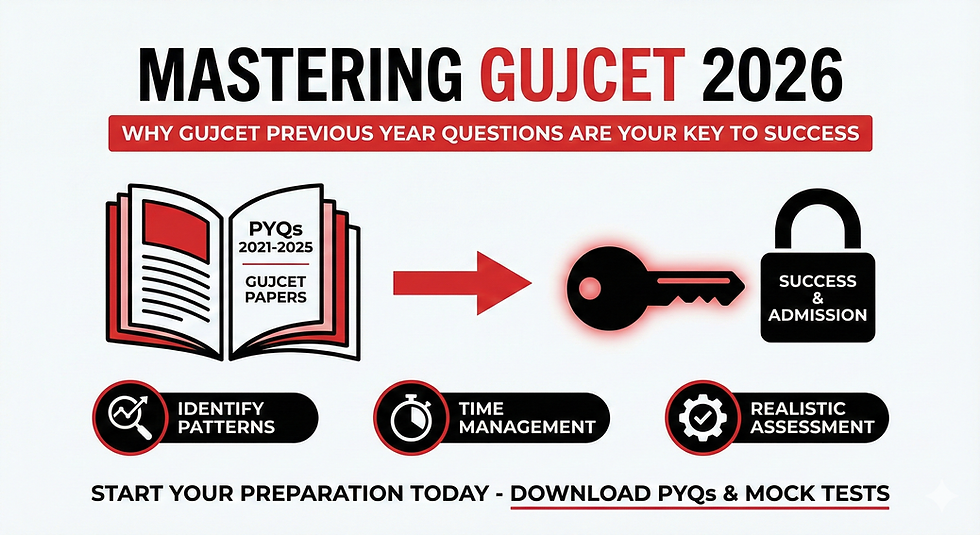
The journey to securing a seat in a premier engineering college in Gujarat is both exciting and rigorous. As the Gujarat Common Entrance Test (GUJCET) 2026 approaches, thousands of aspirants are looking for that one "secret weapon" to gain an edge over the competition. While textbooks provide the foundation, the real mastery of the exam comes from understanding the language of the examiners. This is where GUJCET Previous Year Questions (PYQs) become an indispensable part of your preparation strategy.
For engineering aspirants, GUJCET is the gateway to esteemed institutions like LDCE, Nirma University, and MS University. With the exam scheduled for March 29, 2026, the countdown has begun. In this comprehensive guide, we will delve deep into why solving past papers is the most effective way to prepare, analyze the latest exam patterns, and provide you with a subject-wise roadmap for success.
The Landscape of GUJCET 2026
Before diving into the technicalities of PYQs, it is crucial to understand the current structure of the examination. The Gujarat Secondary and Higher Secondary Education Board (GSEB) has confirmed that the 2026 cycle will continue to follow the NCERT-based curriculum, aligning closely with the Class 12 board syllabus.
Key Exam Highlights for 2026:
Exam Date: March 29, 2026.
Registration Start: December 16, 2025.
Mode of Exam: Offline (Pen-and-Paper based OMR).
Target Audience: Students seeking admission to B.E./B.Tech and B.Pharm courses.
Syllabus Weightage: Approximately 80% from Class 12 and 20% from Class 11 topics.
The competition is fierce. In recent years, over 1.3 lakh students have registered for the exam. To stand out, a student must not only know the concepts but also be able to apply them within a strict time limit.
Why GUJCET Previous Year Questions are Non-Negotiable
Ask any GUJCET topper about their preparation, and "solving past papers" will top the list. But why is it so vital? Let’s break it down.
1. Identifying Recurring Patterns
While the exact questions rarely repeat, the concepts and the framing style often do. By analyzing GUJCET Previous Year Questions, you will notice that certain sub-topics in Physics (like Ray Optics) or Chemistry (like Chemical Kinetics) are favorites of the paper setters. Recognizing these patterns allows you to prioritize your revision.
2. Mastering Time Management
The GUJCET exam is a race against time. You have 180 minutes to solve 120 questions. This gives you exactly 1.5 minutes per question. For Mathematics, where calculations can be lengthy, this is a significant challenge. Solving PYQs in a timed environment trains your brain to process information faster and decide which questions to tackle first and which to skip.
3. Understanding the "Trick" Factor
GUJCET is known for "moderate but tricky" questions. A question might look straightforward, but a small unit change or a conceptual trap could lead to a wrong answer. Exposure to years of past questions helps you develop an "eye for traps," significantly reducing your error rate.
4. Realistic Self-Assessment
No mock test is as accurate as an actual paper from 2023, 2024, or 2025. Solving these gives you a "reality check" on where you stand. If you are consistently scoring low in the Calculus section of a 2024 paper, you know exactly where your focus needs to be for the next week.
GUJCET 2026 Exam Pattern & Marking Scheme
To maximize the benefits of GUJCET Previous Year Questions, you must simulate the actual exam environment. The 2026 pattern is structured into two main sessions:
Session 1: Physics & Chemistry (Combined)
Total Questions: 80 (40 Physics + 40 Chemistry)
Total Marks: 80
Duration: 120 Minutes (2 Hours)
Session 2: Mathematics (For Engineering)
Total Questions: 40
Total Marks: 40
Duration: 60 Minutes (1 Hour)
The Marking Strategy:
Correct Answer: +1 Mark
Incorrect Answer: -0.25 Mark
Unattempted: 0 Marks
Pro Tip: Since there is a negative marking of 0.25, blind guessing is a recipe for disaster. Only use "educated guesses" when you have eliminated at least two options.
Subject-Wise Analysis: Learning from the Past
To help you focus your efforts, we have analyzed the trends from the last five years of GUJCET papers. Below is the expected chapter-wise weightage for the engineering stream.
Mathematics: The Game Changer
In the engineering merit list, Mathematics often acts as the differentiator. Analysis of GUJCET Previous Year Questions shows that Calculus and Algebra dominate the paper.
Chapter/Unit | Expected Questions | Priority Level |
Integration (Definite + Indefinite) | 6–8 | High |
Matrices and Determinants | 4–6 | High |
Vectors and 3D Geometry | 3–5 | High |
Differentiation & Its Applications | 4–5 | High |
Probability | 2–3 | Medium |
Inverse Trigonometric Functions | 2–3 | Medium |
Sets, Relations, and Functions | 2 | Medium |
Analysis: High-weightage topics like Integration and Matrices are often calculation-heavy. Use PYQs to find shortcuts and standard results that can save time.
Physics: Concept Meets Application
Physics is often rated as the most difficult section due to its mix of conceptual theory and numerical problems.
Topic | Weightage (%) | Key Focus Areas |
Mechanics (Class 11 & 12) | 20–25% | Laws of Motion, Work-Power-Energy |
Electrostatics & Current Electricity | 15–20% | Capacitance, Ohm's Law, Circuits |
Optics (Ray & Wave) | 12–15% | Lens Formula, Interference, Diffraction |
Modern Physics | 10–12% | Atoms, Nuclei, Dual Nature |
Magnetism & EMI | 10–12% | Induction, AC Circuits |
Analysis: The trend shows that GSEB focuses heavily on the application of formulas. Don't just memorize; solve the numericals from the 2021–2025 papers to see how variables are manipulated.
Chemistry: The Scoring Subject
Chemistry is usually the highest-scoring section for GUJCET aspirants. It is largely based on the NCERT textbooks.
Section | Importance | Study Tip |
Physical Chemistry | Very High | Focus on formulas in Solutions & Kinetics. |
Organic Chemistry | High | Practice Name Reactions and mechanisms. |
Inorganic Chemistry | Moderate | Focus on P-Block and Coordination Compounds. |
Analysis: PYQ analysis reveals that roughly 70% of Chemistry questions are direct or semi-direct from NCERT lines.
How to Effectively Use GUJCET Previous Year Questions
Simply having a PDF of past papers isn't enough; you need a strategy.
Step 1: The "First Pass" (Chapter-wise)
When you finish a chapter—say, Electrostatics—immediately solve all questions related to it from the last 10 years of GUJCET. This reinforces the concept and shows you how that specific chapter is tested.
Step 2: The "Simulated Drill" (Full Length)
Once you have covered 70-80% of the syllabus, start solving full-length papers.
Sit in a quiet room.
Set a timer for 3 hours (2 hours for P/C, 1 hour for Maths).
Use an OMR sheet to practice bubbling. Many students lose marks due to bubbling errors under pressure.
Step 3: The Post-Mortem Analysis
This is the most critical step. After solving a paper, categorize your mistakes:
Conceptual Error: You didn't know how to solve it. (Action: Re-read the topic).
Silly Mistake: Calculation error or misreading the question. (Action: Improve focus).
Time Out: You knew it but ran out of time. (Action: Practice speed drills).
Important Resources for GUJCET 2026
To aid your preparation, ensure you have the following:
GSEB/NCERT Textbooks: Your primary Bible.
GUJCET PYQ Compilation: A book or PDF containing at least the last 15 years of papers.
Simple Calculator: Unlike JEE, GUJCET allows the use of a simple calculator. Practice using it during your PYQ sessions to increase speed.
Conclusion: Start Your Preparation Today
Success in GUJCET 2026 is a marathon, not a sprint. By integrating GUJCET Previous Year Questions into your daily routine, you transition from a "student" to a "candidate." You stop just learning topics and start learning how to win the exam.
Remember, the goal is not just to solve the paper but to master the environment of the exam. Every past question you solve is a step closer to your dream engineering college in Gujarat.
Frequently Asked Questions (FAQs)
1. Are GUJCET 2026 Previous Year Questions enough to clear the exam?
While solving GUJCET 2026 Previous Year Questions is vital for understanding trends and improving speed, they should be used alongside a thorough study of the NCERT/GSEB textbooks. PYQs help you apply what you have learned, but the conceptual foundation must come from your primary books.
2. Is there negative marking in GUJCET 2026?
Yes, there is a negative marking of 0.25 marks for every incorrect response. There is no penalty for unattempted questions.
3. Which year's GUJCET paper was the hardest?
While "hardness" is subjective, many students found the 2023 and 2025 Mathematics sections to be quite lengthy and challenging. Reviewing these specific GUJCET Previous Year Questions will give you a good idea of the upper limit of the exam's difficulty.
4. Can I get admission to B.Tech based only on GUJCET scores?
In Gujarat, admission to engineering (B.E./B.Tech) typically follows a merit system where 60% weightage is given to Class 12 Board marks (Theory) and 40% weightage is given to GUJCET scores. Therefore, you need to perform well in both.
5. Has the syllabus changed for 2026?
The syllabus for GUJCET 2026 remains based on the NCERT curriculum adopted by the Gujarat Board. It covers both Class 11 and Class 12, with a significantly higher emphasis (approx. 80%) on the Class 12 portion.


Comments