Nursing Specializations After B.Sc Nursing: ICU, OT, Pediatric & More
- Dec 24, 2025
- 5 min read
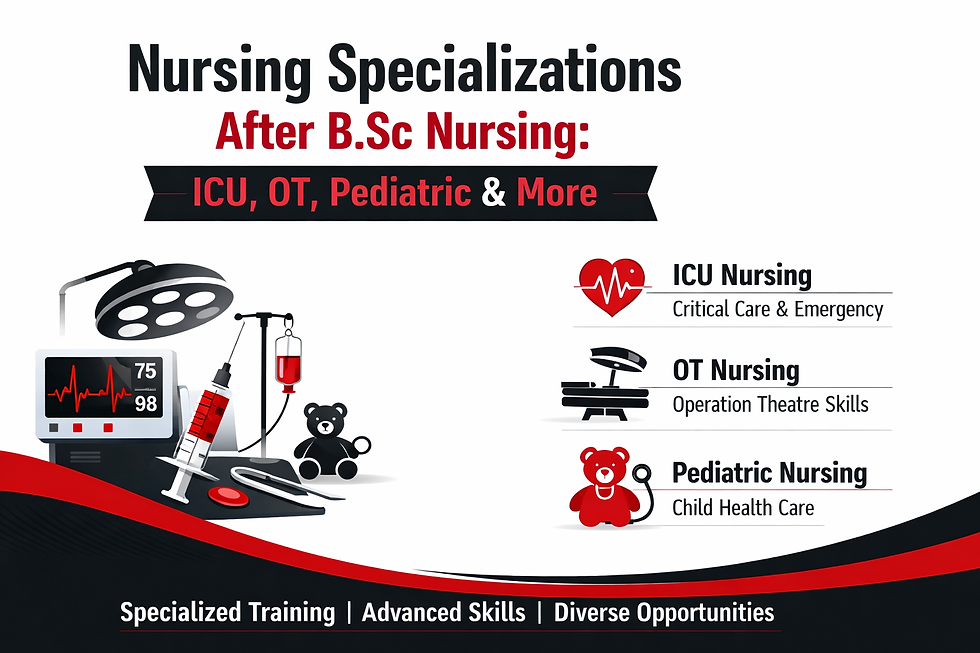
The global healthcare landscape in 2026 is undergoing a massive transformation. With the integration of AI-driven diagnostics, a surge in specialized critical care units, and an aging global population, the role of a nurse has evolved far beyond basic bedside care. For a graduate, choosing the right nursing specializations after B.Sc Nursing is no longer just an option—it is a strategic career move to ensure job security, higher pay, and professional authority.
Whether you are drawn to the high-stakes environment of the Operation Theatre (OT), the delicate care required in Pediatrics, or the tech-forward realm of Nursing Informatics, this guide explores the most lucrative and impactful paths available in 2026.
The Landscape of Nursing Specializations in 2026
After completing a B.Sc. Nursing, graduates can advance their careers through various clinical and non-clinical specializations. In 2026, these paths are typically pursued via a Master of Science (M.Sc.) in Nursing (2 years) or Post Basic/Postgraduate Diplomas (1 year).
The shift toward "Precision Nursing" means that hospitals now prefer specialists over generalists. Modern medical facilities in 2026 are looking for nurses who can manage complex electronic health records (EHR) and operate advanced life-support machinery while maintaining the "human touch" that defines the profession.
Popular Clinical Specializations: High-Stakes Patient Care
Clinical specializations remain the backbone of the hospital ecosystem. These roles focus on direct patient care in specialized units where expertise can mean the difference between life and death.
1. Critical Care/ICU Nursing
As hospitals expand their intensive care infrastructure to handle complex chronic conditions and trauma, the demand for ICU nurses has reached an all-time high. This specialization focuses on treating life-threatening conditions in intensive care units.
Courses:
M.Sc. in Critical Care Nursing, Post Basic Diploma in Critical Care Nursing (1 year), or the Indian Diploma in Critical Care Nursing (IDCCN).
Key Skills:
Ventilator management, advanced life support (ACLS/BLS), and hemodynamic monitoring using AI-integrated sensors.
Scope in 2026:
With the rise of "Smart ICUs," nurses must now be adept at interpreting real-time data analytics to predict patient deterioration.
2. Operation Theatre (OT) Nursing
OT Nursing, also known as Perioperative Nursing, is ideal for those who enjoy a structured, fast-paced environment. These nurses specialize in pre-, intra-, and post-operative care.
Courses:
Post Basic Diploma in Operation Room Nursing.
Roles:
Assisting surgeons, managing robotic surgical instruments, and maintaining a strictly sterile environment.
2026 Trend:
A significant focus on Robotic-Assisted Surgery (RAS) support. OT nurses are now being trained to calibrate and manage surgical robots.
3. Pediatric Nursing
If you have a passion for working with children, Pediatric Nursing offers a rewarding path. This field focuses on infants, children, and adolescents.
Courses:
M.Sc. in Pediatric Nursing or Diploma in Pediatric Nursing.
Sub-specialties:
Neonatal Intensive Care Unit (NICU): Caring for premature or ill newborns.
Pediatric Intensive Care Unit (PICU): Managing critically ill older children.
Key Skills:
Pediatric pharmacology, gentle patient communication, and family-centered care.
4. Mental Health (Psychiatric) Nursing
In 2026, the stigma surrounding mental health has diminished significantly, leading to a massive expansion in psychiatric services. This specialization focuses on treating individuals with psychological disorders.
Courses:
M.Sc. or PG Diploma in Psychiatric Nursing.
The Need:
With global mental health crises on the rise, psychiatric nurses are essential in rehabilitation centers, private clinics, and community health programs.
Beyond the Ward: Emerging & Non-Clinical Paths
The nursing profession is no longer confined to the four walls of a hospital ward. Several emerging nursing specializations after B.Sc Nursing offer autonomy and tech-centric opportunities.
1. Nurse Practitioner (NP)
This is perhaps the most "doctor-adjacent" role a nurse can hold. Nurse Practitioners are advanced practice nurses who can diagnose, treat, and prescribe medications independently or under physician supervision.
Salary Potential:
NPs often command some of the highest salaries in the nursing domain, ranging from ₹8–12 LPA in Indian metropolitan cities.
2. Nursing Informatics
A fast-growing field combining nursing expertise with information technology and data management.
Role:
You act as a bridge between the clinical staff and IT, ensuring that digital health tools actually improve patient outcomes rather than just adding paperwork.
Growth:
In 2026, as AI becomes an "intelligence layer" in hospitals, Nursing Informatics specialists are being hired as "Digital Triage Leads" and "Data Fluency Officers."
3. Oncology Nursing
Dedicated care for cancer patients is a growing necessity. With cancer cases rising globally, oncology nurses who can administer chemotherapy and provide palliative support are in high demand.
4. Public Health & Community Nursing
These nurses work with communities on disease prevention and health education through government agencies or NGOs. In 2026, this role has expanded to include Telehealth Nursing, where care is provided remotely to rural populations.
Comparison of Post-B.Sc. Nursing Options (2026 Outlook)
The following table summarizes the primary pathways available for graduates looking to specialize.
Specialization Type | Common Courses | Duration | Career Goal |
|---|---|---|---|
Academic/Teaching | M.Sc. Nursing, PhD | 2–5 Years | Nursing Tutor, Professor, Researcher |
Clinical Expert | Post Basic Diploma (ICU, OT, Midwifery) | 1 Year | Senior Staff Nurse, Unit In-charge |
Administration | MBA in Healthcare/Hospital Management | 2 Years | Hospital Manager, Nursing Superintendent |
Global Practice | NCLEX-RN (USA), OET/IELTS (UK/Australia) | Varies | Registered Nurse in International Hospitals |
Advanced Practice | MSc (Nurse Practitioner in Critical Care) | 2 Years | Independent Clinical Practice |
Strategic Requirements for Specialization
While the degree provides the foundation, specialization requires clinical maturity. For most advanced certifications and M.Sc. programs, a minimum of 1 to 2 years of clinical experience as a staff nurse is highly recommended or mandatory.
Career Scope and Salaries in 2026
The "Nursing Shortage" of 2025 has turned into a "Specialist Shortage" in 2026. This means higher bargaining power for specialized nurses.
Entry-level B.Sc. Nurse: ₹3.5 – ₹5 LPA
ICU/OT Specialist: ₹5 – ₹8 LPA
Nurse Practitioner: ₹8 – ₹12+ LPA
International Roles (UK/USA/Middle East): ₹25 – ₹60+ LPA (equivalent)
Conclusion
As healthcare evolves rapidly in 2026, specialization has become the cornerstone of a successful nursing career. Choosing the right Nursing Specializations After B.Sc Nursing is no longer just about higher pay or job titles—it’s about aligning your skills with advanced clinical care, technology-driven healthcare, and long-term professional relevance. Whether your path leads to the ICU, Operation Theatre, Pediatric care, or Public Health, specialization empowers you to deliver precise, high-impact care.
The transition from a B.Sc Nursing graduate to a specialized professional demands continuous learning, clinical excellence, and adaptability to emerging trends like AI-assisted monitoring and advanced surgical support. Nurses who invest in specialization today position themselves as future healthcare leaders, ensuring career stability, global opportunities, and deep personal fulfillment in one of the world’s most respected professions.
Frequently Asked Questions
1. Which are the best nursing specializations after B.Sc Nursing for a high salary?
In 2026, the highest-paying nursing specializations after B.Sc Nursing include Nurse Practitioner (NP) roles, Critical Care (ICU) Nursing, and Nursing Informatics. Additionally, specialized roles like Nurse Anesthetists and Oncology Nurses offer significantly higher compensation than general staff nursing.
2. Can I pursue a Nursing specialization after B.Sc Nursing?
While some Post-Basic Diplomas allow immediate entry, most top-tier M.Sc. Nursing programs and Nurse Practitioner courses require at least 1 year of clinical experience. This ensures you have the practical foundation needed for advanced studies.
3. Is Nursing Informatics a good career choice for 2026?
Yes, it is one of the fastest-growing fields. As healthcare goes digital, hospitals need nurses who understand both patient care and data analytics. It is an excellent choice for those who want a non-clinical, tech-oriented career.
4. How do I work abroad after specializing in India?
To work abroad, you usually need to clear the licensing exam of the target country (like NCLEX-RN for the USA or OSCE for the UK) and an English proficiency test (IELTS/OET). Having a clinical specialization like ICU or OT significantly increases your chances of being hired by international recruiters.


Comments