Practical TOEFL Preparation Tips for Beginners (2026) — A Step-by-Step Guide to Score Higher
- Feb 6
- 4 min read
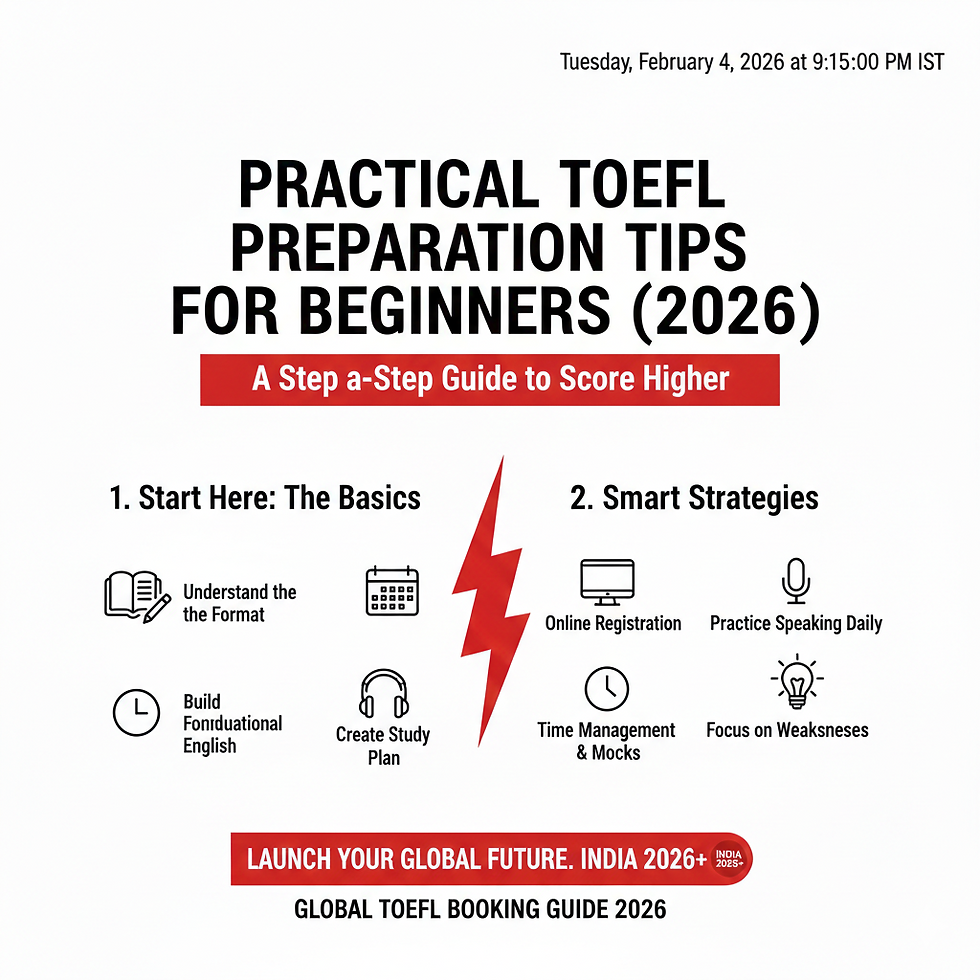
Starting TOEFL prep can feel overwhelming — new format, tightened timing (2026 updates), and lots of advice out there. This practical guide breaks the process down into bite-size, exam-ready steps: how the test works (briefly), an 8-week beginner plan, high-impact study tactics for each section, tools and resources you should trust, a verified FAQ, and a CTA with official links so you can act immediately. The tips below are updated to reflect ETS’s 2026 changes and official practice materials.
Quick official snapshot (what changed in 2026)
ETS introduced a shorter, adaptive TOEFL iBT that reduces total testing time (around 90 minutes) and changed the scoring scale in January 2026. These changes make efficient practice and time management more essential than ever.
Use ETS’s official prep and practice resources as your baseline — they are the authoritative source for item types and scoring rubrics.
How to use this guide
Read the 8-week beginner plan and pick the weekly tasks that match your current level.
Use the section-specific tactics to structure daily practice (Reading, Listening, Speaking, Writing).
Refer to the official links in the CTA to download practice tests and rubrics before you start.
TOEFL at a glance (short): what to practise
Skill | What it tests | High-value practice focus |
Reading | Academic passages — main idea, detail, inference | Skimming, scanning, paraphrase practice |
Listening | Lectures & conversations — gist, detail, speaker intent | Active note-taking, summarising aloud |
Speaking | Short integrated & independent tasks | Structure answers (intro, 2 points, conclusion) |
Writing | Integrated synthesis + independent essay | Quick outlines, clear thesis, evidence |
(ETS continues to test these four skills; see official content pages and practice tests for updated task examples).
8-week blueprint for beginners (daily ≈ 1–2 hours → scale up as you improve)
Week | Focus | Weekly goals |
1 | Diagnostic + foundations | Take an official practice test; note weak sections. |
2 | Reading skills | Daily passages (30–45 min), 5+ timed questions/day |
3 | Listening skills | 30–45 min note-taking practice; transcribe short lectures |
4 | Speaking fundamentals | 10 recorded responses; practice structure + timing |
5 | Writing basics | 6 integrated & 6 independent timed essays |
6 | Mixed skills | Full practice test under real timing; adjust plan |
7 | Speed + accuracy | Targeted drills on weakest sub-tasks (e.g., inference) |
8 | Final simulations | 2 full practice tests; exam day checklist & rest |
Use ETS full-length practice tests periodically so your progress aligns to real scoring.
Section-by-section high-impact tactics
Reading — 5 tactical habits
Skim first: read the title, first sentence of each paragraph, and look at keywords. (ETS recommends skimming as a top strategy.)
Identify question type: main idea, detail, inference, or vocabulary-in-context — answer accordingly.
Paraphrase the question before scanning the passage for a targeted search.
Practice speed: set 18–25 minute windows per passage to match the 2026 shorter format.
Error log: save incorrect items and note why — vocabulary? misread detail? inference?
Listening — note-taking system
Use a 3-column note layout: (Topic / Key details / Example or connection).
Listen for signpost words (however, therefore, in contrast) and clock the speaker’s tone for attitude.
Practice with lectures from university channels and then answer comprehension questions; gradually reduce replay usage.
Speaking — structure beats length
Always follow a 4-part structure: quick intro, point 1 (+example), point 2 (+example), quick conclusion.
Time yourself: with the shorter 2026 pacing, practice concise answers (30–60 seconds depending on task).
Record & compare: use ETS speaking rubrics to self-score and iterate.
Writing — outline, evidence, polish
5-minute outline for integrated tasks: list main points from the reading/listening then draft.
Use linking phrases for cohesion: however, moreover, consequently.
Grammar micro-drills: fix 5 recurring mistakes (articles, tenses, subject-verb) each week.
Daily micro-practice (30–60 minutes options)
15 min: Vocabulary (contextual flashcards)
20 min: Reading passage (timed) + 10 min review
20 min: Listening clip (notes) + 10 min summary aloud
20 min alternate: Speaking prompt (record) or 1 timed essay
Rotate to maintain variety — consistency beats marathon cram sessions.
Tools & verified resources to trust
ETS Official Prep Hub & sample tests — your primary source for real practice items and rubrics.
ETS blog: “20 Proven TOEFL Tips” — practical skill tips for Reading and other sections.
Magoosh practice materials — practice tests built from official question types (useful for additional timed practice).
Smart scheduling for beginners (timeline suggestion)
If you’re starting from scratch and need the TOEFL for a Fall 2027 intake: begin 6–8 months before application deadlines — 8 weeks for focused test readiness + buffer for re-test if needed.
Book a test date 2–3 months after you begin steady study to allow realistic improvement time.
Common beginner mistakes & fixes
Mistake: Studying without official practice tests → Fix: Do an ETS practice test first to calibrate.
Mistake: Overfocusing on word lists → Fix: Learn vocabulary in context via passages and listening sources.
Mistake: Ignoring timing in practice → Fix: Always simulate the 2026 timing conditions in practice tests.
FAQ (includes the focus keyword)
Q1: What are the best TOEFL preparation tips for beginners starting in 2026?
A: Begin with an official ETS diagnostic (full practice test), then follow an 8-week structured plan focusing on one core skill per week, daily micro-practice, and periodic full simulations under 2026 timing. Use ETS practice materials and speaking rubrics to self-score.
Q2: How long should a beginner study before taking the TOEFL?
A: For most beginners, 8–12 weeks of consistent study (1.5–3 hours/day) is a practical window to reach test readiness; adjust based on diagnostic results.
Q3: Are ETS practice tests necessary or can I rely on third-party material?
A: ETS practice is essential — it’s the authoritative source for question types and rubrics. Use third-party resources (e.g., Magoosh) as supplements, not replacements.
Final checklist before test day
Confirm your test format (Home Edition vs test center) and technical requirements if testing at home.
Do two full-length simulations (under the 2026 timing) in the final two weeks.
Sleep well the night before; review errors from your last simulation but avoid heavy new learning.
CTA — official links & next steps
Ready to start? Bookmark these official resources and begin with a diagnostic today:
ETS Test Preparation & Official Practice — practice tests, tips, and official guides. https://www.ets.org/toefl/test-takers/ibt/prepare.html
ETS Full-Length Practice Tests (download) — run a diagnostic test first. https://www.ets.org/toefl/test-takers/ibt/prepare/sample-test-jan-2026-1.html
TOEFL iBT Home Edition information & requirements — if you plan to test from home. https://www.in.ets.org/toefl/test-takers/ibt/about/testing-options/at-home.html


Comments