Reverse Engineering the Syllabus: Starting with Previous Year Questions (PYQs) to identify what not to study.
- Dec 31, 2025
- 3 min read
Preparing for GATE 2026 requires more than just hard work; it demands a strategic "surgical" approach to the vast syllabus. Many aspirants spend months mastering topics that have little to no impact on their final score. Reverse Engineering, the process of starting with Previous Year Questions (PYQs) to decode the examiner’s mind, is the most effective way to identify what not to study, allowing you to focus your energy where the marks actually are.
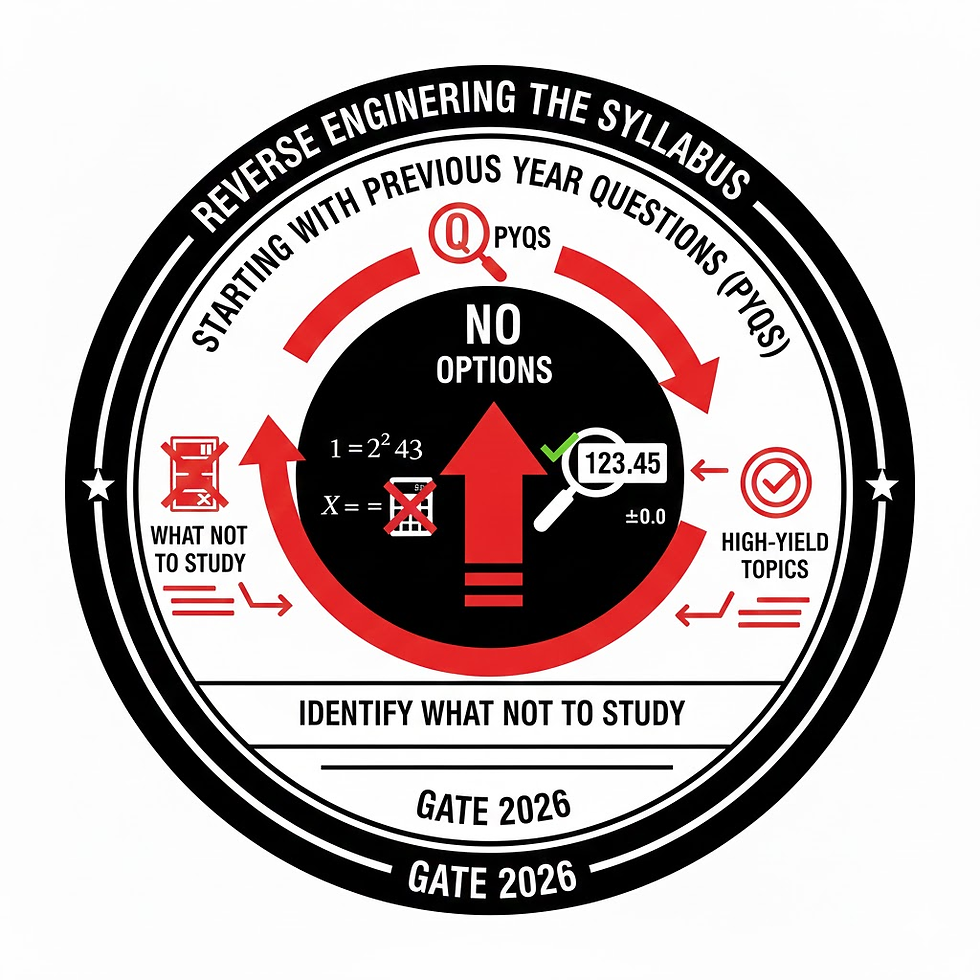
Reverse Engineering the GATE 2026 Syllabus of PYQs
The traditional method involves reading a textbook, then doing exercises, and finally looking at PYQs. Reverse Engineering flips this. You begin by analyzing the last 15–20 years of question papers to map out the "High-Yield" vs. "Dead-Weight" topics.
1. The "What Not to Study" Audit
The GATE syllabus is designed to be comprehensive, but the exam itself is highly selective. By looking at PYQs first, you can identify:
Outdated Topics: Certain sections remain in the official PDF but haven't seen a question in over a decade.
Overly Theoretical Sections: Many engineering subjects have long derivations that are never tested in the numerical-heavy GATE format.
Diminishing Returns: Topics that take 20 hours to master but only yield 1 mark every 5 years.
2. Identifying the "Core 80"
Historically, 80% of the GATE marks come from 20% of the syllabus. For instance, in Computer Science, while "Computer Networks" is huge, a significant chunk of marks consistently comes from IP Addressing and TCP/UDP. By starting with PYQs, you recognize these patterns before you even open a textbook.
High-Weightage vs. Low-Weightage: A Strategy Map
Feature | Focus on (Study These!) | Skip/Minimize (What Not to Study) |
Concept Type | Numerical applications and logic | Purely descriptive or rote-memory topics |
Frequency | Topics appearing in 8 out of 10 years | Topics appearing once in 15 years |
Depth | Core fundamental subjects (Math/Aptitude) | Highly niche, specialized sub-topics |
Preparation | PYQ-based conceptual clarity | Reading every page of a 1000-page "Bible" book |
FAQs
Q: Does GATE repeat questions from previous years?
A: No, GATE rarely repeats the exact question. However, the concepts and the logic repeat almost every year. Solving PYQs helps you master the "templates" of questions.
Q: Is it safe to skip topics entirely?
A: "Skipping" doesn't mean ignoring; it means prioritizing. If a topic has a 0.5% weightage, your time is better spent perfecting Engineering Mathematics (13–15%) or General Aptitude (15%).
Q: How many years of PYQs should I analyze?
A: At least 15 to 20 years. This range is wide enough to show you how the focus shifted when different IITs (e.g., IIT Guwahati for 2026) organized the exam.
Q: Can I crack GATE by only solving PYQs?
A: PYQs are the compass, not the fuel. You use them to identify what to study, but you still need to learn the underlying concepts to solve new variations.
Others:
Ready to start your reverse-engineered preparation? Use these verified resources to begin your analysis:
Official GATE 2026 Syllabus - IIT Guwahati: Get the base document before you start filtering.
Subject-Wise Weightage Analysis: A deep dive into which chapters carry the most marks.
Download GATE Previous Year Papers: Start your "Reverse Audit" by downloading the last 10 years of papers.
GATE Preparation Tracker: Organize your schedule based on the weightage you discover.
Conclusion
Reverse engineering the syllabus isn't about being "lazy"—it's about being efficient. In an exam like GATE 2026, where the competition is fierce, the difference between a topper and an average scorer is often not "how much" they studied, but "what" they chose to study. Use PYQs as your primary filter, eliminate the fluff, and focus on the core concepts that have stood the test of time.


Comments