Scaler School of Technology Admission 2026: Complete Guide to Eligibility, Fees, Selection Process & Placements

The demand for software engineers, AI specialists, and technology professionals continues to grow rapidly, leading many students to explore alternative pathways beyond traditional engineering colleges. One institution that has attracted significant attention in recent years is Scaler School of Technology.
If you're considering applying, this comprehensive Scaler School of Technology Admission 2026 guide covers everything you need to know, including eligibility, admission process, fees, scholarships, curriculum, placements, and career opportunities.
Whether you're a Class 12 student, parent, or aspiring software engineer, this guide will help you understand whether Scaler School of Technology is the right choice for your future.
1.What Is Scaler School of Technology?
Scaler School of Technology is designed for students who want a highly technology-focused undergraduate education.
Unlike many traditional engineering programs, the curriculum emphasizes:
Software Engineering
Programming
Data Structures
Algorithms
Artificial Intelligence
Product Development
Industry Projects
The objective is to help students become industry-ready software professionals through practical learning and hands-on experience.
Why Students Are Interested in Scaler School of Technology Admission 2026
Several factors contribute to the growing interest in Scaler School of Technology Admission 2026.
Industry-Focused Curriculum
Students begin learning programming and software development concepts early.
Project-Based Learning
Practical implementation is emphasized alongside theoretical concepts.
Technology-Centric Environment
The learning ecosystem focuses heavily on software engineering and modern technology careers.
Internship Readiness
Students are encouraged to develop industry-relevant skills from the beginning.
2.Scaler School of Technology Admission 2026 Eligibility Criteria
Before applying, students should ensure they meet the eligibility requirements.
Academic Qualification
Applicants generally need:
Class 12 completion or equivalent
Recognized educational board
Mathematics as a key subject (depending on program requirements)
Age Requirements
Students should review the latest official admission guidelines for age-related eligibility criteria.
Academic Performance
Previous academic records may be considered during the admission process.
Applicants should always verify the latest eligibility criteria directly from official admission sources.
Scaler School of Technology Admission 2026 Process
The Scaler School of Technology Admission 2026 process is designed to evaluate aptitude, problem-solving ability, and potential.
Step 1: Online Application
Students submit their application through the admission portal.
Step 2: Aptitude Assessment
Applicants may be evaluated on:
Logical reasoning
Quantitative aptitude
Analytical thinking
Problem-solving skills
Step 3: Personal Interview
Selected candidates may participate in an interview.
The interview often assesses:
Motivation
Learning mindset
Communication skills
Technology interest
Step 4: Final Selection
Admission decisions are generally based on overall performance throughout the evaluation process.
3.Scaler School of Technology Admission 2026 Fees
One of the most important considerations for students and parents is the fee structure.
Students should evaluate:
Tuition Fees
Program-related academic expenses.
Learning Resources
Technology tools and educational resources.
Additional Costs
Accommodation, travel, and living expenses if applicable.
Fee structures may change periodically, so applicants should refer to official admission resources for the latest information.
Scholarships Available for Scaler School of Technology Admission 2026
Scholarships can help reduce financial burden for deserving students.
Possible scholarship considerations may include:
Merit-Based Scholarships
Awarded based on academic performance.
Performance-Based Scholarships
Linked to assessment or admission process performance.
Need-Based Support
Financial assistance for eligible students.
Students should check the latest scholarship announcements and eligibility requirements.
4.Scaler School of Technology Admission 2026 Curriculum Overview
One of the strongest attractions of the program is its software-focused curriculum.
Programming Fundamentals
Students typically learn:
Python
Java
Problem Solving
Object-Oriented Programming
Data Structures and Algorithms
Core concepts include:
Arrays
Linked Lists
Trees
Graphs
Dynamic Programming
These topics are essential for technical interviews.
Full Stack Development
Students gain exposure to:
Frontend Development
Backend Development
Databases
APIs
Artificial Intelligence and Emerging Technologies
Modern technology topics may include:
AI Concepts
Machine Learning Fundamentals
Cloud Computing
Data Engineering
This curriculum design contributes to interest in Scaler School of Technology Admission 2026.
5.Coding Culture and Learning Environment
Coding culture is often a deciding factor for software engineering aspirants.
Students may participate in:
Hackathons
Competitive coding and innovation events.
Technical Projects
Real-world software development experiences.
Peer Learning
Collaboration with fellow technology enthusiasts.
Industry Mentorship
Guidance from experienced professionals.
Such experiences can help students build strong portfolios.
Internship Opportunities
Internships provide practical exposure before graduation.
Benefits include:
Industry experience
Professional networking
Resume enhancement
Career exploration
Students who complete meaningful internships often improve their employability significantly.
6.Scaler School of Technology Admission 2026 and Placements
Many applicants are interested in placement prospects.
Placement readiness generally depends on:
Technical Skills
Strong coding and development capabilities.
Project Portfolio
Practical software projects demonstrate competence.
Communication Skills
Important during interviews and workplace interactions.
Internship Experience
Industry exposure strengthens candidate profiles.
Students should focus on skill development rather than relying solely on placement statistics.
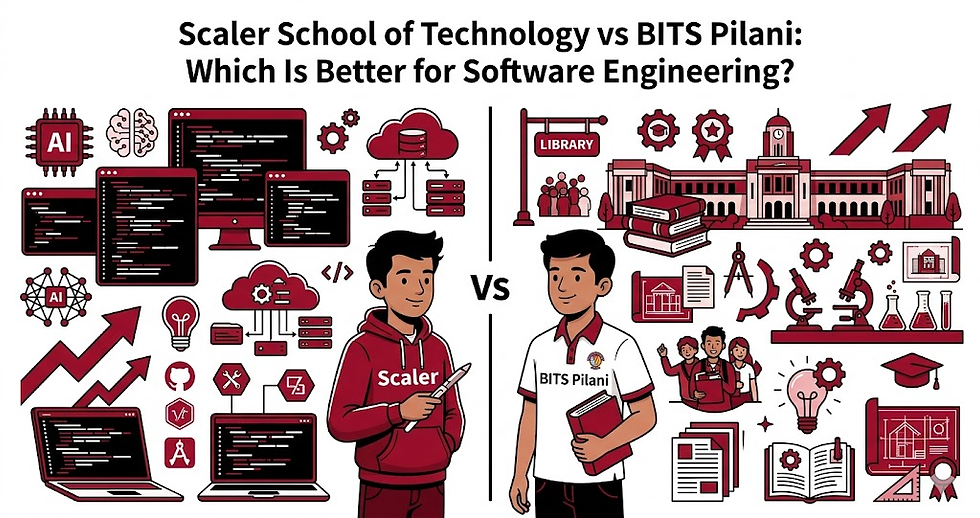
Scaler School of Technology vs Traditional Engineering Colleges
Traditional Engineering Colleges
Advantages:
Established campus culture
Broad engineering education
Larger alumni networks
Scaler School of Technology
Advantages:
Software-first learning
Industry-focused curriculum
Early coding exposure
Project-driven approach
The choice depends on individual career goals and learning preferences.
7.Who Should Apply for Scaler School of Technology Admission 2026?
This pathway may be suitable for students who:
Enjoy coding
Want software engineering careers
Prefer practical learning
Like building projects
Are interested in AI and emerging technologies
Students seeking traditional engineering experiences may prefer conventional colleges.
Career Opportunities After Graduation
Potential career paths include:
Software Engineer
Develop applications and platforms.
Full Stack Developer
Work on frontend and backend systems.
AI Engineer
Build intelligent software solutions.
Product Engineer
Develop scalable technology products.
Startup Founder
Launch technology-driven ventures.
Technology careers continue to expand rapidly, making software-focused education increasingly attractive.
o continuously learn and adapt in the fast-changing technology industry.
FAQs
1.What is Scaler School of Technology Admission 2026?
It refers to the admission process for students seeking enrollment in Scaler School of Technology programs for the 2026 academic cycle.
2.Is JEE Main required for admission?
Applicants should verify the latest admission requirements through official channels, as admission criteria may evolve over time.
3.Does Scaler School offer scholarships?
Scholarship opportunities may be available based on merit, performance, or other eligibility criteria.
4.Is the curriculum focused on software engineering?
Yes, the curriculum is widely recognized for its emphasis on programming, software development, and industry-relevant technologies.
5.Who should apply?
Students passionate about coding, software engineering, AI, and technology careers may find the program particularly suitable.


Comments