Study Abroad After 12th Science (2026): Complete Guide — Best Countries, Courses, Costs, Eligibility & Step-by-Step Plan
- Feb 11
- 5 min read

Choosing to study abroad after 12th science is a big — and exciting — decision. Whether you’re aiming for engineering, medicine, data science, or integrated bachelor’s programmes, this guide (updated for 2026) walks you through the top destinations, realistic cost ranges, eligibility and tests, intake timing, scholarship options, and a clear step-by-step plan so you can apply with confidence.
Why consider study abroad after 12th science in 2026?
Studying overseas after class 12 opens doors to internationally ranked undergraduate programmes, early exposure to research and internships, and global career pathways. In 2026, destinations such as Canada, Germany, UK, Australia and the USA remain the top choices for Indian students because of favourable post-study work options, quality of education, and diverse course offerings. Canada, in particular, is widely seen as the leading option due to a mix of quality and post-study opportunities.
Which countries and programmes should 12th-science students consider?
Destination | Popular UG options after 12th science | Why students choose it (2026) |
Canada | BEng, Computer Science, Data Science, Nursing, Business (co-op) | Good PR pathways, co-op programmes, balanced costs. |
Germany | Engineering (B.Tech), Applied Sciences, Computer Science | Low/zero tuition at public universities, strong engineering industry links. |
United Kingdom | Integrated MSci, Engineering MEng, Biomedical Sciences | Shorter degrees (3–4 years), strong research exposure and scholarships. |
Australia | Engineering, IT, Environmental Science, Biomedical | Multiple intakes, high employer demand in tech/health; research internships. |
USA | BS Engineering, Computer Science, Interdisciplinary STEM | Strong campus resources and internship pipelines; higher costs but high ROI for some fields. |
Note: MBBS/medicine pathways vary widely — low-cost medical seats in places like Kazakhstan or Russia exist, but safety, recognition and return-to-India licensing must be carefully checked. Recent reports have also highlighted welfare and safety concerns in some destinations; choose accredited, well-reviewed medical schools and consult official recognition lists before applying. (See official medical council lists and embassy advisories.)
How much will it cost? (2026 realistic ranges)
Costs vary a lot by country, university, and program. The figures below cover annual total cost (tuition + living) typical for international undergraduates in 2026.
Country | Typical annual range (USD) |
Canada | $12,000 – $30,000 (college to top university). |
Germany | €0 – €6,000 (public universities often charge minimal tuition; living costs ~€10,000). |
UK | $18,000 – $40,000+ (varies by university & course; London higher). |
Australia | $20,000 – $45,000+ (varies by university/program). |
USA | $25,000 – $70,000+ (public vs private; in-state vs out-of-state differences). |
Money-saving tips: choose scholarship-friendly universities, co-op programmes (paid internships), low-tuition public options (Germany, some Canadian colleges), or regional universities with lower living costs.
Eligibility, tests and documents you’ll need
Typical undergraduate admissions requirements for students who finished 12th science:
Academic record: Class 12 marks (high-scoring science students — particularly in maths/physics/chemistry — are competitive). Some universities expect a minimum percentage (e.g., 75–90% depending on competitiveness).
Standardised tests: SAT/ACT are optional at many places but still used by US colleges; some Canadian/UK universities may not require SAT but may want subject test evidence. English proficiency tests: IELTS/TOEFL/PTE are commonly required unless waived.
Application materials: Statement of Purpose (SOP), Letters of Recommendation (teachers), CV (if applicable), passport, transcript and, for some programmes, a portfolio or interview.
Visa & financial proof: Proof of funds, blocked accounts (some countries), health insurance, and police clearances as required.
Pro tip: For engineering degrees, highlight maths and science projects, Olympiad awards, or coding/internship experience in your SOP and CV.
Intake timing — when to apply
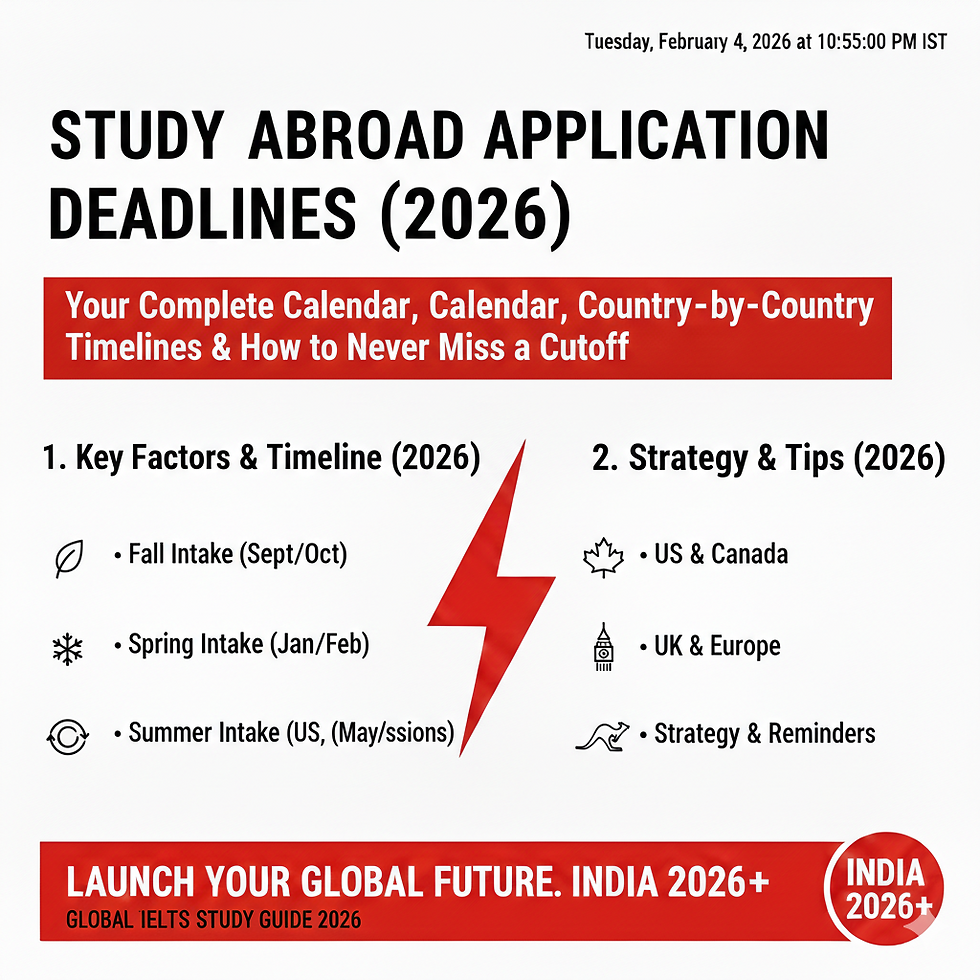
Most students aiming for a September/February intake should start 10–12 months in advance. Canada and the UK’s main (Fall) intakes require early-year applications (Dec–Mar deadlines for many programs). Australia often runs Feb and Jul intakes — check program pages. Always confirm each university’s deadline and plan visa time (IRCC, UKVI, Home Affairs processing times vary).
Scholarships & funding (2026 updates)
Scholarships are competitive but available. Examples and routes:
University scholarships: Many universities offer merit scholarships for high-achieving school leavers.
Country/External scholarships: Government and international scholarships (e.g., scholarships by specific universities, New Zealand/Australia awards, or targeted India-UK Commonwealth schemes at postgraduate level). University of Auckland’s India High Achievers Scholarship is a recent example for 2026 (up to NZD 20,000).
Need-based / private scholarships: Foundations and NGOs sometimes fund exceptional students.
Action: apply early and separately for scholarships (many close before final admissions decisions). Use university portals and scholarship databases.
Step-by-step plan: how to apply for study abroad after 12th science
Decide field & shortlist countries (Month 1–2)— Choose between engineering, pure sciences, computing, medical/paramedical or interdisciplinary STEM. Consider language, cost, and long-term plans.
Research universities & programs (Month 2–3)— Shortlist 6–10 universities across safety/match/reach tiers; check program eligibility, intakes, fees, and scholarship pages.
Register & prepare tests (Month 3–6)— Book IELTS/TOEFL (allow retake), SAT/ACT/GRE where required. Plan for 6–8 weeks of preparation; many students take mock tests.
Collect documents & request LORs (Month 4–7)— Secure original transcripts, teacher recommendations, passport, and draft SOP/CV. For engineering, include project summaries.
Apply (Month 6–10)— Submit applications early for priority consideration and scholarships (main intake deadlines often sit 10–12 months before course start).
Accept offer & apply for visa (Month 9–12)— After offer and scholarship decisions, arrange finances, get domicile/loan sanction letters, and apply for your student visa. Start visa application as soon as you get I-20/CAS/Letter of Offer.
Pre-departure (final 2 months)— Book flights, arrange accommodation, buy insurance, and attend pre-departure orientation.
Which route is best for MBBS / medicine aspirants?
MBBS after 12th science is available abroad (Russia, Kazakhstan, Kyrgyzstan, some Eastern Europe countries). But in 2026 you must be extra cautious: check recognition by India’s National Medical Commission (NMC) or the destination’s licensing body, safety records, and student welfare reports. Some destinations have seen welfare concerns — always verify credentials, campus safety, and language of instruction (many MBBS are in English but clinical years may require local language). If your goal is to practice in India, check the NMC/FMGE/NExT recognition route before committing.
Quick comparison table — good fits by student profile
Student profile | Good country fits |
Cost-sensitive, strong academics | Germany, Canada (public colleges/universities) |
Want PR & easy work | Canada, Australia, New Zealand |
Top-rank research + internships | USA, UK |
Fast, structured engineering degrees | Germany (TU), Netherlands (HBO/WO) |
FAQ — focused on the core question
Q1: Is it a good idea to study abroad after 12th science instead of doing an Indian engineering entrance?
A1: Yes — if you want early international exposure, diverse pedagogy, and internship chances. Weigh costs and recognition: for some regulated professions (medicine, law), check licensing in India before choosing. Scholarships, work rights and PR pathways (e.g., Canada) can offset costs for many students.
Q2: Which tests do I absolutely need after 12th science?
A2: English proficiency (IELTS/TOEFL/PTE) is standard. SAT/ACT may be needed for US undergraduate study; many Canadian/UK universities accept Class 12 scores instead but check each program. Some destinations also accept test-waivers based on strong school performance.
Q3: Can I get scholarships straight after 12th?
A3: Yes — many universities offer merit scholarships to school leavers; some external scholarships exist too. Apply early and meet scholarship deadlines (often earlier than admissions). See recent institutional scholarships (e.g., University of Auckland’s India High Achievers Award).
Safety, accreditation & common pitfalls
Verify university accreditation with official government/university bodies.
Check professional recognition for regulated degrees (MBBS, pharmacy, nursing).
Watch for last-minute “cheap” offers or unaccredited private providers. Read student reviews and embassy advisories. Recent reporting shows welfare concerns for students in some countries — pick well-ranked, transparent institutions and connect with alumni or student groups if possible. (Search local news and embassy updates for your target destination.)
Final checklist — ready to apply
Shortlist 6–10 universities (reach/match/safety) ✔
Register language/tests and schedule retakes if needed ✔
Draft SOP, get 2–3 LORs ✔
Prepare bank statements/loan sanction letters for visa ✔
Apply for scholarships & check deadlines ✔
Save timelines for intakes & visa processing ✔
Call to action — start your journey (official resources & next step)
Ready to move from “thinking” to “applying”? Start here:
Country trends & top destinations: Avanse 2026 country guide.
Costs & budgets: country cost comparisons (2026 numbers).
Intake & application timing (Canada examples): IDP / Credila intake pages.
Scholarships & recent awards: University of Auckland India High Achievers Scholarship (2026).


Comments