10 Proven Tips to Master NCERT Textbooks Fast for 2026 Exams
- 4 days ago
- 5 min read
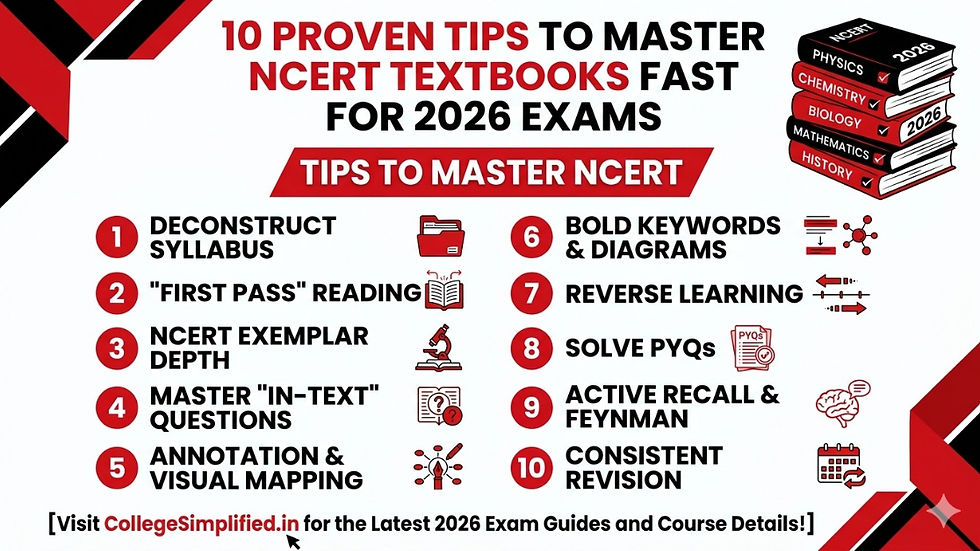
INTRODUCTION
Mastering the National Council of Educational Research and Training (NCERT) textbooks is the fundamental pillar for cracking any major academic or competitive milestone in India. Whether you are appearing for the CBSE Class 10 or 12 Board Exams, JEE, NEET, or UPSC 2026, these books serve as the definitive source of truth. However, with a vast syllabus to cover, students often struggle with speed and retention.
If you want to finish your syllabus early without compromising on depth, you need a strategic approach. Here are the top 10 expert tips to master NCERT quickly while ensuring 100% conceptual clarity for the 2026 academic cycle.
Why NCERTs are Mandatory for 2026 Exams
Before diving into the "how," it is vital to understand the "why." In 2026, exam patterns continue to shift toward competency-based questions. The NTA and CBSE have increasingly relied on the line-by-line logic found in NCERTs to frame assertion-reasoning and case-study questions. Mastering these texts isn't just about reading; it's about decoding the language used by paper-setters.
1. Deconstruct the Syllabus First
Before opening Chapter 1, align your NCERT reading with the latest 2026 syllabus. The curriculum often undergoes rationalization, where certain chapters or topics are dropped to reduce the content load.
Action: Cross-reference your textbook index with the official 2026 circulars from CBSE or relevant exam authorities.
Benefit: You avoid wasting hours on deleted topics, saving significant time.
2. The "First Pass" Reading Technique
Don’t try to memorize everything in the first go. Treat the first reading like a storybook. Focus on understanding the narrative and the flow of concepts.
Tip: Read the "Introduction" and "Summary" of the chapter first. This gives your brain a roadmap of what to expect.
3. Leverage NCERT Exemplar for Depth
For subjects like Physics, Chemistry, and Mathematics, the standard textbook is only half the battle. The NCERT Exemplar contains higher-order thinking skills (HOTS) questions that are frequently mirrored in competitive exams.
Strategy: After finishing a chapter, solve at least five Exemplar problems to test if you’ve truly mastered the core concepts.
4. Master the "In-Text" Questions
Most students skip the blue-box questions or the small queries scattered within the chapters. For the 2026 exams, these are goldmines. They are designed to check if you understood the paragraph you just read.
Key Tip: If you can’t answer an in-text question, do not move to the next page.
5. Annotate and Use Visual Mapping
NCERT margins are perfect for "micro-notes." Instead of maintaining separate bulky notebooks, write definitions, formula derivations, or mnemonics directly next to the relevant paragraph.
Visual Aid: Create a quick flowchart for processes like the Water Cycle or Reactions in Organic Chemistry directly on the page.
Looking for specific course breakdowns? Check out our detailed guide on MPSC Syllabus and Course Structure 2026 to see how NCERTs fit into state-level preparation.
6. Focus on Bold Keywords and Diagrams
NCERT textbooks are written with extreme precision. Words in bold or italics are usually the technical terms required to score marks in board exams.
Diagrams: In Biology and Geography, the diagrams are not just illustrations—they are potential questions. Practice labeling them until you can draw them from memory.
7. The Reverse Learning Method (Back-to-Front)
If you are short on time, try the reverse method. Read the exercise questions at the end of the chapter first. This primes your mind to look for specific "answers" while you are reading the text. This is one of the most effective tips to master NCERT for students aiming for quick revision.
8. Solve Previous Year Questions (PYQs) Simultaneously
As you finish a unit, look at how that specific unit was tested in 2024 and 2025. This helps you identify "High-Yield" areas—sections of the NCERT that the examiners
love to revisit every year.
9. Active Recall and Feynman Technique
After finishing a section, close the book and explain the concept out loud as if you are teaching a friend. If you stumble, your "mastery" is incomplete. Go back and re-read the specific sub-topic.
10. Consistent Revision Cycles
The human brain forgets 70% of new information within 24 hours. Use the 1-7-30 Rule:
Revise the chapter after 1 day.
Review it again after 7 days.
Do a final sweep after 30 days.
Effective Tips to Master NCERT: Course vs. Stream Selection
When choosing your stream (Science, Commerce, or Arts) for 2026, your comfort level with NCERTs is a great litmus test.
Science Stream: Focuses heavily on NCERT Physics, Chemistry, and Biology/Maths.
Commerce Stream: Relies on NCERT Accountancy and Business Studies.
Humanities: Requires deep reading of History, Pol Science, and Geography NCERTs.
Understanding the structure of these courses helps you decide which path aligns with your learning style.
Pro Tip: Not sure which stream to pick? Visit CollegeSimplified.in for a comprehensive breakdown of 2026 course details and stream-specific NCERT requirements.
FAQ: Tips to Master NCERT Textbooks for 2026
Q1: What are the best tips to master NCERT for competitive exams like NEET 2026?
A1: The best tips to master NCERT for NEET involve a line-by-line reading of Biology. Every caption under a diagram and every summary point is a potential MCQ. For Chemistry, focus on the "In-text" solved examples.
Q2: Is it possible to master NCERT textbooks in 3 months?
A2: Yes, by using the 80/20 rule. Focus on the chapters that carry the most weightage. Using tips to master NCERT like active recall and skipping deleted 2026 syllabus topics will help you finish within 90 days.
Q3: Should I buy side books or are these tips to master NCERT enough?
A3: For 2026 exams, NCERT should be your primary source. Side books should only be used for extra practice after you have used these tips to master NCERT to finish the base textbooks completely.
Q4: How many times should I read the book to say I have mastered NCERT?
A4: Most toppers suggest at least 3 to 4 thorough readings. The first is for understanding, the second for highlighting, and the third for memorizing keywords using our recommended tips to master NCERT.
Q5: Can I rely on online notes instead of the actual book?
A5: While notes are helpful for revision, the actual language of the exam often mimics the textbook. One of the most critical tips to master NCERT is to read the original text at least twice before switching to summary notes.
Conclusion
Mastering NCERT is not about rote learning; it’s about strategic engagement with the content. By aligning your study plan with the 2026 exam patterns, focusing on diagrams, and utilizing active recall, you can significantly reduce your study time while increasing your marks.
Ready to take the next step in your academic journey?
Whether you are looking for detailed course information or stream-specific guidance for the upcoming session, we’ve got you covered.


Comments