Agentic AI in Engineering: NIAT 2026 Course Syllabus and Stream Specializations
- Apr 23
- 4 min read
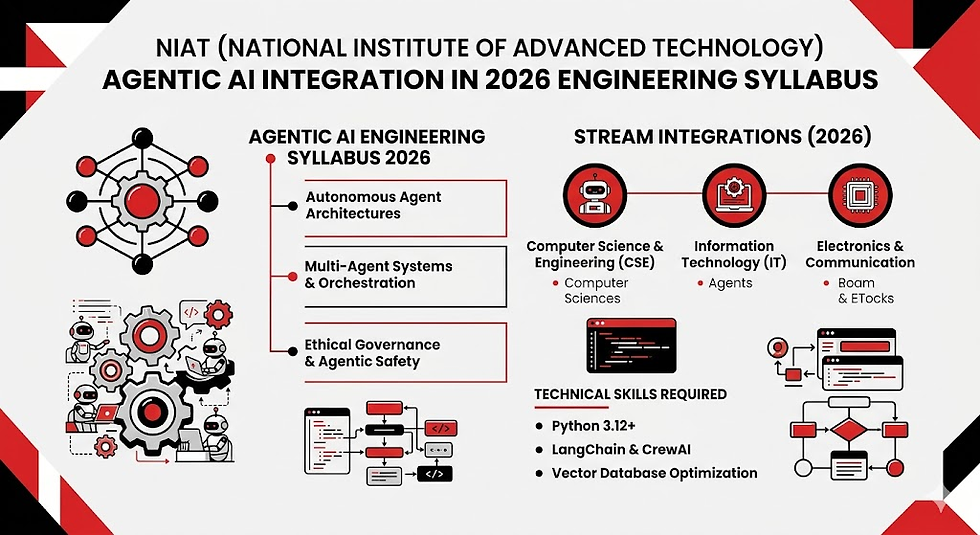
The academic landscape of 2026 has shifted from teaching students how to code AI to teaching them how to architect Agentic AI. At the forefront of this transition is the National Institute of Advanced Technology (NIAT). As engineering disciplines evolve, the integration of autonomous, goal-oriented systems has become the backbone of the modern curriculum.
For students looking to stay ahead, understanding the Agentic AI Engineering Syllabus 2026 is no longer optional—it is the new standard for technical excellence.
The Evolution of Curriculum: Why Agentic AI in 2026?
Traditional AI education focused heavily on "Generative" models—systems that respond to prompts. However, 2026 marks the era of "Agentic" systems that don't just generate; they act. NIAT has recognized that engineering students must master the loop of perception, reasoning, and action.
The Agentic AI Engineering Syllabus 2026 at NIAT is designed to move beyond static machine learning. It introduces students to frameworks where AI agents can browse the web, use software tools, and collaborate with other agents to solve complex engineering bottlenecks without constant human intervention.
Apply Now for NIAT 2026: Click here to access the NIAT Exam Application (Use Code: NIATCS400)
Detailed Breakdown of the Agentic AI Engineering Syllabus 2026
NIAT’s integration of Agentic AI is categorized into core modules that span across Computer Science, Information Technology, and specialized AI streams.
1. Autonomous Agent Architectures
This module forms the heart of the 2026 curriculum. Students deep-dive into the "Brain" of the agent.
Reasoning Frameworks: Implementation of Chain-of-Thought (CoT) and ReAct (Reason + Act) patterns.
Memory Management: Learning how to give agents long-term memory using Vector Databases and RAG (Retrieval-Augmented Generation).
Planning Algorithms: Developing agents that can break down a 10-step engineering task into sub-goals.
2. Multi-Agent Systems (MAS) and Orchestration
In the 2026 stream, the focus is on collaboration. Students learn to build "swarms" of agents.
Agent Communication Protocols: How different AI agents exchange data securely.
Conflict Resolution: Algorithms that manage differing outputs from multiple autonomous agents.
Tool Use (Function Calling): Teaching agents to interact with external APIs, CAD software, and compilers.
3. Ethical Governance and Agentic Safety
As agents gain autonomy, safety becomes a primary engineering constraint.
Agentic Constraints: Programming "guardrails" to prevent autonomous loops.
Transparency Logs: Auditing why an agent took a specific action in a live environment.
Stream-Specific Integration: How Branches are Changing
The Agentic AI Engineering Syllabus 2026 is not limited to just one department. NIAT has infused these concepts into various streams:
Computer Science & Engineering (CSE)
The CSE stream focuses on the Development of agentic frameworks. Students work on building custom LLM-based agents that can perform automated debugging and continuous integration (CI/CD) tasks autonomously.
Information Technology (IT)
The IT stream emphasizes Deployment and Scaling. The syllabus includes "AgentOps"—a new discipline focused on monitoring, rate-limiting, and managing the lifecycle of AI agents in cloud environments.
Electronics & Communication
In this stream, Agentic AI is integrated into Edge Computing. Students learn to deploy lightweight agents directly onto hardware sensors that can make autonomous decisions in IoT networks.
Technical Skills Required for NIAT 2026
To excel in the updated syllabus, students are expected to gain proficiency in:
Python 3.12+ and advanced asynchronous programming.
LangChain & CrewAI: The industry-standard frameworks for agent orchestration.
Vector Database Optimization: Handling high-dimensional data for agent memory.
Admission Alert: To secure your seat in these advanced streams, ensure you complete your registration. Visit the NIAT 2026 Official Application Portal.
Comparative Analysis: 2025 vs. 2026 Syllabus
Feature | 2025 AI Syllabus | 2026 Agentic AI Syllabus |
Primary Goal | Content Generation | Autonomous Task Execution |
Interaction | Chat-based / Passive | Action-based / Proactive |
Key Tool | Simple Prompting | Multi-Agent Orchestration |
Project Focus | Chatbots & Image Gen | Autonomous Dev-Agents |
Frequently Asked Questions (FAQ)
What is the core focus of the Agentic AI Engineering Syllabus 2026?
The core focus of the Agentic AI Engineering Syllabus 2026 is to transition from passive AI models to active autonomous agents. It covers the design, reasoning, and tool-integration of AI systems that can execute multi-step engineering tasks independently.
Are there specific prerequisites for the Agentic AI Engineering Syllabus 2026?
Yes, the Agentic AI Engineering Syllabus 2026 requires a strong foundation in Data Structures, Algorithms, and Python. NIAT also recommends a basic understanding of Large Language Models (LLMs) before entering the advanced modules.
How does NIAT evaluate students on the Agentic AI Engineering Syllabus 2026?
NIAT uses a project-based evaluation for the Agentic AI Engineering Syllabus 2026. Students must build a "Functional Agentic System" that can solve a real-world technical problem, such as an autonomous code-reviewer or a self-healing network agent.
Which engineering streams include the Agentic AI Engineering Syllabus 2026?
While primarily centered in Computer Science and IT, the Agentic AI Engineering Syllabus 2026 is also integrated as a minor or elective in Electronics, Mechatronics, and Data Science streams at NIAT.
Is the Agentic AI Engineering Syllabus 2026 updated for the latest industry tools?
Absolutely. The Agentic AI Engineering Syllabus 2026 is updated semi-annually to include the latest advancements in frameworks like AutoGPT, LangGraph, and specialized Agentic safety protocols.
Conclusion
The shift towards Agentic AI represents a fundamental change in how engineering is taught and practiced. The National Institute of Advanced Technology (NIAT) has set a benchmark with its 2026 curriculum, ensuring that students are not just users of AI, but the architects of autonomous systems. By mastering the Agentic AI Engineering Syllabus 2026, future engineers will be equipped to lead the next wave of technological innovation.
For more detailed guides on engineering entrance exams and syllabus breakdowns, stay tuned to collegesimplified.in.
CTA
Ready to Start Your Journey?
Don't miss the opportunity to join the most advanced engineering cohort of the year.
Apply for NIAT 2026: Direct Application Link
Final Call: Register for NIAT Exam 2026 here.


Comments