BAN vs ZIM Pitch Analysis: Batting or Bowling-Friendly?
- Jul 17
- 5 min read
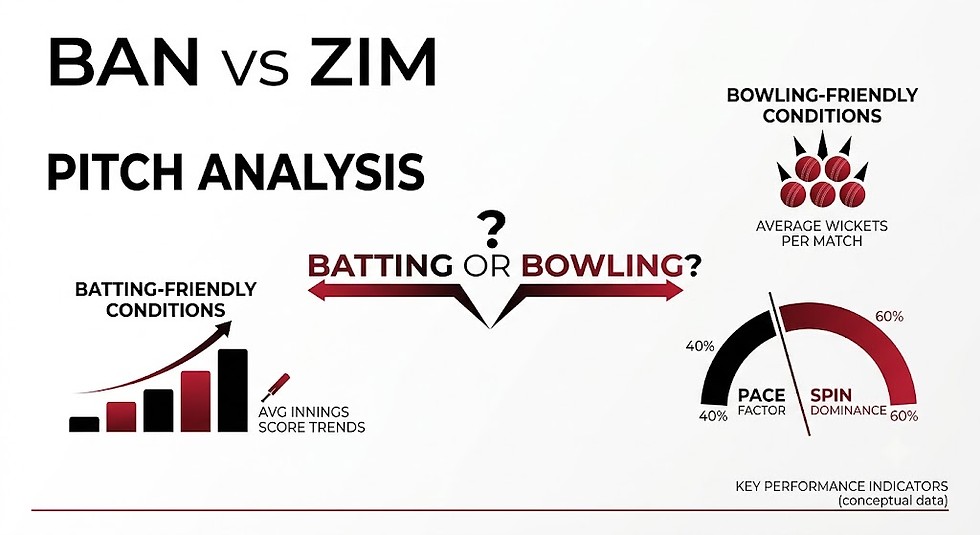
When Bangladesh and Zimbabwe clash on the cricket field, tactical masterclasses are won or lost long before the first ball is bowled. The determining factor is almost always hidden beneath the surface of the 22 yards. For passionate cricket analysts and fantasy managers, deciphering a BAN vs ZIM pitch analysis is the ultimate key to predicting match outcomes.
In this comprehensive tactical breakdown updated with international metrics from the 2026 season, we examine whether these matchups lean toward high-scoring batting paradises or defensive bowling battlefields. By analyzing historical statistics, venue dynamics, and real-time performance curves, you will gain a definitive edge in understanding this fascinating rivalry.
The Core Question: Batting or Bowling-Friendly?
To answer whether Bangladesh vs. Zimbabwe surfaces favor the bat or the ball, we have to look closely at geography. Because these two teams play extensively in distinct conditions—the subcontinental tracks of Bangladesh and the hard, high-bounce pitches of Zimbabwe—the nature of the pitch completely transforms depending on who is hosting.
The Subcontinental Reality: A Spinner’s Paradise
When matches take place in Bangladesh, the surface heavily favors bowlers, specifically slow left-arm and off-spin maestros. Venues like the newly renamed Bir Shreshtho Flight Lieutenant Matiur Rahman Cricket Stadium (formerly Zohur Ahmed Chowdhury Stadium in Chattogram) and Dhaka's iconic Mirpur strip inherently offer low bounce, slow pace, and significant turn as the game progresses. Batting first here is a game of patience rather than brute force.
The African Terrain: True Bounce and Pace Acceleration
Conversely, when the rivalry shifts to grounds like the Harare Sports Club or Queen’s Sports Club in Bulawayo, the script flips completely. These surfaces are traditionally much more balanced to batting-friendly. The red clay soil provides consistent carry, allowing top-order stroke-makers to trust the bounce and play through the line. However, fast bowlers who hit the deck hard find significant reward early on.
Key Venue Breakdown: Where the Battle is Won
Let's look at the data across the primary stadiums where these two nations face off. The surface variations dictate exact team selections and tactical approaches.
1. Sher-e-Bangla National Cricket Stadium (Dhaka)
Known across the cricketing world as a spin trap, Mirpur is famously difficult for aggressive white-ball batters.
Average 1st Innings Score (T20I): 139 runs
Pitch Behavior: Highly spin-friendly, slow surface, medium boundaries (63–70 meters).
Tactical Insight: The ball grips and turns fiercely in the middle overs. Teams batting first look to maximize the powerplay before the surface slows down, though heavy evening dew can throw a lifeline to chasing teams in night fixtures.
2. Bir Shreshtho Flight Lieutenant Matiur Rahman Cricket Stadium (Chattogram)
Historically known for producing flatter wickets initially, this venue has evolved into a balanced yet spin-heavy asset for the hosts.
Pitch Behavior: Good for batting on Days 1 and 2 of a Test, but deteriorates rapidly into a dustbowl by Day 4. In limited-overs formats, it requires smart accumulation rather than blind hitting.
2025/2026 Precedent: During their recent bilateral cycles, spinners from both sides extracted dramatic turn here, with finger spinners dominating the wickets columns.
3. Harare Sports Club (Harare)
Zimbabwe’s premium international venue offers a refreshing contrast to subcontinental dry patches.
Average 1st Innings Score (ODI): 240–260 runs
Pitch Behavior: True bounce, excellent outfield speed, and early assistance for swing bowlers.
Tactical Insight: The pitch remains uniform across both innings. Batters who successfully navigate the first 10 overs against the moving new ball can score freely across the ground.
Head-to-Head Statistics & Pitch Trends (2025–2026)
Recent international fixtures between Bangladesh and Zimbabwe highlight how drastically the location impacts performance.
Venue Location | Format | Average Innings Score | Primary Dominant Discipline | Tactical Recommendation |
Bangladesh (Home) | Test / ODI | 210 – 245 | Slow Left-Arm & Off-Spin | Accumulate early; pack the side with spin options. |
Zimbabwe (Home) | Test / ODI | 260 – 310 | Express Pace & Top-Order Batting | Heavy focus on swing bowlers and anchor batters. |
In the mid-2026 multi-format series played in Zimbabwe, the hosts capitalized heavily on their home deck advantages, securing an emphatic Test victory at Harare and taking the ODI leg 2–1 by exploiting high-bounce tracks that exposed technical subcontinental flaws. Conversely, when Zimbabwe traveled to Bangladesh in the preceding period, the turning tracks allowed operators like Mehidy Hasan Miraz to control the game rhythm effortlessly.
Tactical Fantasy Cricket Tips for BAN vs ZIM
If you are setting up fantasy lineups or analyzing upcoming match dynamics, apply this strategic checklist based on our BAN vs ZIM pitch analysis:
The Toss Factor: On subcontinental pitches, look to back the team batting first in ODIs to avoid a crumbling pitch later in the afternoon. In African conditions, chasing under clear skies is highly viable due to the structural integrity of the pitch remaining intact.
Selection Priority: Always choose premium all-rounders who bowl their full allocation of overs. Players who manipulate pace off the ball are incredibly valuable on slower tracks.
Powerplay Valuation: On high-bounce wickets, top-order batters hold maximum fantasy value. On turning tracks, drop middle-order anchors in favor of spin-bowling match-winners.
Frequently Asked Questions (FAQs)
Is the Mirpur pitch batting or bowling-friendly?
The pitch at the Sher-e-Bangla National Stadium in Mirpur is historically bowling-friendly, specifically prioritizing spin bowlers. The surface is naturally slow with a lower bounce, making it tough for incoming batters to hit big shots immediately.
How does the BAN vs ZIM pitch analysis vary by country?
A definitive BAN vs ZIM pitch analysis shows that games played in Bangladesh heavily favor slow, spin-friendly bowling tactics. Meanwhile, games held at venues across Zimbabwe offer truer bounce, giving pace bowlers early movement and rewarding technically sound batters once the ball softens.
What is a good competitive score at Chattogram?
In T20Is, a score of 160+ is highly competitive, whereas in ODIs, a first-innings total mapping around 265–280 allows defending teams to control the match using variable turn during the second half of the game.
Does dew impact pitch conditions in Bangladesh?
Yes, dramatically. During day-night white-ball matches, significant evening dew frequently coats the outfield. This makes the ball slick and difficult for spinners to grip, shifting the advantage back to the chasing side during the second innings.
Elevate Your Cricket Analytics Strategy
Navigating pitch metrics requires access to real-time data, expert structural mapping, and breaking team updates. Don't leave your match predictions or fantasy selections to guesswork. Stay ahead of the curve by leveraging professional resources designed to elevate your tactical game.
Get deep-dive stadium data and direct live match commentaries on the official ICC Match Centre.
Access real-time scorecards, local weather indicators, and live multi-format tracking directly via ESPNcricinfo.
Review comprehensive athletic updates and tour schedules via the Bangladesh Cricket Board (BCB).


Comments