Best Board After Class 10 for NEET 2026: A Comprehensive Comparison
- Jan 15
- 4 min read
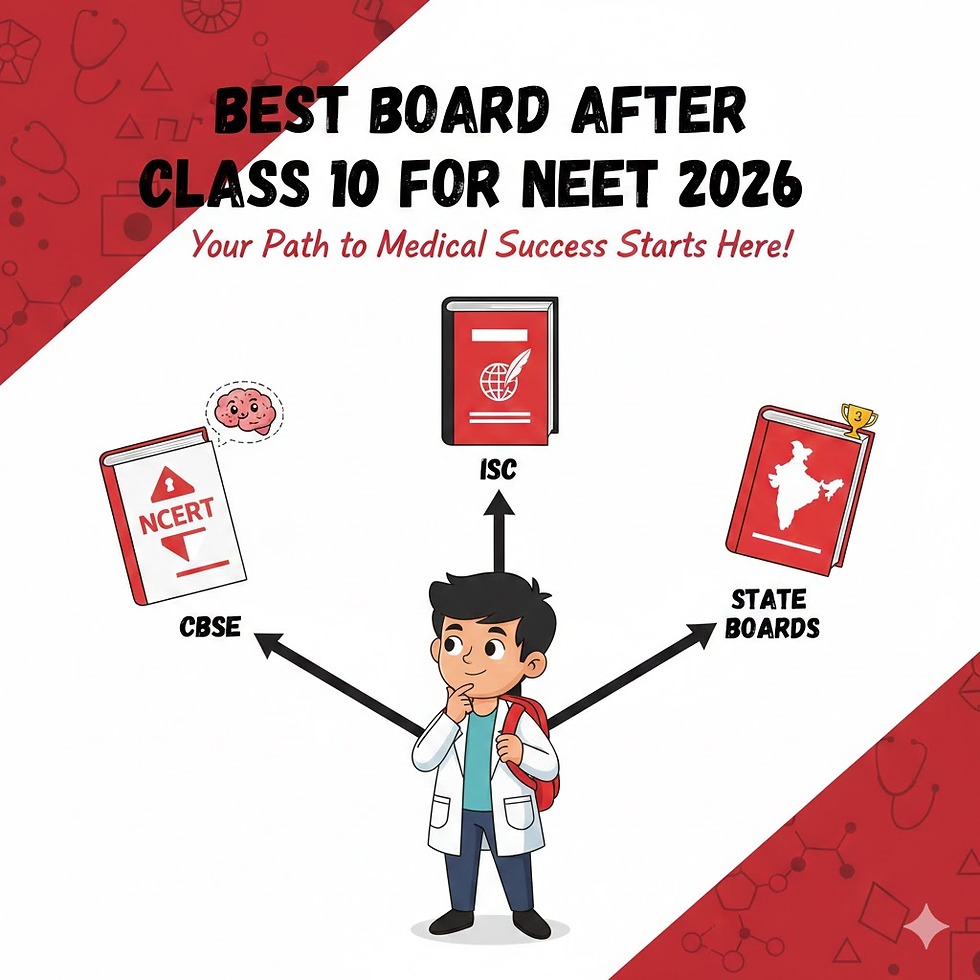
Deciding the best board after Class 10 is the first official step in your medical career. With over 25 lakh students expected to appear for NEET 2026, the competition is at an all-time high. The National Testing Agency (NTA) and National Medical Commission (NMC) have standardized the exam, making your choice of board a strategic decision rather than just an academic one.
In this article, we will break down the pros and cons of CBSE, ICSE, and various State Boards to help you identify which one aligns best with your NEET goals.
Latest NEET 2026 UpdatesExam Date: Tentatively scheduled for the first Sunday of May 2026.Syllabus: Strictly based on the rationalized NCERT curriculum (Class 11 & 12).Application Mode: Online via the official NTA portal.Eligibility: Candidates must have completed Class 12 with Physics, Chemistry, Biology/Biotechnology, and English.
Importance of Choosing the Best Board After Class 10
The best board after Class 10 for a medical aspirant is defined by one core factor: Syllabus Overlap. NEET is a marathon of 200 minutes where you solve 180 questions out of 200. The questions are conceptual and derived directly from the lines of the NCERT textbooks. If your school board teaches from different books or follows a vastly different exam pattern, you will be forced to study "double"—once for your school and once for your entrance exam.
1. CBSE: The NCERT Advantage
The Central Board of Secondary Education (CBSE) remains the top recommendation for most medical aspirants.
Why CBSE is favored for NEET:
Direct Alignment: Since NTA uses NCERT books as the primary source for NEET questions, CBSE students have a natural "home-ground" advantage.
Logical Marking Scheme: CBSE exams focus on step-marking and conceptual clarity, which builds the foundation for solving MCQs.
National Uniformity: No matter where you move in India, the CBSE syllabus remains consistent, making it easier for students who attend national-level coaching institutes.
Focus on Science: The board has significantly reduced the weightage of rote learning, shifting toward "Case-Based Questions," which mimic the complexity of NEET.
2. ICSE/ISC: Rigor vs. Relevance
The Council for the Indian School Certificate Examinations (CISCE) offers the ISC (Class 12) curriculum. While intellectually stimulating, it is often considered a "heavier" path for NEET.
Key Considerations:
Depth of Content: ISC Biology and Physics go much deeper than NCERT. While this helps in building a brilliant "Doctor’s mindset," it can sometimes distract from the specific facts required for NEET.
Language Proficiency: If you aim to take the USMLE or PLAB later to practice medicine abroad, the English standard of ISC is unmatched.
Time Management: ISC students often struggle with the sheer volume of lab work and projects, leaving less time for dedicated NEET mock tests.
3. State Boards: Flexibility and Local Quotas
State boards like Maharashtra (HSC), Karnataka (PUC), and Telangana (BIE) are the choice of many toppers who prefer a "Coaching-First" approach.
The Strategic Benefits:
Integrated Coaching: Many state board schools offer "Integrated Programs" where NEET coaching is part of the school day.
State Quota: Staying in your state board makes the process of claiming the 85% State Quota seats in government colleges much simpler during counseling.
Reduced Pressure: Traditionally, state board exams are perceived to be slightly less demanding than ISC or CBSE, allowing students more energy for entrance preparation.
Curriculum Shift: By 2026, almost all major state boards have shifted their Science and Math textbooks to the NCERT format to level the playing field.
Comparative Analysis: Best Board After Class 10
Feature | CBSE | ISC | State Boards |
Primary Textbook | NCERT (Strictly) | ISC Prescribed Books | State Textbooks / NCERT |
NEET Syllabus Match | 100% | 85-90% | 90-95% |
Difficulty Level | Moderate | High | Easy to Moderate |
Preparation Time | High (Efficient) | Low (Vast syllabus) | Very High (Flexible) |
Scoring Potential | High | Moderate | Very High |
Expert Preparation Strategy for 2026
Success in NEET 2026 isn't just about the board; it's about how you utilize it. Here is a year-wise roadmap:
Class 11
Physics: Focus on Mechanics and Thermodynamics. These are the "rank-maker" topics.
Chemistry: Master the Mole Concept and Chemical Bonding.
Biology: Don't just read NCERT; memorize the diagrams and examples.
Class 12
Integration: Map your school chapters with your NEET coaching schedule.
Mock Tests: By October 2025, you should be appearing for at least one full-length mock test every 15 days.
Previous Year Papers: Solve the last 15 years of NEET and AIPMT papers.
Frequently Asked Questions (FAQs)
Q1. Which is the best board after Class 10 for NEET 2026?
Ans: Based on current exam trends and syllabus alignment, CBSE is considered the best board after Class 10 for NEET. Its curriculum is based on NCERT, which is exactly what the NEET 2026 exam will be based on.
Q2. Is NCERT enough for NEET Biology?
Ans: For 2026, NCERT Biology is like a "Bible." Approximately 95% of questions are directly from NCERT. However, for Physics and Chemistry, you may need additional practice for numerical problems and advanced reactions.
Q3. Can a State Board student get an All India Rank (AIR) 1?
Ans: Yes! In recent years, several NEET toppers have come from state boards like Tamil Nadu and Maharashtra. The key is to use NCERT books alongside your state board books.
Q4. Does the board choice affect MBBS admission?
Ans: Indirectly, yes. Your board percentage is usually just an eligibility criterion (50% for General category), but your NEET score is what gets you the seat. Choosing a board that allows you more study time is always a benefit.
Conclusion:
There is no "one-size-fits-all" answer to which board is best for NEET after Class 10.
Choose CBSE if you want a balanced, national curriculum.
Choose State Board if you are attending a high-intensity coaching program and need more time for self-study.
Choose ISC only if you are exceptionally strong in academics and want a more challenging school curriculum.
Regardless of your choice, remember that NEET is an NCERT-centric exam. Your board is the vehicle, but your hard work is the fuel.
CTA
Stay updated with the latest in nursing and healthcare! Explore more expert guides and exam tips. For More :


Comments