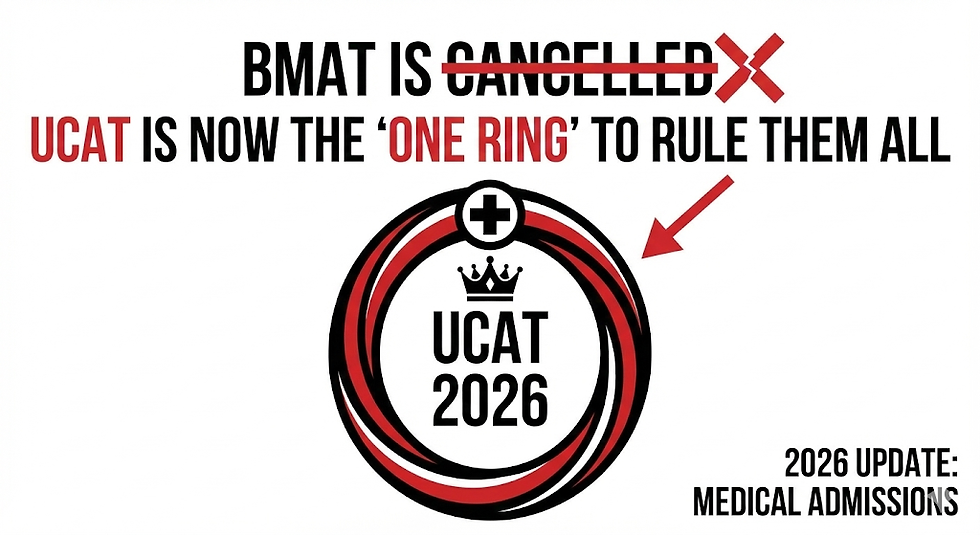
BMAT is Cancelled: Why UCAT is Now the "One Ring" to Rule Them All (2026 Update)
- Jan 5
- 4 min read
Introduction
If you are an Indian student planning to apply for MBBS in the UK for the 2026 intake, you might be looking for "BMAT coaching centers" or "Past BMAT papers."
Stop immediately.
The landscape of UK medical admissions has just gone through its biggest revolution in 20 years.
The BMAT is Dead: Cambridge Assessment has officially discontinued the Biomedical Admissions Test.
The UCAT has Changed: For the 2026 entry (testing in 2025), the UCAT is shifting to a new format with a maximum score of 2700 (down from 3600).
For over two decades, students had to choose: take the UCAT for most universities, or take the science-heavy BMAT for elite institutions like Oxford and Cambridge. For the 2026 Intake, that choice is gone.
In this guide, we break down why the UK medical school entrance exam 2026 landscape has shifted, exactly what the "New UCAT" looks like, and what score you now need to crack Oxford.
The Big Switch: Who Has Moved to UCAT?
Previously, the "Golden Triangle" universities required BMAT. Now, they have all adopted UCAT. This unifies the application process but raises the stakes.
University | Old Exam (Pre-2024) | New Exam (2026 Intake) |
University of Oxford | BMAT | UCAT |
University of Cambridge | BMAT | UCAT |
Imperial College London | BMAT | UCAT |
University College London (UCL) | BMAT | UCAT |
Leeds / Lancaster | BMAT | UCAT |
The Strategy Shift: You no longer need to study Physics or Biology for the entrance exam. However, since everyone is taking the same test, the competition for a high UCAT score will be fiercer than ever.
The "New" UCAT Format (2026 Entry)
Warning: Most older prep books are now wrong.
In previous years, the UCAT was scored out of 3600 (4 Cognitive Sections x 900).
For the 2026 intake cycle, the UCAT has removed the Abstract Reasoning section from the scoring, bringing the total max score to 2700.
The 4 Sections of the New UCAT
Verbal Reasoning (VR):
What it is: Speed reading. You have to read long passages and answer "True/False/Can't Tell" in seconds.
Why it's hard: It tests critical thinking, not just vocabulary.
Score: 300 - 900.
Decision Making (DM):
What it is: Logic puzzles, probability, and identifying assumptions.
Why it's hard: It’s like a rapid-fire IQ test.
Score: 300 - 900.
Quantitative Reasoning (QR):
What it is: Mental Maths. Percentages, ratios, and data interpretation.
Why it's hard: The math is Class 10 level, but you have less than 40 seconds per question.
Score: 300 - 900.
Situational Judgement (SJT):
What it is: Medical ethics scenarios.
Score: Band 1 (High) to Band 4 (Low). This is scored separately and is critical for universities like Edinburgh and Nottingham.
Total Score: 900 – 2700.
What is a "Good" UCAT Score Now? (2700 Scale)
Since the total has dropped, you cannot compare your mock scores to last year's 3000+ scores.
Target University | Estimated Competitive Score (New Scale / 2700) |
Oxford / Cambridge | 2250+ (Top 10%) |
Imperial / UCL | 2200+ |
King's / Bristol | 2100 - 2200 |
Liverpool / Plymouth | 1900 - 2100 |
Pro Tip: Oxford has stated they will weight the UCAT heavily for shortlisting interviews. If you score below 2100, your chances for the "Golden Triangle" drop significantly, regardless of your school grades.
Preparation Timeline for Indian Students (2026 Entry)
The timeline is aggressive. You must sit the test before applying.
Jan - April 2025: Start "slow prep." Familiarize yourself with question types. Work on mental maths speed.
May 2025: Booking Opens. Book your slot immediately for July/August.
June - July 2025: Intense Prep. Take 1 full mock test every 3 days. Analyze your weak sections.
July - Sept 2025: Testing Window. Sit the exam at a Pearson VUE center in India.
October 15, 2025: UCAS Deadline. Submit your application to 4 medical schools.
Common Myths vs. Reality
Myth 1: "I need 98% in CBSE/ISC to offset a bad UCAT."
Reality: False. For universities like Newcastle and Bristol, the UCAT is a "Gatekeeper." If you don't meet the cutoff, your application is rejected by the computer before a human even reads your 98% marks.
Myth 2: "I can take the UCAT in January."
Reality: No. The UCAT testing window closes in late September. If you miss it, you cannot apply for Medicine that year. There is no "Winter Sitting."
Myth 3: "SJT doesn't matter, it's just bands."
Reality: Many universities (like Imperial) will automatically reject anyone with Band 4, even if they have a perfect cognitive score. Always aim for Band 1 or 2.
FAQs for Indian Aspirants
Q1. Does AIIMS or NEET accept UCAT?
Ans: No. UCAT is strictly for UK, Australian, and New Zealand medical schools. You still need NEET to study in India.
Q2. Is UCAT harder than BMAT?
Ans: It is different. BMAT tested knowledge (Physics/Biology). UCAT tests speed and IQ. Most students find UCAT more stressful due to the time pressure (seconds per question), but less academically draining.
Q3. Can I use a calculator?
Ans: Yes, there is a simple on-screen calculator. However, using it slows you down. Top scorers do 80% of the math in their heads.
Q4. What if I get a low score?
Ans: You must apply strategically. Some universities (like Cardiff or Keele) place less weight on the UCAT and more on your personal statement and Class 10/12 grades. We help students choose the right universities based on their final score.
Conclusion
The cancellation of BMAT simplifies the process—you have one exam to focus on. But it also raises the stakes. You have one shot at the UCAT to impress Oxford, Imperial, and King's simultaneously.
Start preparing early. Since there is no "Science" to learn, your prep is purely about building cognitive speed and reflex.
Ready to Master the UCAT?
Visit College Simplified for more updates!


Comments