B.Sc Agriculture vs B.Tech Agriculture 2026: Detailed Course and Stream Guide
- Jan 24
- 4 min read
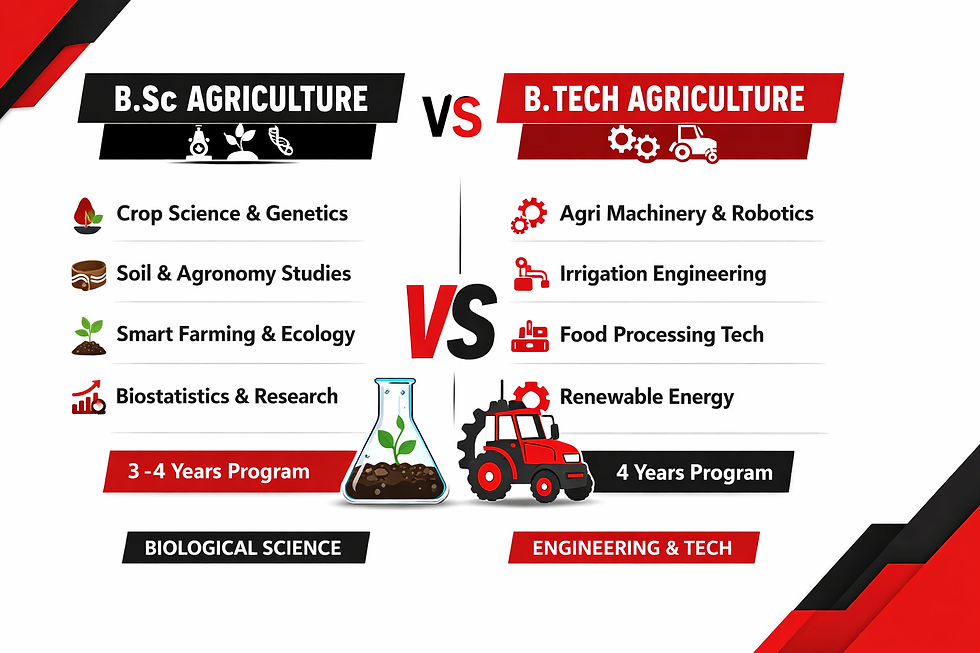
Choosing the right academic path in the agricultural sector has become a sophisticated decision in 2026. As the industry shifts toward "Agri-Tech" and sustainable "Bio-Sciences," the distinction between scientific study and engineering application is more prominent than ever. This guide provides a comprehensive breakdown of B.Sc Agriculture vs B.Tech Agriculture 2026 to help students navigate these two powerhouse streams.
Understanding the Academic Streams in 2026
The year 2026 marks a pivotal era where biological literacy and mechanical innovation must coexist. While both degrees fall under the broad umbrella of agricultural studies, they cater to entirely different mindsets.
What is B.Sc Agriculture?
The B.Sc Agriculture stream is a science-intensive undergraduate program. It focuses primarily on the biological and chemical aspects of farming. Students delve deep into crop physiology, soil chemistry, and plant genetics. In 2026, the curriculum has been updated to include "Smart Farming" modules that teach students how to manage natural resources using biological data.
What is B.Tech Agriculture (Agricultural Engineering)?
On the other hand, B.Tech Agriculture is an engineering discipline. It is for students who love mathematics, physics, and machinery. This stream focuses on the design and development of agricultural tools, irrigation systems, and post-harvest technology. It is less about "how plants grow" and more about "how to build the machines that help them grow efficiently."
B.Sc Agriculture vs B.Tech Agriculture 2026: Key Course Comparisons
When evaluating B.Sc Agriculture vs B.Tech Agriculture 2026, it is essential to look at the structural differences in the curriculum and eligibility.
Feature | B.Sc Agriculture (2026) | B.Tech Agriculture (2026) |
Focus Area | Biological Science & Research | Engineering & Tech Innovation |
Duration | 3 to 4 Years (NEP 2020) | 4 Years (8 Semesters) |
Core Subjects | Agronomy, Genetics, Entomology | Farm Power, Food Engineering, Robotics |
Math Requirement | Basic Biostatistics | Advanced Calculus & Physics |
Entrance Exams | CUET-UG, ICAR AIEEA, MP PAT | JEE Main, JEE Advanced, MHT CET |
Eligibility | 10+2 with PCB/PCM (50-60%) | 10+2 with PCM (60% Average) |
Pro Tip: Under the New Education Policy (NEP) 2020, many universities in 2026 now offer a 4-year B.Sc (Honours with Research). This path allows students to skip a Master's degree and head straight into a PhD if they maintain a 75% aggregate.
Detailed Syllabus & Subject Analysis
The academic rigors of these two courses vary significantly. If you prefer the laboratory and the field, B.Sc is your calling. If you prefer the workshop and the CAD (Computer-Aided Design) software, B.Tech is the way to go.
Core Subjects in B.Sc Agriculture
Agronomy & Crop Science: The study of soil management and crop production.
Plant Breeding: Using genetics to create resilient crop varieties.
Soil Microbiology: Understanding the living organisms within the soil.
Agricultural Economics: The business side of food production and distribution.
Core Subjects in B.Tech Agriculture
Farm Machinery & Power: Designing autonomous tractors and harvesters.
Irrigation & Drainage Engineering: Developing water-efficient systems like drip and sprinkler tech.
Food Processing Engineering: Technologies for preserving and packaging food.
Renewable Energy: Implementing solar and wind power in rural farm setups.
Related Academic Insights
If you are interested in the microscopic or molecular side of these sciences, you might also want to explore related fields.
Check out: BSc Microbiology Course Details 2026: Subjects, Eligibility & Admissions.
Read more: BSc Microbiology vs Biotechnology 2026: Detailed Course and Stream Guide for a deep dive into laboratory-based streams.
Admissions and Entrance Exams 2026
The admission landscape for B.Sc Agriculture vs B.Tech Agriculture 2026 has become more centralized.
For B.Sc Seekers: The CUET-UG is the primary gateway for Central Universities. However, state-level exams like UPCATET or OUAT remain critical for regional agricultural universities.
For B.Tech Seekers: Since this is an engineering degree, JEE Main is the gold standard. Many top-tier institutes, including certain IITs (like IIT Kharagpur), offer specialized B.Tech programs in Agricultural and Food Engineering.
Which Stream Should You Choose?
Deciding between these two depends on your academic strengths:
Choose B.Sc Agriculture if: You have a passion for biology, enjoy working with plants and soil, and are interested in research, sustainability, or agricultural consultancy.
Choose B.Tech Agriculture if: You are strong in Mathematics and Physics, love solving mechanical problems, and want to build the next generation of "Agri-Bots" or smart irrigation hardware.
Frequently Asked Questions (FAQs)
1. Which course has more mathematics, B.Sc or B.Tech?
B.Tech Agriculture involves significantly more mathematics, including calculus and mechanics, whereas B.Sc Agriculture focuses on basic biostatistics and data analysis.
2. Is 10+2 Biology mandatory for B.Sc Agriculture vs B.Tech Agriculture 2026?
For B.Sc Agriculture, Biology (PCB) is generally required, though some universities allow PCM. For B.Tech Agriculture, Physics, Chemistry, and Mathematics (PCM) are strictly mandatory.
3. Can I switch from B.Sc to B.Tech later?
No, these are distinct degrees. While some foundational subjects overlap, the technical engineering credits required for a B.Tech cannot be fulfilled within a B.Sc framework.
4. What is the duration of these courses in 2026?
B.Tech is a fixed 4-year program. B.Sc is typically 3 years, but most top universities now offer a 4-year "Honours with Research" track under the NEP guidelines.
Conclusion
Whether you choose the scientific depth of B.Sc or the technical innovation of B.Tech, the agriculture sector in 2026 offers a stable and evolving academic path. Both streams are essential for global food security and the modernization of rural economies.


Comments