CA Course Duration 2026: How Many Years and Attempts?
- Jan 19
- 4 min read

Entering the world of professional accountancy in 2026 means navigating a modernized, globally-aligned curriculum. The Institute of Chartered Accountants of India (ICAI) has fully implemented its New Scheme of Education and Training, which significantly impacts the CA course duration 2026. What was once a 5-year marathon has been refined into a high-intensity, 42-month journey for those who clear their levels systematically.
In 2026, the focus has shifted from mere rote learning to a "competency-based" model. This article breaks down the technical specifics of the levels, the revamped exam frequency, and the specific subject streams you will encounter.
Understanding the 42-Month Timeline in 2026
The CA course duration 2026 is structured to allow students to qualify in approximately 3.5 years (42 months) from the date of registration at the Foundation level. This timeline is achievable through the reduction of the mandatory articleship period and the introduction of more frequent examination windows.
Phase | Duration | Key Requirements |
CA Foundation | 4 Months | Minimum study period after Class 12. |
CA Intermediate | 8 Months | Study period after passing Foundation. |
Practical Training (Articleship) | 2 Years | Reduced from 3 years; begins after clearing both Inter groups. |
CA Final | 6 Months | Study period post-articleship completion. |
Stream-Wise Subject Breakdown: The 2026 Curriculum
The ICAI has reduced the total number of papers across the Intermediate and Final levels to ensure students can focus on core competencies. In 2026, the structure is as follows:
1. CA Foundation Level
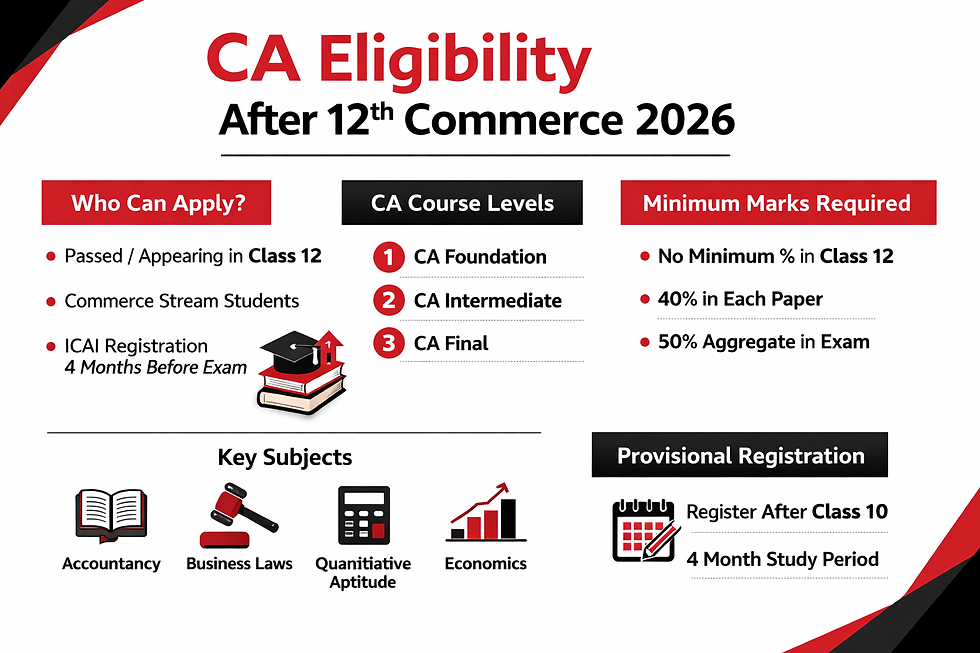
This entry-level stream consists of four papers designed to build a base in accounting and mercantile laws.
Paper 1: Accounting (100 Marks)
Paper 2: Business Laws (100 Marks)
Paper 3: Quantitative Aptitude (Maths, Logical Reasoning, Statistics)
Paper 4: Business Economics
2. CA Intermediate Level
The Intermediate level is now divided into two groups with three papers each, totaling 6 papers (down from 8 in previous years).
Group I: Advanced Accounting, Corporate and Other Laws, Taxation.
Group II: Cost and Management Accounting, Auditing and Ethics, Financial Management and Strategic Management (FM-SM).
3. CA Final Level
The Final level also follows a 6-paper format, incorporating "Self-Paced Online Modules" (SPOM) to cover specialized areas without increasing the physical exam load.
Core Papers: Financial Reporting, Advanced Financial Management, Advanced Auditing.
Integrated Business Solutions: A multidisciplinary case study paper that tests the application of all subjects.
Pro Tip: While you master the financial streams, remember that the digital landscape is changing. If you are interested in the intersection of tech and security, check out this guide on Cybersecurity Courses 2026 to understand how data protection is becoming a core part of auditing.
The New Exam Frequency: 3 Times a Year
One of the most significant changes affecting the CA course duration 2026 is the "Thrice-a-Year" exam policy. Starting in 2025 and continuing through 2026, all three levels (Foundation, Intermediate, and Final) are conducted in:
January
May
September
This change reduces the "waiting period" for students who may not clear an attempt. Instead of waiting 6 months, a student can reappear in just 4 months, significantly protecting their career timeline.
The Evolution of Practical Training
In 2026, the articleship period is a strict 2-year commitment. However, it is important to note that this is now 100% practical. Under the 2026 rules:
Students can only start articleship after passing both groups of CA Intermediate.
The "Industrial Training" option is available during the last 9 to 12 months of articleship.
A 12-day annual leave is permitted, ensuring the focus remains on hands-on professional experience.
As an aspiring CA, your ability to handle digital assets and secure financial data is paramount. For those looking to specialize in the investigative side of finance, exploring the Cybersecurity Digital Forensics 2026 syllabus can provide a competitive edge in forensic auditing.
Exemptions and Passing Criteria 2026
The ICAI has maintained a rigorous standard for passing while offering a "Permanent Exemption" rule:
Passing Mark: 40% in each paper and a 50% aggregate in the group.
Exemption Rule: If you score 60% or more in a paper, you are exempt from that paper for the next three attempts.
Permanent Exemption: Under the 2026 guidelines, students can opt to make an exemption permanent after the third attempt, provided they pass the remaining papers with at least 50% in each.
FAQs: CA Course Duration 2026
Q1: What is the total CA course duration 2026 for a Foundation route student?
If cleared in the first attempt, the total duration is approximately 42 months (3.5 years), including study periods and 2 years of articleship.
Q2: How many times are CA exams conducted in 2026?
The exams are conducted three times a year: January, May, and September.
Q3: Can I skip the Foundation level?
Yes, through the "Direct Entry Route" for graduates (55% for commerce, 60% for others) or those who have cleared the CS/CMA Intermediate levels.
Q4: Is the articleship duration still 3 years?
No, under the New Scheme active in 2026, the articleship duration has been reduced to 2 years.
Q5: Are there any online modules in the CA course duration 2026?
Yes, students must complete four sets of Self-Paced Online Modules (SPOM) before appearing for the CA Final exams.
Conclusion: Is the 2026 CA Stream Right for You?
The 2026 structure is designed for efficiency. By reducing the number of papers and the articleship length, the ICAI has made the CA designation more accessible without compromising the prestige of the qualification. Success in 2026 depends on strategic planning around the three-exam-a-year cycle and a deep understanding of the newly merged subjects like Advanced Accounting and FM-SM.

Comments