Close Encounters: Bus-Sized Asteroid Whizzes Past Earth as NASA Clears Future Threat
- Mar 13
- 3 min read
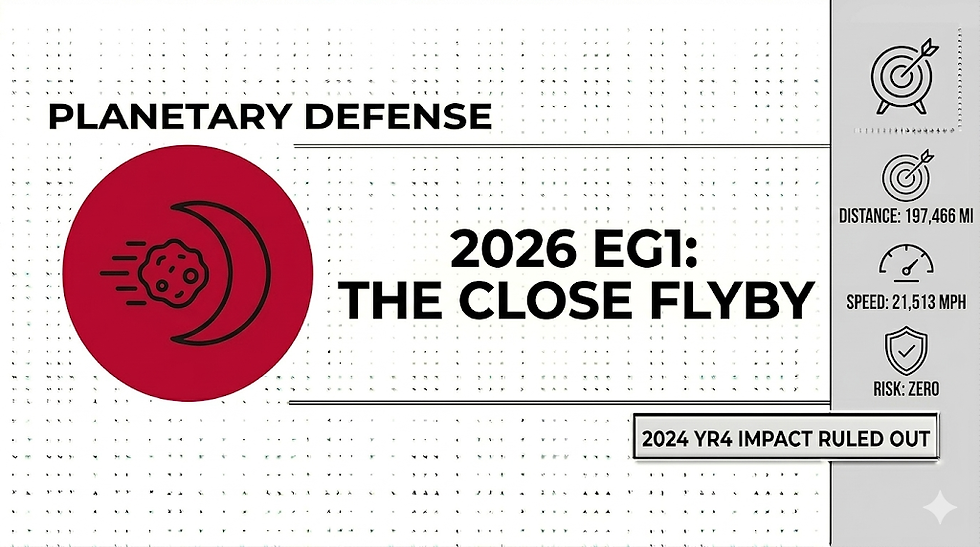
The night sky was a hive of activity for planetary defense experts on Thursday night and Friday morning, March 13, 2026. NASA’s Center for Near-Earth Object Studies (CNEOS) tracked a newly discovered asteroid, 2026 EG1, as it made an exceptionally close approach to our planet, passing well inside the orbit of the Moon.
While the "close shave" captured headlines, the bigger scientific news today comes from the James Webb Space Telescope (JWST). Using its ultra-sensitive infrared eyes, NASA has officially refined the orbit of a different, more concerning object—2024 YR4—completely ruling out a previously feared collision with the Moon in 2032.
Today's Flyby: Asteroid 2026 EG1
Discovered just five days ago on March 8, 2026, this bus-sized space rock serves as a reminder of how many "stealth" asteroids still lurk in our cosmic neighborhood.
Metric | Asteroid 2026 EG1 Data | Comparison |
Size | 32 to 72 feet (9 - 22 meters) | Roughly the size of a city bus. |
Closest Approach | 197,466 miles (317,800 km) | Closer than the Moon (238,855 mi). |
Relative Velocity | 21,513 mph (34,621 km/h) | 10x faster than a rifle bullet. |
Time of Approach | 11:27 p.m. EDT (March 12) | Safely passed the Southern Hemisphere. |
Risk Level | Zero | No danger to Earth or Moon. |
1. The "Stealth" Asteroid: 2026 EG1
Asteroid 2026 EG1 is part of the "Apollo" group of near-Earth objects.
Late Detection: It was only spotted on March 8, 2026, by the Vera Rubin Observatory in Chile. This highlights the importance of the observatory's new 800,000 nightly alerts in finding small, fast-moving objects.
The Flyby: It traveled at an astonishing speed of 34,621 km/h, whizzing past the Earth’s Southern Hemisphere. Astronomers used the event to gather rare data on the rotation and light-reflectivity of smaller, metallic asteroids.
2. The 2032 "Moon Impact" Ruled Out
The major sigh of relief today involves Asteroid 2024 YR4, a 65-meter-wide rock that had a 4.3% chance of hitting the Moon on December 22, 2032.
The JWST Intervention: NASA used the James Webb Space Telescope on February 18 and 26 to make some of the faintest asteroid observations ever recorded.
The Result: The new data refined the asteroid’s path. Instead of a collision, 2024 YR4 is now expected to pass the lunar surface at a safe distance of 13,200 miles (21,200 km).
3. DART Mission: The Long-Term Success
In a related update today, a new study confirmed that NASA's DART (Double Asteroid Redirection Test) didn't just move the moonlet Dimorphos; it shifted the entire binary system’s orbit around the Sun. This proves that "kinetic impactors" are a viable tool for permanent planetary defense.
4. FAQs
Q1. Could we see Asteroid 2026 EG1 with the naked eye?
Ans: No. Despite its proximity, the asteroid is too small and faint (magnitude ~18). You would need a professional-grade telescope or advanced amateur equipment to spot it.
Q2. What would happen if a bus-sized asteroid like 2026 EG1 hit Earth?
Ans: It would likely break up in the atmosphere, creating a brilliant fireball (bolide). It might cause a localized shockwave (similar to the 2013 Chelyabinsk event), but it wouldn't be a global threat.
Q3. Why is NASA just now ruling out the 2032 Moon impact?
Ans: When asteroids are first discovered, their orbital "error bars" are wide. Only after months or years of observations—like the ones just provided by the James Webb Telescope—can scientists narrow down the path with 100% certainty.
Q4. Is there any other asteroid threat in March 2026?
Ans: NASA is currently tracking over 41,000 near-Earth objects. While several will pass by this month, none have any measurable risk of impacting Earth in the next 100 years.
Q5. Where can I track real-time asteroid approaches?
Ans: You can use the NASA CNEOS "Eyes on Asteroids" web app for a 3D real-time visualization of all known objects in our solar system.
Conclusion
The NASA asteroid approaching Earth 2026 news for March 13 is a win for science and safety. We have the technology to spot "stealth" rocks like 2026 EG1 and the precision to clear the names of future threats like 2024 YR4. Space is a busy place, but thanks to our growing planetary defense shield, we are safer today than ever before.


Comments