CMSE Syllabus 2026 Explained: Subject-Wise Breakdown for Success
- 8 hours ago
- 4 min read
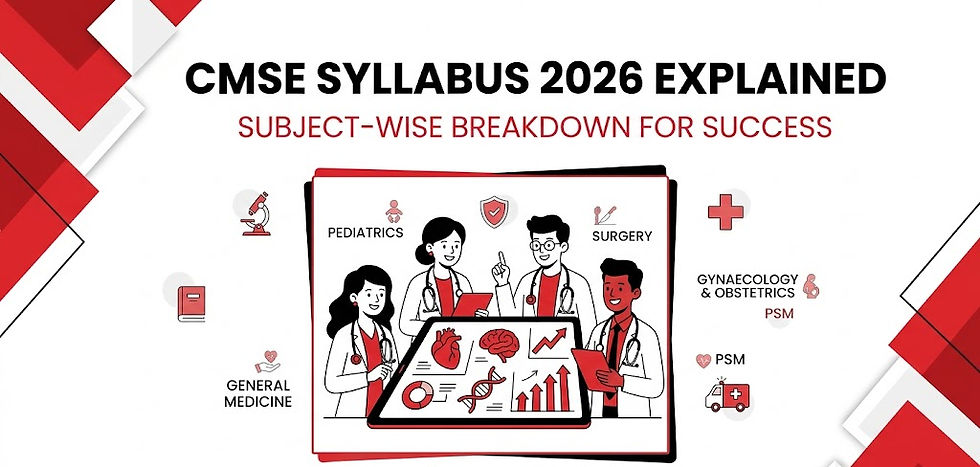
The CMSE Syllabus 2026 is the definitive roadmap for medical graduates aspiring to secure prestigious medical officer positions within the Government of India. Conducted by the Union Public Service Commission (UPSC), the Combined Medical Services Examination (CMSE) demands not just medical knowledge, but a strategic understanding of the exam's weightage and structure. As we look toward the 2026 recruitment cycle, staying updated with the latest official patterns is non-negotiable for success.
Understanding the CMSE Syllabus 2026 and Exam Structure
To conquer the UPSC CMS 2026, one must first grasp the two-stage selection process. The first stage is a Computer-Based Test (CBT) consisting of two objective papers, followed by a Personality Test for those who qualify.
The Marking Scheme at a Glance
Total Marks (Written): 500 Marks
Paper 1: 250 Marks (120 Questions)
Paper 2: 250 Marks (120 Questions)
Negative Marking: 1/3rd (0.33) of the marks assigned to the question.
Personality Test: 100 Marks
Detailed Subject-Wise Breakdown of CMSE Syllabus 2026
The syllabus is broad, covering almost the entirety of the MBBS curriculum, but the UPSC emphasizes clinical application and public health relevance. Below is the detailed breakdown for both papers.
Paper 1: General Medicine and Pediatrics
Paper 1 is heavily weighted toward Medicine, which accounts for 80% of the questions in this section.
1. General Medicine (96 Questions)
This is the "make or break" section of the CMSE Syllabus 2026. Based on previous year trends, the following systems are high-yield:
Cardiology: Valvular heart diseases, MI management, and arrhythmias.
Respiratory Diseases: COPD, Asthma, and Tuberculosis (national guidelines).
Infectious Diseases: Viral (Dengue, HIV), Bacterial, and Protozoan infections.
Neurology & Endocrinology: Stroke management and Diabetes Mellitus.
Emergency Medicine: Common poisonings, snake bites, and ACLS protocols.

2. Pediatrics (24 Questions)
Though fewer in number, these questions are often straightforward. Focus on:
Developmental Milestones: Motor, social, and language growth.
Neonatology: APGAR score, neonatal jaundice, and resuscitation.
National Programs: Immunization schedules and nutrition programs like POSHAN Abhiyaan.
Paper 2: Surgery, OBG, and Preventive & Social Medicine
Paper 2 is divided equally among three core clinical subjects, with 40 questions dedicated to each.
1. Surgery (40 Questions)
The surgery portion of the CMSE Syllabus 2026 includes general surgery and several sub-specialties:
General Surgery: Wound healing, fluid/electrolyte management, and shock.
Specialties: ENT, Ophthalmology, Orthopaedics, and Traumatology.
Abdominal Surgery: Liver, pancreas, and intestinal obstructions.
2. Gynaecology & Obstetrics (40 Questions)
Questions here focus on maternal health and family welfare:
Obstetrics: Antenatal care, high-risk pregnancy, and labor management.
Gynaecology: Genital tract infections and neoplasms (Cervical and Breast cancer).
Family Planning: Contraceptive methods and MTP Act updates.
3. Preventive and Social Medicine (PSM) (40 Questions)
This is arguably the most dynamic part of the syllabus.
Epidemiology: Study designs and screening tests.
National Health Programs: NHM, Ayushman Bharat, and RNTCP.
Biostatistics: Mean, median, mode, and P-value significance.
High-Yield Topics Analysis 2022–2025
Analyzing previous papers reveals a pattern of "repeat themes." While the questions change, the concepts remain constant. In the CMSE Syllabus 2026, candidates should prioritize:
Subject | Most Repeated Concept | Strategy |
Medicine | HIV/TB & Tropical Diseases | Focus on latest WHO/GOI treatment protocols. |
PSM | Vaccines & Epidemiology | Memorize the National Immunization Schedule. |
Surgery | Trauma & Burn Management | Master the "Rule of Nines" and ATLS guidelines. |
Pediatrics | Neonatal Resuscitation | Understand the step-by-step algorithm. |
Preparation Strategy for CMSE Syllabus 2026
Success in the UPSC CMS requires a shift from "academic reading" to "competitive solving."
1. Master the Core Formulas
While you don't need to perform complex calculus, you must be fluent in the names and applications of clinical and statistical formulas.
Body Mass Index (BMI) Formula
Parkland Formula (for burn fluid resuscitation)
Child Growth Percentiles
Sensitivity and Specificity Formulas (in Epidemiology)
2. Clinical Case Integration
UPSC has increasingly moved toward case-based questions. Instead of asking for a drug dose, they will describe a patient with specific symptoms and ask for the "Next Best Step" in management.
3. Time Management in CBT
With 120 questions to be solved in 120 minutes, you have exactly 60 seconds per question. Practice with online mock tests to build the speed required for the computer-based format.
Conclusion
Mastering the CMSE Syllabus 2026 is the first and most crucial step toward a rewarding career in the Indian Central Health Services. By focusing on high-yield topics, understanding the clinical nuances of Paper 1 and Paper 2, and practicing under timed conditions, you can significantly improve your chances of success. Stay updated with official notifications from the UPSC and keep your clinical concepts sharp.
Frequently Asked Questions (FAQs)
What is the primary focus of the CMSE Syllabus 2026?
The CMSE Syllabus 2026 focuses on the clinical application of medical knowledge across five major subjects: General Medicine, Pediatrics, Surgery, OBG, and Preventive & Social Medicine. It tests the candidate's readiness to serve as a Medical Officer in various central government organizations.
Is there a specific book for the CMSE Syllabus 2026?
While standard MBBS textbooks (like Harrison for Medicine or Bailey & Love for Surgery) are the foundation, many toppers recommend using dedicated CMS prep guides that offer subject-wise MCQ breakdowns and previous year solved papers.
How many marks are deducted for wrong answers?
For every incorrect response, 1/3rd of the marks assigned to that question are deducted. It is better to skip a question than to make an uneducated guess.
Can final year MBBS students apply for CMS 2026?
Yes, candidates who are appearing for the final MBBS examination are generally eligible to apply, provided they complete their internship before the date specified in the official UPSC notification.


Comments