Common Mistakes UPSC Aspirants Make: A 2026 Strategy to "Engineer" Your Selection
- Feb 25
- 5 min read
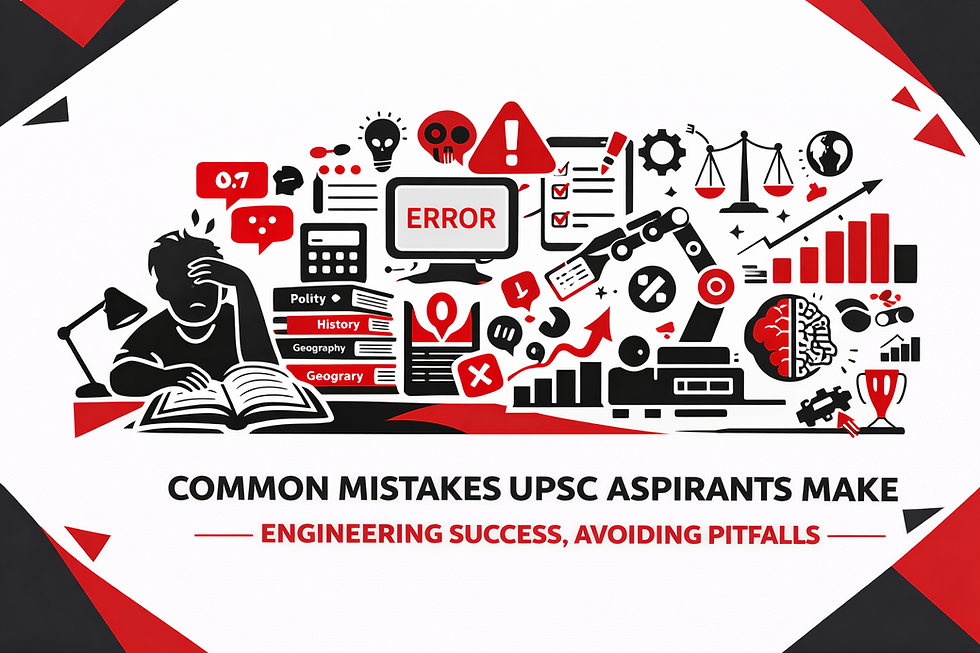
The landscape of the Civil Services Examination (CSE) in 2026 is vastly different from what it was even five years ago. With the UPSC integrating more contemporary technical themes like Artificial Intelligence, Blockchain, and Environmental Sustainability into the syllabus, the "traditional" way of studying is becoming obsolete. For candidates with an engineering background, this shift is a double-edged sword. While the technicality of the papers aligns with your DNA, the "binary" mindset of a coder or an engineer can sometimes lead to traps that humanities students easily avoid.
Identifying the Common Mistakes UPSC Aspirants Make is the first step toward building a fail-proof preparation model. In 2026, the success rate for the Engineering Services Exam (ESE) and the CSE remains highly competitive, often dipping below 1%. This means your margin for error is non-existent.
In this comprehensive guide, we will analyze the technical pitfalls, the "resource hoarding" habits, and the mindset shifts necessary to transform your preparation from "busy work" to "result-oriented engineering."
2026 UPSC Reality Check: Trends and Success Data
Before diving into the errors, let's look at the data. Engineering graduates still lead the final selections, but the "Humanities Surge" of the last two years proves that technical knowledge alone isn't enough.
Metric | 2026 Trend Data | Engineering Takeaway |
Total Vacancies (Approx) | 950 – 1,100 | High competition; efficiency is key. |
Success Ratio (Prelims) | < 1% | You cannot afford to skip any section. |
Syllabus Shift | Tech-Ethics & Digital Governance | Your technical edge is now a GS requirement. |
Selection Background | Engineering (50%), Humanities (35%) | Engineers must master "Social Perspectives." |
CSAT Difficulty | High (CAT-level logic) | Don't be overconfident in your math skills. |
The "Resource Trap": Why Hoarding is Your Worst Enemy
One of the most frequent Common Mistakes UPSC Aspirants Make is the "Sea of Books" syndrome. In 2026, the digital era has made information infinite, but your time remains finite.
1. The PDF Hoarding Habit
Engineers are great at organizing folders. However, downloading 500 GB of material from Telegram or subscribing to five different "Daily Current Affairs" AI summaries creates "Analysis Paralysis."
The Fix: Stick to the "1:5 Rule"—One source, five revisions. Whether it is Laxmikanth for Polity or a specific technical module for your Optional, master the base before looking for supplements.
2. Misusing AI in 2026 Preparation
In 2026, many aspirants use AI to generate "ready-made" answers. UPSC examiners are now trained to detect the "robotic" and "generic" tone of AI.
The Error: Copy-pasting AI summaries instead of deep-reading original reports like the Economic Survey or PIB releases.
The Solution: Use AI for "Debugging"—ask it to find flaws in your logic or to simplify a complex concept like Quantum Entanglement, but write the final answer in your own human voice.
Technical Pitfalls: Common Mistakes UPSC Aspirants Make from an Engineering Background
Engineers often struggle with the "subjectivity" of the UPSC. Here is how to navigate the technical-social overlap.
3. The "Objective" Fallacy in Mains
In engineering exams, 2+2 is always 4. In UPSC GS Paper II or the Essay, there is no "correct" answer—only a "well-argued" one.
The Mistake: Writing answers that are too bulleted and lack a narrative flow.
The Engineering Edge: Use your logical structuring to create "Flowcharts" and "Infographics," but ensure your introduction and conclusion have the "human touch" that shows empathy and administrative vision.
4. Overconfidence in CSAT (Paper II)
A recurring theme in the Common Mistakes UPSC Aspirants Make is treating the CSAT as a "walk in the park." In recent years, the Math section has reached a difficulty level comparable to the GMAT or CAT.
The Reality: Many engineers fail the Prelims because they couldn't score the 33% qualifying marks in CSAT while scoring 110+ in GS Paper I.
The Strategy: Treat CSAT with the same respect you gave your JEE. Practice at least 10 full-length mocks under timed conditions.
Answer Writing: Moving Beyond "Copy-Paste"
The 2026 Mains evaluation focuses heavily on "Inter-disciplinary Linking."
5. Neglecting the "Directive Words"
A common error is ignored the "Tail" of the question. If the question asks you to "Critically Examine," and you only "Discuss," you lose 40% of the potential marks.
Analyze: Break it into parts.
Evaluate: Give a judgment based on evidence.
Discuss: Give multiple perspectives.
6. The "Revision Blind Spot"
Pouring new data into your brain without revising the old is like trying to fill a bucket with a hole in the bottom.
The 80/20 Revision Rule: Spend 80% of your day on the new syllabus and a non-negotiable 20% on revising yesterday's work. By the time the 2026 exam arrives, you should have revised your core notes at least 7 to 10 times.
Psychological and Health Hurdles
You are not a machine. Engineering your success requires maintaining the "hardware"—your body and mind.
7. The Comparison Trap
In the digital age, seeing others' "study-grams" or 14-hour study logs can lead to burnout.
The Mistake: Focusing on "Hours Sat" instead of "Concepts Mastered."
The Health Factor: Skipping sleep to finish a chapter is a net loss. Sleep is when your brain consolidates memory. Without it, you are just reading, not learning.
Frequently Asked Questions (FAQ)
1. What are the most common mistakes UPSC aspirants make in their first attempt? The most common mistake is starting without a "Map"—ignoring the syllabus and Previous Year Questions (PYQs). Beginners often dive straight into heavy books without understanding the depth and style of questions UPSC actually asks. Another error is neglecting answer writing until the "syllabus is finished"—which never actually happens!
2. How do engineers avoid the mistake of being too technical in the Essay paper? An essay is a test of your personality and vision, not just your data. To avoid being too technical, use the PESTEL framework (Political, Economic, Social, Technological, Environmental, and Legal) to broaden your scope. Connect a technical problem (like Cyber Security) to its social impact (Digital Divide) and ethical dilemmas.
3. Is coaching necessary to avoid the common mistakes UPSC aspirants make in 2026? No, coaching is a tool, not a requirement. In 2026, most toppers are "Hybrid Learners." They use online resources for specific doubts but follow a self-disciplined routine. The biggest "coaching mistake" is following a topper's strategy blindly instead of creating one that fits your own strengths.
4. How does the "Revision Blind Spot" affect Prelims 2026? In Prelims, the options are often designed to confuse you. If you haven't revised, you will recognize the topic but fail to distinguish between two close options (Option A vs Option B). Revision builds the "precision" needed to eliminate wrong answers with confidence.
5. How should I use AI without making it a "mistake" in my prep? Use AI as a mentor, not a writer. Use it to generate "What if" scenarios for the Interview or to create 10 MCQ-style questions from a newspaper editorial to test your recall. Never use it to replace your original analytical thinking.
Conclusion: Engineering a "Topper" Mindset
Cracking the UPSC in 2026 is an exercise in "Efficiency Engineering." By avoiding the Common Mistakes UPSC Aspirants Make, you are already ahead of 90% of the competition. Remember, this exam doesn't just test your knowledge of History or Geography; it tests your ability to stay disciplined, prioritize high-value tasks, and maintain your composure under pressure.
Treat your UPSC preparation like a high-stakes engineering project: define the scope (Syllabus), run simulations (Mock Tests), debug your errors (Error Analysis), and keep the hardware running (Health).


Comments