Districts as Export Hubs: Guide for Small Businesses in India
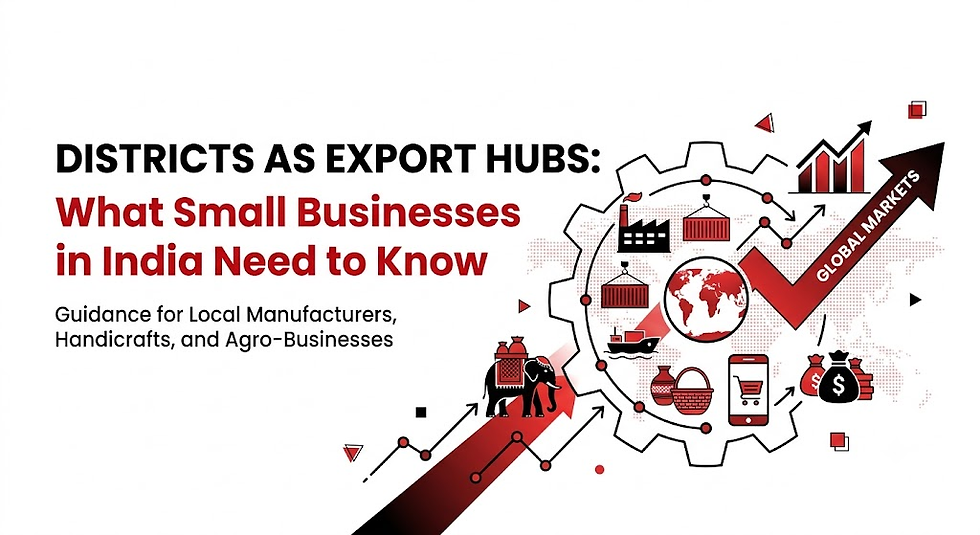
For decades, international trade in India was largely dominated by large industrial conglomerates located in major metro hubs or port cities. Historically, less than 10% of India's 700+ districts accounted for nearly 80% of total merchandise exports. This concentration left thousands of specialized tier-2, tier-3, and rural manufacturing clusters—producing everything from precision hand tools to specialized textiles and agricultural goods—isolated from foreign buyer networks.
To bridge this structural gap and democratize international trade, the Government of India launched the Districts as Export Hubs (DEH) initiative under the Directorate General of Foreign Trade (DGFT) and the Department of Commerce. Integrated into Chapter 3 of the Foreign Trade Policy (FTP) and operationally merged with the One District One Product (ODOP) scheme, this policy shifts export promotion directly to the grassroots level.
If you run a small or medium manufacturing unit, an artisan cluster, or an agro-processing enterprise in India, this initiative offers a direct bridge to international markets. Here is everything your small business needs to know to navigate government export channels, overcome regulatory hurdles, and scale globally.
What is the Districts as Export Hubs Initiative?
The Districts as Export Hubs initiative treats every district in India as an independent economic engine with distinct manufacturing and export potential. Rather than forcing local producers to navigate complex foreign trade bureaucracies in distant capital cities, the program establishes district-level governance structures designed to identify, support, and scale local products for the global market.
The core objective is to convert local manufacturers, micro-enterprises, and agricultural cooperatives into export-ready entities by addressing localized bottlenecks. This includes fixing gaps in cold chains, testing laboratories, raw material sourcing, export documentation, and last-mile freight logistics.
Primary Drivers of the Policy
Decentralized Trade Governance: Local authorities, led by the District Collector or Magistrate alongside DGFT Regional Authorities, directly lead trade facilitation.
Targeted Infrastructure Upgrades: Government funding is directed toward resolving specific local bottlenecks, such as setting up regional quality testing labs or customs clearance facilitation centers.
E-Commerce Export Integration: By partnering with digital marketplaces and setting up dedicated E-Commerce Export Hubs (ECEHs), the policy reduces entry barriers for micro-manufacturers.
Global Branding for Local Specialties: Geographically Indicated (GI) products, specialized handicrafts, and unique industrial items receive dedicated branding and promotion through Indian diplomatic missions abroad.
Key 2026 Landscape: Data and Progress Across Indian Districts
As India advances toward its broader goal of achieving $2 trillion in total exports ($1 trillion in merchandise and $1 trillion in services) by 2030, district-led manufacturing has become a critical pillar of trade policy. Government statistics reveal significant momentum in grassroots trade integration:
Metric | Official Progress & Status |
Districts Identified with Export Potential | 734+ Districts across all 36 States/UTs |
State Export Promotion Committees (SEPCs) | Functional across all 36 States/UTs |
District Export Action Plans (DEAPs) | Over 590 drafted; 250+ formally notified |
Key Product Categories | MSME industrial goods, GI handicrafts, agricultural clusters, toy clusters |
Trade Tracking Platforms | Real-time monitoring via NIRYAT and DGCIS portals |
By mobilizing local manufacturing hubs—such as ceramic tile manufacturing in Sabarkantha (Gujarat), banana processing in Jalgaon (Maharashtra), or iron craft in Bastar (Chhattisgarh)—the government is actively spreading export wealth beyond traditional industrial corridors.
How Districts as Export Hubs Accelerate Small Business Growth
For a small manufacturer, transitioning from domestic sales to cross-border trade can seem overwhelming due to compliance standards, shipping logistics, and international payment risks. The Districts as Export Hubs framework reduces these entry barriers in several key ways:
1. Direct Solution to Local Bottlenecks
Under each district's District Export Action Plan (DEAP), local authorities identify why a particular product struggles to reach international buyers. If a textile cluster in Uttar Pradesh lacks zero-liquid-discharge dyeing facilities or an agro-processing unit in Madhya Pradesh lacks cold-storage capacity near railheads, the DEPC works directly with central and state ministries to allocate targeted infrastructure funding.
2. Streamlined Quality Certification and Testing
Global buyers demand strict compliance with international standards, such as ISO certifications, CE marking, or phytosanitary clearances. Through the DEH framework, the government is establishing decentralized testing facilities and offering financial subsidies for compliance through converged schemes like the MSME Champions Scheme.
3. Reduced Financial and Credit Friction
Financial constraints frequently stop small enterprises from accepting foreign orders. The DEH initiative connects local producers directly with institutional lenders like SIDBI (Small Industries Development Bank of India), NABARD, and Export Credit Guarantee Corporation (ECGC). This facilitates access to pre-shipment and post-shipment credit at competitive interest rates, backed by government-supported risk cover.
4. Simplified E-Commerce Export Routes
Recognizing that traditional business-to-business (B2B) export channels can require heavy upfront capital, the government has established specialized E-Commerce Export Hubs (ECEHs). These hubs streamline customs clearance, return processing, and international courier dispatch, allowing small manufacturers to sell directly to foreign consumers via global online storefronts.
Step-by-Step Guide: Tapping Into Government Export Channels
If you are a local manufacturer looking to capitalize on district-level export support, follow this practical five-step roadmap:
Step 1: Secure Basic Export Registrations
Before accessing government export benefits, ensure your business is formally registered.
Obtain an Import Export Code (IEC) from the DGFT online portal. The process is completely digital, PAN-based, and takes less than 24 hours.
Register your entity under Udyam (for MSMEs) to qualify for financial incentives, technology upgrade grants, and priority sector lending.
Apply for a Registration-cum-Membership Certificate (RCMC) from the relevant Export Promotion Council (EPC) associated with your industry (e.g., CLE for leather, TEXPROCIL for cotton textiles, or APEDA for agricultural produce).
Step 2: Connect with Your Local DEPC
Reach out to the District Industries Centre (DIC) or the DGFT Regional Authority in your district. Request a meeting with the Nodal Officer for the District Export Promotion Committee (DEPC).
Inquire whether your manufactured product falls under the district's identified export focus or One District One Product (ODOP) list.
Submit your business details to be included in the district's official database of potential exporters. This database is regularly shared with Indian diplomatic missions abroad to match you with foreign trade leads.
Step 3: Utilize Up-skilling and Capacity-Building Programs
Take advantage of government-sponsored export training workshops. The DGFT, under its Niryat Bandhu Scheme, conducts regular capacity-building sessions in tier-2 and tier-3 cities. These programs cover crucial operational topics, including:
International trade documentation and customs clearance.
Export pricing strategies and Foreign Exchange Management Act (FEMA) compliance.
Foreign market demand analysis and product modification for target regions.
Step 4: List Your Products on Trade Connectivity Portals
Register your products on the official Indian Trade Portal and the government's Trade Connect e-Platform. These platforms use trade analytics to connect Indian sellers with verified global buyers, inform you about tariff advantages under India's Free Trade Agreements (FTAs), and highlight upcoming international trade expos.
Step 5: Leverage Financial Subsidies and Freight Support
Explore state-specific and central financial assistance programs:
Market Access Initiative (MAI) Scheme: Grants financial support to small exporters for stall rentals at foreign trade fairs, testing charges, and airfare for international buyer meetings.
Duty Remission Schemes (RoDTEP / RoSCTL): Provides refunds on embedded taxes, duties, and levies paid on raw materials during manufacturing, keeping your final export prices competitive.
Interest Equalisation Scheme: Provides interest subvention on pre- and post-shipment rupee export credit for qualified MSME manufacturers.
Practical Case Studies: Grassroots Success Stories
To understand how district-level trade facilitation works in practice, consider these real-world examples:
Case Study 1: Agricultural Exports from Jalgaon, Maharashtra
Jalgaon was recognized for its high-quality banana production, yet smallholder farmers lacked direct access to international buyers and cold-chain facilities. Under the DEH initiative, a tailored export plan established packhouses and cold-storage infrastructure at the district level while facilitating phytosanitary certifications locally. Today, Jalgaon bananas are exported directly to Middle Eastern markets, eliminating multiple layers of intermediaries and increasing net revenue for local growers.
Case Study 2: Terracotta Crafts from Gorakhpur, Uttar Pradesh
Gorakhpur's traditional terracotta artisans struggled with fragile supply chains, low production capacity, and limited market visibility. By listing terracotta under the district's export focus and merging it with ODOP support, local artisans received automated clay-blending machines, specialized packing training, and access to international design consultants. The product now reaches home-decor buyers across North America and Europe via e-commerce export channels.
Common Challenges for MSME Exporters (And How to Overcome Them)
While government schemes offer significant support, small manufacturers often face operational roadblocks. Here is how to navigate the most common hurdles:
Strict Quality Standards: Work with your regional DIC to identify local testing labs accredited by the NABL (National Accreditation Board for Testing and Calibration Laboratories).
Payment Default Risks: Never ship goods overseas without securing risk cover from the Export Credit Guarantee Corporation of India (ECGC), which protects against foreign buyer insolvency or political disruptions.
Logistics Bottlenecks: Utilize inland container depots (ICDs) identified under your District Export Action Plan to clear customs closer to your factory, avoiding delays at major sea ports.
Frequently Asked Questions (FAQs)
What is the primary objective of the districts as export hubs scheme?
The primary objective of the districts as export hubs scheme is to decentralize export promotion by identifying products and services with high export potential in every district. It aims to address local manufacturing and logistics bottlenecks, enhance product quality, and link small businesses directly to international supply chains.
How can a small business register under districts as export hubs programs?
To participate in the districts as export hubs ecosystem, a small business should first obtain an Import Export Code (IEC) from the DGFT and register under Udyam as an MSME. Next, contact your local District Industries Centre (DIC) or DGFT Regional Authority to connect with your District Export Promotion Committee (DEPC) and get listed in the district exporter database.
Does the ODOP (One District One Product) scheme differ from DEH?
While ODOP focuses on identifying and branding one specific unique product per district, the districts as export hubs initiative is a broader operational umbrella. DEH incorporates ODOP while also addressing general industrial clusters, services, agricultural products, logistics, quality compliance, and overall export infrastructure within the district.
Can agricultural producers and artisans benefit from district export initiatives?
Yes. The DEH initiative places special emphasis on agricultural clusters, toy clusters, handlooms, and Geographically Indicated (GI) products. Farmers' Producer Organizations (FPOs), local artisan cooperatives, and micro-enterprises receive targeted assistance in packaging, quality certification, and direct buyer linkage.
Take Action: Start Your Global Export Journey Today
Transforming your local manufacturing business into a global brand is no longer restricted to large corporations. With district-level government machinery actively working to eliminate trade barriers, there has never been a better time for Indian MSMEs to explore foreign markets.
Take the first step today by leveraging these official, verified government trade portals:
Obtain Your Import Export Code: Register digitally on the Directorate General of Foreign Trade (DGFT) Portal.
Track Live Export Data & Opportunities: Monitor trade stats on the NIRYAT Portal.
Explore MSME Financial & Growth Schemes: Learn about government support at the Ministry of MSME Portal.
Discover Foreign Market Demand & FTAs: Access comprehensive trade intelligence on the Indian Trade Portal.


Comments