E20 Ethanol Blended Fuel Policy: Import Savings vs Vehicle Concerns
India’s energy transition reached a milestone when national oil marketing companies (OMCs) successfully achieved the E20 ethanol blended fuel policy target of 20% ethanol blending in petrol. Originally slated for 2030 under the National Policy on Biofuels, this goal was fast-tracked to the 2025–2026 Ethanol Supply Year (ESY). Today, E20 petrol is available across pump stations nationwide, positioning India alongside Brazil as a global leader in biofuel integration.
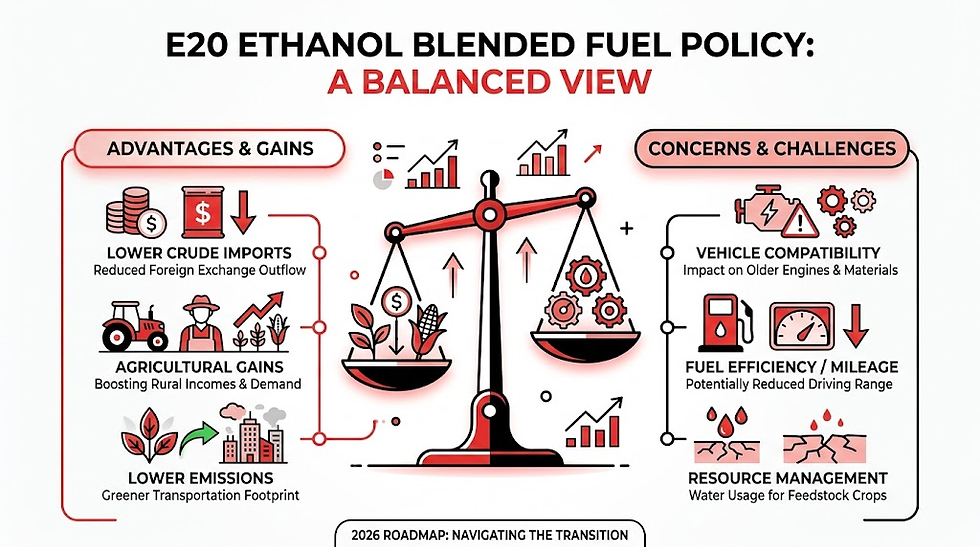
However, behind the celebratory headline lies a complex balancing act. On one side of the scale are substantial macroeconomic victories: billions of dollars saved in foreign exchange, reduced carbon emissions, and direct cash injections into rural farming communities. On the other side are growing consumer concerns regarding vehicle compatibility, mileage drop, long-term engine wear in older automobiles, and the environmental footprint of water-intensive feedstock crops.
As the country turns its sight toward higher blending targets—such as E27 and flex-fuel adoption by 2030—evaluating the true cost-benefit equilibrium of biofuel mandates becomes essential.
1. The Macroeconomic Imperative: Foreign Exchange Savings and Energy Security
India imports over 85% of its crude oil requirements, leaving the national economy vulnerable to geopolitical disruptions and international price swings. The E20 ethanol blended fuel policy was established as a strategic buffer to build domestic energy resilience.
Slashing the Crude Import Bill
By substituting 20% of conventional petrol with domestically produced bio-ethanol, India has significantly curbed its foreign currency outflows. Official figures from the Ministry of Petroleum and Natural Gas show that the Ethanol Blended Petrol (EBP) Programme has yielded cumulative foreign exchange savings exceeding ₹1.90 lakh crore since 2014. In 2025 alone, the substitution offset crude imports by nearly 3.5%, generating single-year foreign exchange savings close to ₹42,000 crore.
The Fiscal Reality of Procurement
While the macroeconomic foreign exchange savings are clear, the microeconomic cost structure presents a more nuanced picture. Ethanol is an administered-price commodity in India. OMCs pay ethanol suppliers between ₹65 and ₹72 per litre depending on the feedstock used (sugarcane juice, B-heavy molasses, damaged foodgrains, or maize).
By comparison, pre-tax refinery-gate petrol typically hovers around ₹50 to ₹58 per litre when global crude trades in the $70–$80 per barrel range. Consequently, fuel retailers pay a modest premium per litre for ethanol over unblended petrol at current oil prices. The true financial advantage of blending expands exponentially during periods of elevated global oil prices (above $100/barrel), serving as an indispensable macroeconomic hedge against global price shocks.
2. Agricultural Gains and the Water-Food-Energy Nexus
Beyond energy security, the biofuel mandate serves as a rural economic engine. The guaranteed procurement of ethanol by state-run oil companies has established a predictable revenue stream for millions of agricultural households.
Boosting Rural Incomes and Feedstock Diversification
Since the inception of the accelerated blending roadmap, over ₹1.60 lakh crore has been disbursed directly to farmers and sugarcane mills. Historically, sugarcane farmers faced severe payment delays from sugar mills during surplus harvest seasons. The diversion of excess sugar syrup and B-heavy molasses toward ethanol production has stabilized sugar market prices while ensuring timely liquid payouts to cultivators.
To prevent over-reliance on sugarcane and mitigate land-use competition with food crops, policy adjustments incentivized grain-based ethanol. Today, a significant portion of domestic ethanol is distilled from maize, damaged rice, and surplus foodgrains supplied through government agricultural channels. This diversification has expanded cash-crop opportunities for grain farmers across northern and central states.
Evaluating Environmental and Resource Costs
The agricultural gains must be evaluated against natural resource consumption:
Water Intensity: Sugarcane requires approximately 2,100 litres of water per kilogram, while spring maize demands around 500 litres per kilogram. In water-stressed agricultural belts, expanding acreage for thirsty crops places heavy demands on regional groundwater reserves.
Fiscal Subsidies: The true public cost of crop-based ethanol includes indirect agricultural support, such as subsidized canal water, rural electricity, and subsidized fertilizers (urea and DAP).
Soil Health: Intensive monoculture of high-water feedstocks can risk long-term soil nutrient balance if not rotated responsibly.
To address these vulnerabilities, state and central authorities are enforcing mandatory water-use audits for distilleries and shifting long-term subsidy structures toward Second-Generation (2G) advanced biofuels derived from non-food agricultural waste, such as rice straw (stubble), cotton stalks, and bagasse.
3. Vehicle Compatibility Concerns Under the E20 Ethanol Blended Fuel Policy
The most debated aspect of the nationwide E20 transition is its operational impact on the existing vehicular fleet. While energy security and agricultural growth represent clear policy benefits, motorists encounter practical challenges at the pump.
Energy Density Deficit and Real-World Fuel Economy
Ethanol possesses a lower calorific value (energy content) than pure petrol—carrying roughly 30% to 33% less energy per litre. When blended at a 20% ratio (E20), the resulting fuel mixture contains approximately 6% to 7% less energy per volume than unblended petrol.
E20-Optimized Engines: Vehicles engineered specifically for E20 feature higher compression ratios, recalibrated Electronic Control Units (ECUs), and modified ignition timing. These technical enhancements offset much of the calorific deficit, resulting in a minor mileage variation of roughly 2% to 3%.
Legacy Vehicles (Pre-April 2023): Older automobiles and two-wheelers tuned for E5 or E10 blends cannot dynamically adjust their compression parameters to compensate for the lower energy density. Under real-world driving conditions, owners of legacy vehicles report fuel economy drops ranging between 5% and 10%.
Because retail petrol prices remain unified regardless of ethanol concentration, consumers driving legacy automobiles experience a slight increase in their effective cost-per-kilometre.
Material Compatibility and Engine Longevity
Ethanol is alcohol-based and inherently hygroscopic—meaning it actively absorbs moisture from ambient air. Additionally, its chemical oxidation products can increase acidity over extended periods.
In unadapted fuel systems, high concentrations of ethanol can react with certain materials:
Rubber and Elastomers: Conventional rubber fuel hoses, gaskets, and O-rings can swell, harden, or degrade prematurely when exposed to high alcohol concentrations.
Metallic Components: Water absorbed by ethanol can cause localized corrosion in steel fuel tanks, fuel pumps, and carburetor jets in older two-wheelers.
Engine Deposits: In vehicles left parked for long durations, phase separation (where water and ethanol detach from petrol and settle at the bottom of the tank) can lead to hard starting or rough idling.
Industry Response and Compliance Standards
The Society of Indian Automobile Manufacturers (SIAM) and major auto manufacturers have progressively updated manufacturing standards:
April 2023 Mandate: All new light-duty passenger vehicles were manufactured with E20 material-compliant fuel lines, seals, and injectors.
April 2025 Mandate: All new BS-VI Stage II petrol vehicles were required to achieve full E20 engine-tuning and certification, optimizing combustion efficiency and ensuring full manufacturer warranty support.
For owners of legacy cars manufactured before 2023, automotive experts recommend simple preventive care: avoiding long-term fuel stagnation, inspecting rubber fuel lines during routine servicing, and using fuel stabilizers if a vehicle remains parked for extended periods.
4. Strategic Road Ahead: 2G Biofuels, E27, and Flex-Fuel Vehicles
With the E20 target successfully achieved, India's energy roadmap focuses on refining biofuel architecture to ensure long-term ecological and economic viability.
Transitioning to Second-Generation (2G) Ethanol
To protect groundwater tables and food security, government policy heavily prioritizes 2G ethanol plants. These specialized facilities convert non-edible lignocellulosic biomass—such as paddy straw, corn cobs, and sugarcane bagasse—into high-purity ethanol.
By commercializing agricultural residue, 2G plants offer a dual environmental benefit: they supply clean bio-fuel while eliminating the seasonal crop-stubble burning that causes severe air pollution across northern agricultural belts every autumn.
Flex-Fuel Vehicles (FFVs) and Higher Blends
Looking ahead to 2030, the National Policy on Biofuels outlines plans to introduce E27 blends and promote Flex-Fuel Vehicles (FFVs) capable of running on any blend from E20 up to E85 (85% ethanol). FFV technology utilizes flexible sensors that detect the exact ethanol ratio in the tank, automatically adjusting fuel injection and spark timing in real time.
Recommended Policy Refinements
To maintain consumer confidence while expanding biofuel integration, industry analysts advocate three key adjustments:
Transparent Pump Labelling: Clear labeling at retail stations specifying fuel blend levels (E10 vs. E20) allows consumers to make informed choices for older vehicles.
Rationalized Tax Structures: Aligning GST and excise duties to reflect energy density differences could provide consumers with a slight price reduction at the pump, balancing the mileage differential.
Dedicated 2G Supply Chain Subsidies: Directing financial incentives toward biomass collection networks will accelerate the transition away from water-intensive 1G food crops.
Frequently Asked Questions (FAQs)
Q1: How does the E20 ethanol blended fuel policy affect my car's fuel efficiency?
Under the E20 ethanol blended fuel policy, vehicles experience a slight variation in mileage due to ethanol's lower energy density compared to pure petrol. Vehicles manufactured after April 2025 are optimized for E20 and typically see a minor efficiency drop of 2% to 3%. Older vehicles manufactured before 2023 may experience a 5% to 10% reduction in real-world fuel economy depending on driving conditions and engine tuning.
Q2: What vehicles are fully compliant with E20 fuel?
All new BS-VI vehicles manufactured in India from April 2023 onward feature E20 material-compliant fuel systems. Furthermore, vehicles manufactured from April 2025 onward are fully certified and calibrated for optimum performance on E20 fuel under the national E20 ethanol blended fuel policy standards.
Q3: Will E20 petrol damage the engine or fuel lines of older cars?
E20 fuel is safe for daily driving in modern vehicles. In legacy cars (pre-2023) that lack ethanol-resistant rubber compounds, prolonged exposure to 20% ethanol can accelerate wear on non-compliant rubber seals, hoses, and fuel pump gaskets over time. Regular maintenance inspections during scheduled engine services help prevent material degradation issues.
Q4: Why is ethanol blended into petrol if it gives slightly lower mileage?
Ethanol blending provides significant national economic and environmental benefits. It reduces reliance on imported crude oil (saving tens of thousands of crores in foreign exchange), lowers greenhouse gas emissions, and transfers substantial revenues directly to domestic farmers who supply sugarcane, maize, and grain feedstocks.
Q5: Can I mix E10 and E20 petrol in my car's fuel tank?
Yes. E10 and E20 petrol are completely miscible and can be safely mixed in your vehicle’s fuel tank without causing mechanical lockup or chemical separation during normal vehicle operation.
Conclusion & Helpful Resources
The E20 ethanol blended fuel policy represents one of the most ambitious energy transformations in modern industrial history. By hitting its 20% blending milestone years ahead of schedule, India has demonstrated how targeted policy design can strengthen national self-reliance, lower crude import bills, and empower rural agricultural economies.
As the country advances toward higher blending ratios and 2G bio-refineries, the focus shifts toward protecting consumer interests through engine optimization, fair pricing structures, and sustainable resource management. Balancing these economic, agricultural, and automotive priorities will ensure a sustainable energy transition for years to come.
Explore Official Sources & Live Updates
Learn more about national energy statistics at the Ministry of Petroleum and Natural Gas (MoPNG).
Review global biofuel blending frameworks on the International Energy Agency (IEA).
Access government notifications and energy announcements on the Press Information Bureau (PIB).


Comments