Election Commission of India Facts for UPSC and SSC: Comprehensive Analysis & 2026 Updates
- Jul 2
- 6 min read
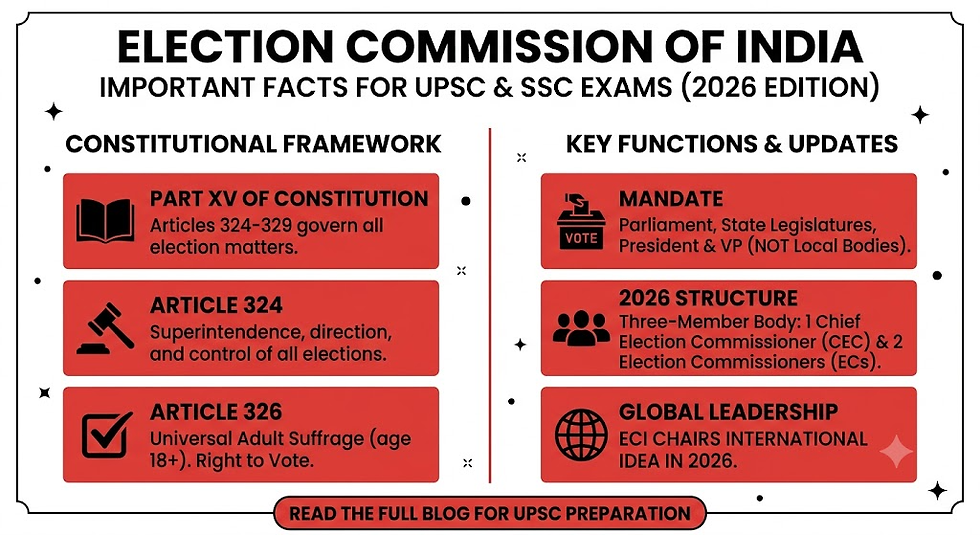
The Election Commission of India (ECI) serves as the ultimate custodian of the world’s largest democratic exercise. For aspirants preparing for competitive examinations like the UPSC Civil Services and various SSC Tiers, a thorough understanding of the ECI is not just a syllabus requirement but a strategic necessity. Questions regarding its structural framework, constitutional mandates, legislative evolution, and administrative powers frequently appear across both preliminary and mains formats.
This comprehensive analysis delivers the crucial constitutional pillars, operational machinery, historical evolutionary shifts, and the latest institutional developments relevant to the 2026 exam cycle.
Constitutional Framework and Core Provisions
The Election Commission of India is a permanent, autonomous, and independent constitutional body established directly by the Constitution of India on January 25, 1950 (a date now commemorated annually as National Voters' Day).
The primary constitutional framework governing the ECI is encapsulated within Part XV of the Indian Constitution:
Article 324: Vests the superintendence, direction, and control of the entire electoral process in the Election Commission. This mandates the body to conduct elections to Parliament (Lok Sabha and Rajya Sabha), State Legislatures (Legislative Assemblies and Legislative Councils), and the offices of the President and Vice-President of India.
Article 325: Assures that no person shall be ineligible for inclusion in an electoral roll or claim to be included in any special electoral roll on grounds only of religion, race, caste, or sex.
Article 326: Establishes Universal Adult Suffrage, granting the right to vote to every citizen of India who is not less than 18 years of age (reduced from 21 years by the 61st Constitutional Amendment Act, 1988).
Article 327: Empowers Parliament to make provisions with respect to elections to Legislatures.
Article 328: Empowers State Legislatures to make provisions with respect to elections to such Legislatures, subject to parliamentary laws.
Article 329: Bars courts from interfering in electoral matters, specifically regarding the delimitation of constituencies or allotment of seats.
Crucial Exam Pointer: The ECI is not responsible for conducting elections to local bodies such as Municipalities and Panchayats. Those fall explicitly under the jurisdiction of the respective State Election Commissions (SECs) under Articles 243K and 243ZA.
Evolutionary Trajectory: From Single-Member to Multi-Member Body
The structural composition of the ECI has undergone significant shifts since its inception, making it a favorite topic for historical tracking questions in SSC and UPSC papers.
       [1950 to 1989]                     [1989 to 1990]                     [1990 to 1993]                   [1993 to Present]
+--------------------------+      +--------------------------+      +--------------------------+      +--------------------------+
| Single-Member Commission | ---> |  Multi-Member Structure  | ---> |   Reverted to Single-    | ---> | Multi-Member Commission  |
|       (Only CEC)         |      | (CEC + 2 Commissioners)  |      |    Member Commission     |      | (CEC + 2 Commissioners)  |
+--------------------------+      +--------------------------+      +--------------------------+      +--------------------------+
1950 – 1989: The Commission functioned strictly as a single-member body, consisting solely of the Chief Election Commissioner (CEC). Sukumar Sen served as India’s first CEC.
October 1989: To manage the sudden expansion of the voter base after the voting age was lowered to 18, the President appointed two additional Election Commissioners. This phase was short-lived and rescinded in January 1990.
October 1993: The President permanently appointed two additional Election Commissioners. Since then, the ECI has functioned seamlessly as a three-member body.
Current Composition and the 2023 Selection Act Regime
The structure and administrative rules governing the top tier of the ECI are highly dynamic. Under the contemporary framework applicable for 2026, the commission consists of three members:
Chief Election Commissioner: Shri Gyanesh Kumar (assumed office as the 26th CEC on February 19, 2025).
Election Commissioner: Dr. Sukhbir Singh Sandhu.
Election Commissioner: Dr. Vivek Joshi.
The Appointment Framework
Historically, appointments were made by the President on the advice of the Prime Minister and Executive Council. However, following judicial interventions, Parliament enacted the Chief Election Commissioner and Other Election Commissioners (Appointment, Conditions of Service and Term of Office) Act, 2023.
Under this legislative framework, a high-level Selection Committee recommends appointments to the President. The mechanism works via a distinct two-stage layout:
Stage | Panel | Responsibility |
Stage 1: Search Committee | Headed by the Cabinet Secretary and including two members not below the rank of Secretary to the Government of India. | Shortlists a panel of five candidates matching the rigorous experience criteria. |
Stage 2: Selection Committee | Chaired by the Prime Minister, and comprising a Union Cabinet Minister (nominated by the PM) and the Leader of the Opposition (or leader of the single largest opposition party in Lok Sabha). | Evaluates the shortlist and recommends the final appointments to the President of India. |
Tenure, Status, and Removal Safeguards
To maintain an unyielding wall of institutional autonomy against political influence, the Constitution provides stringent service conditions:
Tenure: The CEC and ECs hold office for a term of 6 years or until they reach the age of 65, whichever occurs earlier.
Rank and Equivalence: They enjoy the exact same status, salary, and perks as a Judge of the Supreme Court of India.
Decision-Making: The CEC does not possess overriding power. All institutional business and decisions are transacted via consensus or by a majority vote among the three members.
Removal Mechanism: The CEC is protected by robust constitutional safeguards and can only be removed from office in the manner and on the grounds specified for a Supreme Court Judge (via a motion passed by both Houses of Parliament with a special majority on grounds of proved misbehavior or incapacity). However, the other Election Commissioners cannot be removed except on the explicit recommendation of the CEC.
Powers, Mandate, and Core Functional Spheres
The extensive spectrum of responsibilities assigned to the ECI can be broadly categorized into three fundamental functional spheres:
1. Administrative Powers
Demarcation of Constituencies: Assisting the Delimitation Commission in defining the geographical boundaries of electoral constituencies based on census data.
Electoral Rolls: Preparing, maintaining, and periodically revising accurate digital and physical electoral registries, ensuring no eligible citizen is disenfranchised.
Political Party Recognition: Granting recognition to political entities as National or State parties based on highly structured statistical thresholds regarding polled votes and seats won.
2. Quasi-Judicial Powers
Disputes Redressal: Settling internal splits, mergers, and disputes within registered political parties, including the allocation of official party symbols.
Disqualification Advisory: Advising the President of India (in the case of MPs) and Governors of States (in the case of MLAs/MLCs) on matters concerning the post-election disqualification of legislators under constitutional provisions.
3. Regulatory Powers
Model Code of Conduct (MCC): Enforcing the strict guidelines of the MCC from the date elections are officially declared until results are finalized, keeping political campaigns, speeches, and government announcements within democratic bounds.
Expenditure Monitoring: Setting and monitoring strict financial expenditure ceilings for contesting candidates to minimize the influence of unmonitored money power.
ECI in 2026: Technology and Global Leadership
As an institution, the ECI has consistently evolved its technological infrastructure to keep step with modern challenges. In 2026, the commission continues to advance digital access through its integrated portals, such as the Citizen Service Portal, enabling seamless remote voter registrations, application tracking, and grievance redressal via decentralized channels.
Furthermore, India’s electoral credibility has earned substantial international recognition. Reflecting its global standing as an elite Election Management Body (EMB), the Election Commission of India holds the prestigious Chairship of the Council of Member States of the International Institute for Democracy and Electoral Assistance (International IDEA) for the year 2026. This positioning underscores the ECI’s leadership role in managing complex, inclusive, and technologically resilient democratic exercises on a global scale.
Frequently Asked Questions (FAQs)
Q1: What is the primary role of the Election Commission of India?
The primary role of the Election Commission of India is to superintend, direct, and control the entire operational pipeline of free, fair, and transparent elections across the country. This encompasses managing general elections to the Lok Sabha, Rajya Sabha, State Legislative Assemblies, Legislative Councils, and the top constitutional offices of the President and Vice-President.
Q2: What are the main Election Commission of India facts for UPSC aspirants to prioritize?
For aspirants tracking Election Commission of India facts for UPSC, focus heavily on Part XV of the Constitution (Articles 324-329), the exact composition of the multi-member setup, and the landmark appointment framework introduced by the 2023 Selection Act. Understanding the separation of duties between the ECI and State Election Commissions (SECs) is also highly critical for avoiding trap questions in the Prelims paper.
Q3: How are the members of the ECI appointed under the latest laws?
As per the Chief Election Commissioner and Other Election Commissioners Act of 2023, the members are appointed by the President following the recommendations of a three-member Selection Committee. This committee is chaired by the Prime Minister and includes a nominated Union Cabinet Minister alongside the Leader of the Opposition or leader of the single largest opposition party in the Lok Sabha.
Q4: Can the Election Commission of India disqualify a sitting Member of Parliament?
The ECI does not directly disqualify a sitting legislator. Instead, it acts in an advisory capacity. Under constitutional provisions, the President of India must seek the mandatory opinion of the ECI regarding the post-election disqualification of an MP. The opinion rendered by the ECI is legally binding upon the President.
Strategic Resources for Aspirants
To secure top marks in polity sections, candidates must combine conceptual fundamentals with verified administrative updates. Access the specialized portals below to keep your notes up to date with the latest press releases and statutory modifications:
Official Updates and Data: For verification of current structural benches and electoral statistics, consult the Official Election Commission of India Portal.
Voter Registrations & Services: To understand real-time digital documentation, electronic electoral roll mechanisms, and form provisions, visit the ECI Citizen Service Portal.


Comments