GRE Accepting University National University of Singapore (NUS) (Singapore)
- Jan 14
- 6 min read
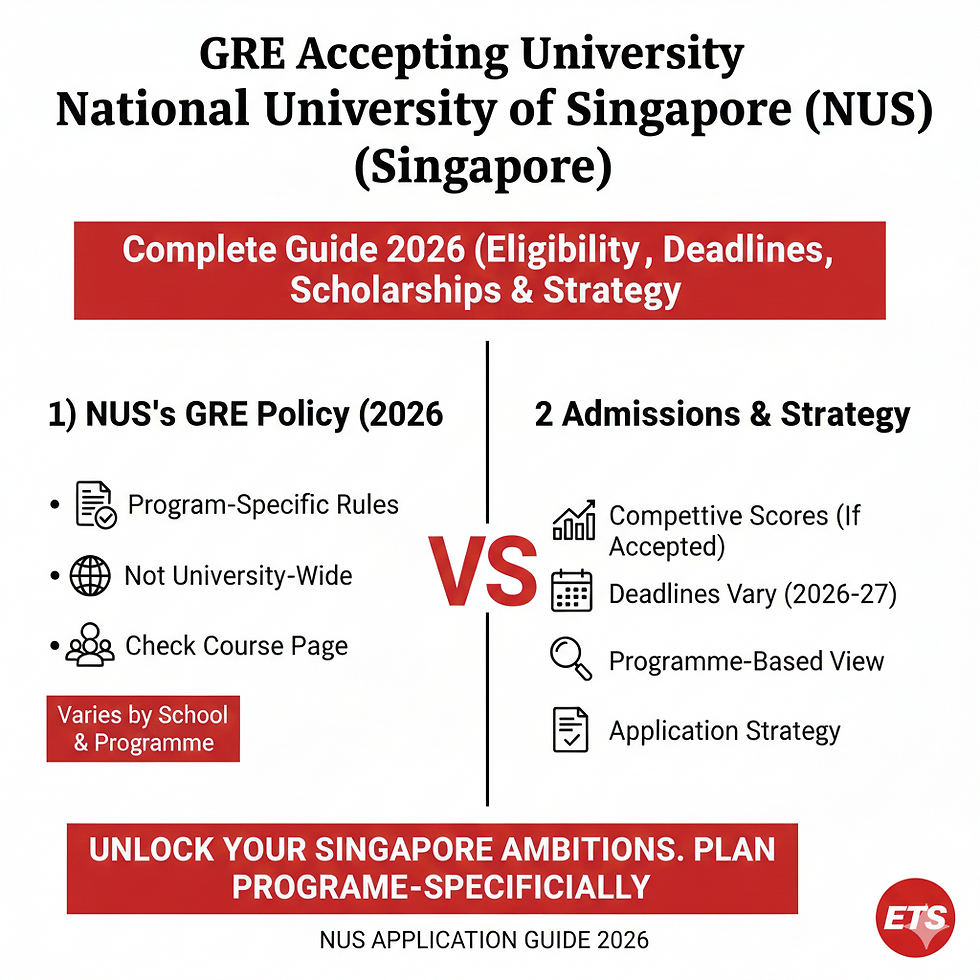
NUS (National University of Singapore) is a top choice for international students aiming for Asia’s strongest graduate ecosystem—especially in business, public policy, computing, engineering, and research degrees. For 2026 intake planning, the most important thing to understand is this:
✅ NUS can be “GRE-friendly,” but GRE rules differ by school and programme.Some programmes require a test (often GMAT/GRE), many treat GRE as optional but recommended, and others don’t need it unless stated.
This guide gives you an accurate, 2026-ready, programme-based view of GRE at NUS, along with real application dates, what scores matter, and a clear strategy to apply confidently.
What “GRE Accepting” Means at NUS in 2026
At NUS, “GRE accepting” generally falls into 3 categories:
GRE/GMAT required (common in certain business-style programmes)
GRE optional but strongly encouraged (common in policy/research-aligned programmes)
GRE not required / not mentioned (many taught master’s and department-specific courses)
NUS Graduate School also frames standardized test scores like GRE as an application-strengthening component for research admissions rather than a universal must-have.
GRE Accepting University NUS: Programme-wise GRE Policy (2026 Snapshot)
Below is a practical table using official NUS pages (school/programme sites) to show how GRE is treated in key NUS areas for 2026.
GRE Policy Table (NUS – selected programmes/schools)
NUS school/programme (examples) | GRE status for 2026 | What the official page says (summary) |
NUS MBA (Business School) | GMAT/GRE expected/required as part of application | NUS MBA admissions pages highlight submitting required documents and test scores by deadlines. |
NUS Business School – PhD | GMAT or GRE optional for admissions Aug 2026 onwards | Explicitly states GMAT/GRE scores are optional for Aug 2026 onwards; tests must be within 5 years. |
Lee Kuan Yew School of Public Policy (LKYSPP) – PhD/Policy | GRE optional but strongly encouraged | Notes standardized test scores such as GRE are optional but strongly encouraged; checklist includes GRE/GMAT as standardised tests. |
Saw Swee Hock School of Public Health – Graduate Research | GRE not mandatory, strongly encouraged | Says GRE is not mandatory, but strongly encouraged; strong GRE can strengthen application. |
NUS Law (policy update) | GRE optional (effective AY2025/2026) | States GRE scores will be optional with effect from AY2025/2026; strong evidence of skills helps. |
College of Design & Engineering – Graduate by Research | GRE can strengthen application | Mentions GRE evidence strengthens application for research pathways. |
School of Computing (example: MComp CS Specialisation page) | Depends on programme; validity guidance shown | Shows GRE/GMAT validity guidance and directs to programme admission requirements. |
Key takeaway: NUS is genuinely “GRE accepting,” but there is no single GRE rule for the whole university—you must follow the programme page.
2026 Intake: Real NUS Application Dates (Tables with Verified Deadlines)
Because you asked for real dates, here are official programme deadline tables for popular NUS programmes tied to 2026 entry.
1) NUS MBA Deadlines (August 2026 Intake)
NUS MBA confirms the August 2026 intake opens 1 August 2025, with multiple rounds for full-time and part-time options.
MBA format | Round | Deadline (official) |
Full-time MBA | Round 1 | 30 October 2025 |
Full-time MBA | Round 2 | 15 January 2026 |
Full-time MBA | Round 3 | 31 March 2026 |
Part-time MBA | Round 1 | 30 October 2025 |
Part-time MBA | Round 2 | 02 February 2026 |
Part-time MBA | Round 3 | 05 May 2026 |
Practical tip (2026): If you need scholarships/funding, earlier rounds typically give more flexibility for interviews and funding decisions—so treat Round 1 as your “best shot” window.
2) NUS MSc Finance – August 2026 Intake (Key Dates)
NUS MSc Finance provides a clear August 2026 application timeline including study award consideration cut-offs and class start window.
Stage | Date (official) |
Application opens | 1 September 2025 |
1st round cut-off + study award consideration | 15 November 2025 |
Final application deadline | 15 February 2026 |
Outcome notification | By June 2026 |
Orientation / classes commence | Late July 2026 |
3) NUS MSc in Management (MiM) – August 2026 Intake Dates
NUS MiM shows a structured intake cycle with scholarship-linked rounds and a final deadline.
Stage | Date (official) |
Applications open | 1 September 2025 |
1st round cut-off + study award consideration | 15 November 2025 |
2nd round cut-off | 15 February 2026 |
Final deadline | 30 June 2026 |
When Should You Submit GRE for NUS?
Use this simple decision rule:
Submit GRE if:
Your programme requires a standardized test (common for MBA-style programs)
Your programme says GRE is optional but strongly encouraged (policy/public health/research tracks)
You want to strengthen your profile in:
quantitative readiness
analytical writing
competitive international comparison
You can skip GRE if:
Your programme does not mention GRE/GMAT anywhere, and your profile is already strong
You’re applying to a programme that explicitly states GRE is optional, and your academics/research/work evidence is strong enough (example: NUS Business PhD “optional for Aug 2026 onwards”).
What GRE Score is “Good” for NUS in 2026?
NUS programmes often avoid publishing rigid GRE cut-offs (especially where GRE is optional). In practice:
Competitive programmes use GRE to validate academic readiness.
If your undergrad is from a lesser-known university or your GPA is borderline, a strong GRE can help.
For quant-heavy degrees (analytics/finance/public policy), higher quant performance is typically beneficial.
Also note: NUS Business School (PhD) specifies test validity expectations (e.g., tests taken within a set period). And School of Computing programme pages commonly mention score validity guidance too.
2026 strategy: Don’t chase a random “minimum.” Instead, aim for a score that supports your programme’s demands, and submit early enough to meet round-based deadlines.
Documents That Matter More Than GRE at NUS
Even when GRE is accepted, most NUS programmes are holistic. Typically, your selection depends heavily on:
Academic transcripts + degree rigor
Statement of Purpose (SOP) aligned to programme outcomes
Letters of recommendation (especially for research/policy/public health tracks)
CV + quantifiable impact
Research exposure (for graduate-by-research routes)
NUS Graduate School explicitly lists research involvement and standardized tests like GRE as strengthening signals for research admissions.
Step-by-Step: How to Apply to NUS with GRE (2026 Plan)
Step 1: Choose your intake (Aug 2026 vs others)
Many NUS programmes are aligned to August intakes, while some have other entry points depending on programme structure (example pages show distinct intake cycles).
Step 2: Confirm GRE requirement on your exact programme page
Do not generalize. NUS policies differ across schools:
“Required” for MBA-style pathways
“Optional but strongly encouraged” in policy/public health/research pathways
“Optional from Aug 2026 onwards” for NUS Business PhD
Step 3: Build a timeline using your real deadline table
Example: if your programme has a 15 Nov 2025 scholarship cut-off, take GRE early enough to avoid score delays.
Step 4: Submit early rounds if scholarships are involved
NUS programme pages frequently mark early-round cut-offs for study award consideration.
Step 5: Use GRE as a “proof of readiness,” not the whole story
Pair your GRE with strong SOP, references, and relevant projects.
Common Mistakes Students Make (Avoid These in 2026)
Assuming all NUS programmes require GRE (false—many are optional or not needed).
Missing scholarship-linked rounds (e.g., “study award consideration” cut-offs).
Submitting GRE late and losing time on score reporting near deadlines.
Weak SOP that doesn’t match programme outcomes (this hurts more than a medium GRE).
Generic references that don’t prove research/analytical ability.
FAQ (2026) — NUS + GRE
1) Is GRE Accepting University NUS a good choice for 2026 applicants?
Yes. GRE Accepting University NUS is a strong target for 2026 because multiple schools/programmes accept GRE either as a required standardized test (in some cases) or as an optional-but-strongly-encouraged credential (in others). Always confirm your programme’s exact policy on its official page.
2) What are the NUS MBA deadlines for the August 2026 intake?
NUS MBA applications for August 2026 open 1 August 2025, with Round 1 on 30 Oct 2025, Round 2 on 15 Jan 2026, and Round 3 on 31 Mar 2026 (full-time).
3) Does NUS Business School require GRE for PhD from 2026?
For NUS Business School PhD admissions Aug 2026 onwards, the school states GMAT or GRE scores are optional (not mandatory).
4) Is GRE mandatory for NUS public policy / public health research?
Not always. For some tracks, NUS pages indicate GRE is not mandatory but strongly encouraged, as it strengthens evidence of quantitative/verbal/analytical skills.
CTA: Your Next Steps (With Official Links)
If you’re applying to NUS for 2026, do this next:
Check NUS Graduate School admissions guidance (baseline requirements + research admissions context).
If you’re targeting MBA, use the NUS MBA admissions & deadlines page to plan your round.
For business research (PhD), verify the Aug 2026 onwards GRE/GMAT optional policy directly.
For MiM / MSc Finance, use the official key dates pages and target the scholarship-linked rounds.


Comments