GRE Exam Fees 2026: Updated Registration Cost, Reschedule Charges, Score Report Fees & Money-Saving Tips
- Jan 9
- 5 min read
Planning to take the GRE this year? Then you should budget for more than just the registration amount. In 2026, the total cost can include the base test fee, plus optional (but common) add-ons like rescheduling, additional score reports, and score review—and the final amount can vary by country because of local pricing, taxes, and currency conversions.
This blog breaks down the latest GRE exam fees 2026 using up-to-date official info, explains what’s included in the fee, lists common extra charges, and shows smart ways to reduce your total spend—without hurting your score.
What Are the GRE Exam Fees 2026 (Most Important Numbers)
GRE General Test fee in India (ETS India)
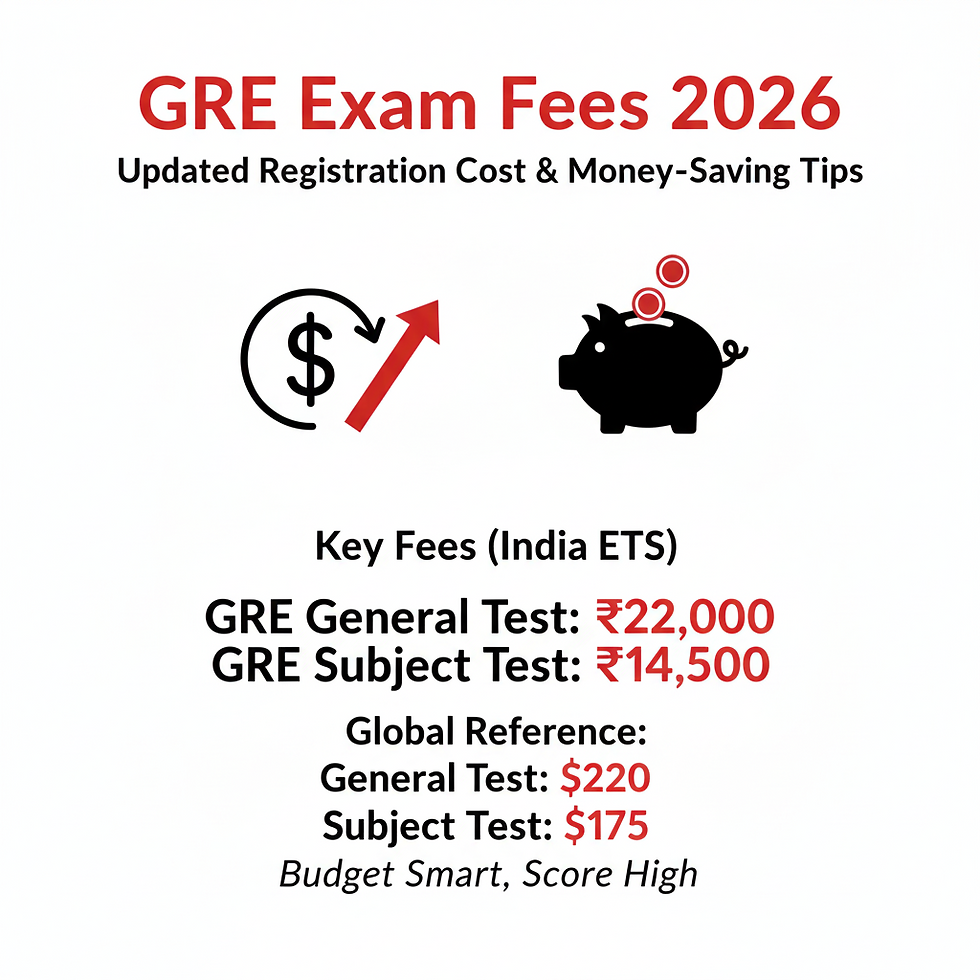
For test takers registering through ETS India, the GRE General Test fee is ₹22,000 in 2026.
GRE Subject Test fee in India (ETS India)
The GRE Subject Test fee is ₹14,500 in India.
Global reference (most locations)
ETS also states that the GRE General Test costs $220 in most parts of the world, while China and India cost slightly more.
For the GRE Subject Test, ETS lists a worldwide fee of $175 (note: India has a separate local-fee page).
Important note for 2026: ETS mentions that fees are stated in U.S. dollars (on relevant ETS pages), and are subject to change—so always verify right before you pay.
GRE Exam Fees 2026: What Your Registration Fee Includes
Most students think they’re paying only for “the exam.” But your GRE fee includes a few valuable built-ins:
The full GRE test administration (test center or at-home, depending on what you book).
Sending scores to 4 institutions on test day is included in the cost (this is a major hidden saver).
Because you get four score recipients included, the biggest cost mistake is choosing your recipients randomly. In 2026, plan your shortlist early so those four free sends do real work for you.
H2: GRE Exam Fees 2026 Breakdown (Full Cost Table You Should Budget For)
Below is a practical “budget view” of what many students actually pay in 2026.
1) Base test fee (India)
GRE General Test: ₹22,000
GRE Subject Test: ₹14,500
2) Additional score reports (after the 4 free ones)
If you want to send your scores to more universities later, ETS allows ordering Additional Score Reports (ASRs). ETS lists the ASR fee as US$35 per recipient.
Real-world tip: If you apply to 8–12 universities, ASRs can become a significant extra cost. Use your 4 free sends wisely, then pay for ASRs only for final shortlisted programs.
3) Fee Reduction Program (major discount for eligible students)
ETS offers a GRE Fee Reduction option for eligible individuals. If you receive a fee reduction voucher, ETS states you’ll pay $100 to register for the GRE General Test, and 50% of the regular test fee for a GRE Subject Test.
ETS also notes that fee reduction recipients get free access to certain official prep resources (a real value-add if you’re budgeting hard).
Extra Charges That Increase Your Total GRE Cost (Hidden-but-Common)
Even if you pay the base fee once, students often pay more due to timing mistakes and admin changes. The most common extras are:
Rescheduling or changing plans
Rescheduling fees and deadlines can vary by region and policy updates, so you should always check your ETS account and local ETS pages when you make changes. Many prep sites commonly cite a rescheduling fee around $50, but treat third-party numbers as a reference and verify the final fee inside your official registration flow.
Additional score reporting costs
As covered above, sending more than four score reports costs US$35 per recipient through ETS.
Score review and score services (where applicable)
Different score-related services (like score review, reinstatement, etc.) may have separate charges depending on the service and region. Before purchasing, confirm the exact fee and eligibility in your ETS account or official ETS pages relevant to your country.
Test Center vs At-Home: Do GRE Exam Fees Change in 2026?
In most cases, the base GRE registration fee is set by the country/region rather than “test center vs at-home.” The bigger cost difference usually comes from:
Travel + local transportation to the test center
Rescheduling risk (if you choose a busy center with limited slots)
Equipment / environment readiness for at-home testing (not a direct fee, but a real cost if you need upgrades)
Use the option that reduces your “risk cost,” not just the registration cost.
Why Fees Vary by Country (and Why Your INR Amount Can Look Different)
Even if your country fee is listed in INR, students still see small differences due to:
Taxes and local pricing rules
Forex conversions (when fees are set in USD and converted)
Bank conversion rates and international transaction charges (depending on your payment method)
That’s why you should avoid last-minute booking—rush decisions often create extra paid changes.
How to Reduce Your GRE Exam Fees 2026 (Legit Methods Only)
Here are practical ways to keep your total cost low:
1) Use the ETS Fee Reduction Program (if eligible)
If you qualify, this is the biggest legal discount: $100 GRE General Test fee with the voucher.
2) Pick your 4 free score recipients strategically
Because you can send scores to four institutions on test day at no extra cost, shortlist 4 “sure-shot + realistic” programs in advance.
3) Avoid rescheduling by planning backward
Most reschedule fees happen because of:
booking too early without a stable prep plan, or
booking too late and settling for an inconvenient date/time.
Choose a test date when you can reliably finish 6–10 mocks and your revision loop.
4) Reduce ASR spending with a shortlist strategy
Instead of applying to 15 programs blindly:
start with a longlist for research
then a shortlist for actual score sending
Pay for ASRs only when you are actually ready to apply.
Sample Budgets: What You Might Really Pay in 2026
Here are realistic scenarios (for India):
Budget A: Simple (1 attempt, minimal extras)
GRE General Test: ₹22,000
Extra score reports: ₹0 (use 4 free) Estimated total: ~₹22,000 (plus bank/transaction charges if any)
Budget B: Normal (1 attempt + additional score reports)
GRE General Test: ₹22,000
4 extra universities after test day: 4 × $35 Estimated total: ₹22,000 + (ASRs converted to INR)
Budget C: Costly (reschedule + extra reports)
GRE General Test: ₹22,000
Reschedule fee (commonly cited around $50; verify in ETS flow)
Multiple ASRs: $35 each Estimated total: can rise quickly if you change dates and apply broadly.
FAQ: GRE Exam Fees 2026
1) What are the GRE exam fees 2026 in India?
As per ETS India’s fee page, the GRE General Test fee is ₹22,000 and the GRE Subject Test fee is ₹14,500.
2) How many free score reports do I get with the GRE fee?
ETS notes the GRE cost includes the ability to send score reports to four schools on test day.
3) How much does it cost to send additional GRE score reports in 2026?
ETS lists US$35 per score recipient for Additional Score Reports.
4) Is there any official discount or fee reduction for GRE?
Yes. ETS offers a Fee Reduction Program—voucher recipients pay $100 for the GRE General Test and get 50% off the regular GRE Subject Test fee (plus some free prep resources).
CTA: Check Official Fees, Register Smartly, and Avoid Extra Charges (Links)
Use official ETS pages to verify fees right before payment and to register safely.
ETS India – GRE General Test Fees (INR): https://www.in.ets.org/gre/test-takers/general-test/register/fees.html
ETS GRE Registration (India): https://www.in.ets.org/gre/test-takers/general-test/register.html
ETS – Send GRE Scores / Additional Score Reports (ASR): https://www.in.ets.org/gre/test-takers/general-test/scores/send-scores.html
ETS – GRE Fee Reduction Program: https://www.in.ets.org/gre/score-users/reducing-barriers/fee-reductions.html
ETS – GRE Subject Test Fees (Worldwide reference): https://www.ets.org/gre/test-takers/subject-tests/register/fees.html


Comments