Greenwashing 3.0: Why Net Zero Pledges Are Now Legally Binding Advertising
- Jul 19
- 6 min read
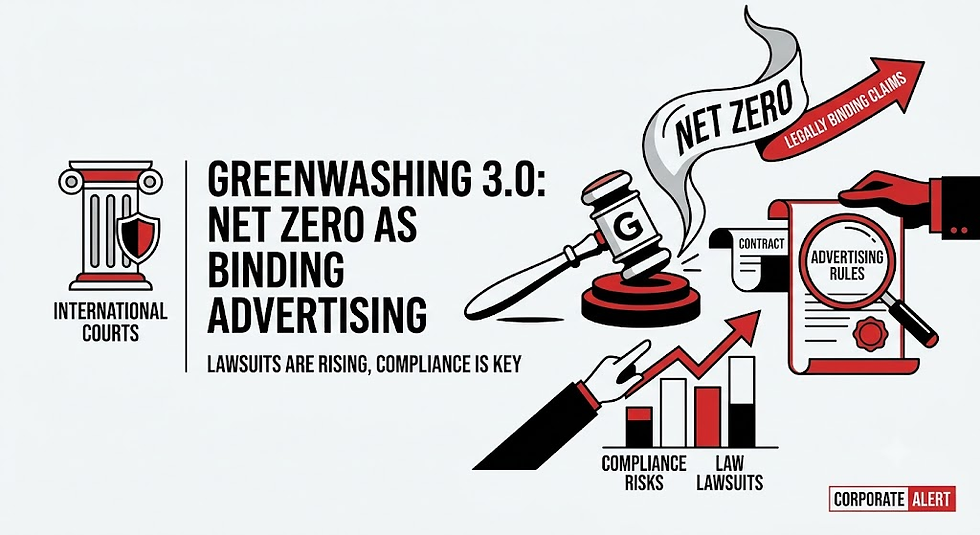
The era of consequence-free corporate environmentalism is officially dead. For the past decade, multinational corporations have freely deployed sweeping, long-term public relations campaigns promising carbon neutrality by 2040 or 2050. These aspirational slogans filled glossy sustainability reports, dominated social media feeds, and appeased climate-conscious consumers—all with minimal legal risk.
But as we cross into mid-2026, the global legal landscape has undergone a tectonic shift. We have entered the era of Greenwashing 3.0, a highly combative compliance reality where international courts, national regulators, and civil protection agencies are no longer treating environmental marketing as harmless puffery. Instead, judges worldwide are explicitly ruling that a company’s high-profile climate goals constitute legally binding advertising.
If a business advertises a "Net Zero" future while simultaneously expanding its carbon-heavy legacy operations behind the scenes, it faces immediate, multi-million dollar class-action lawsuits, market bans, and structural court mandates.
This comprehensive deep-dive explores how international tribunals are redefining accountability, the core legal precedents shaping 2026, and the critical framework compliance teams must adopt to survive the modern regulatory crackdowns.
The Evolution: From Greenwashing 1.0 to the Realities of Greenwashing 3.0,Legally binding advertising
To understand why corporate legal teams are suddenly in a state of high alert, it helps to track how environmental marketing deception evolved into a high-stakes litigation minefield.
Greenwashing 1.0 (The Visual Era): Pioneered in the 1990s and 2000s, this phase was characterized by basic visual manipulation. Companies slapped green leaf icons, pristine nature imagery, and buzzwords like "eco-safe" or "all-natural" onto standard products without altering their production methods.
Greenwashing 2.0 (The Unverified Accolade Era): Emerging in the 2010s, this shifted toward unverified carbon offsets and vague corporate branding campaigns. Companies proclaimed they were "planting trees" or buying carbon credits to balance out massive supply chain emissions, relying on loose reporting standards.
Greenwashing 3.0 (The Binding Pledges Era): The current reality in 2026. This phase targets systemic structural disconnects between a company's forward-looking public marketing and its actual, short-term capital expenditures (CapEx). Courts are ruling that when a corporation uses long-term climate targets to cultivate commercial goodwill, win customer loyalty, or justify premium pricing, those targets immediately become consumer-facing product claims subject to strict truth-in-advertising laws.
The Landmark Precedents Threatening Global Corporations
The conceptual shift from "future aspiration" to "binding promise" is not a hypothetical legal theory; it is active case law establishing severe corporate penalties across various jurisdictions.
The TotalEnergies Precedent: A Historic Reckoning for Big Oil
The ultimate turning point occurred when a coalition of non-governmental organizations (NGOs), including ClientEarth and Greenpeace, won a historic, landmark civil ruling against French energy giant TotalEnergies. The court directly scrutinized the firm's widespread media campaigns, which asserted it was a "major player in the energy transition" with an ambition to achieve net-zero carbon emissions by 2050.
The French court declared that these public marketing narratives were explicitly misleading under European consumer protection law. The judicial reasoning was definitive: the company could not legally promote a Net Zero endpoint to consumers while simultaneously increasing its investments in fossil fuel extraction and fossil gas infrastructure. The court mandated an immediate cessation of the deceptive marketing and ordered the public display of the judgment on the firm’s primary website under severe daily penalties. This established the definitive precedent that a 30-year climate target is an actionable advertising claim today.
The Fast-Fashion Fines and Corporate Shell Game
The legal crackdown has expanded rapidly beyond the energy sector. In late 2025, an Italian court slammed the European operating subsidiary of the fast-fashion giant Shein with a sweeping €1 million fine. Regulators discovered that sustainability messaging across campaigns like #SHEINTHEKNOW and evoluSHEIN relied on generic, overly broad statements regarding circular economy metrics and product recyclability without verified, auditable data.
Similarly, food conglomerates like Tyson Foods have faced persistent litigation, forcing them to completely withdraw public marketing campaigns that claimed their beef production was inherently "climate-friendly" or on an unchecked path toward carbon neutrality.
How the Law Treats Net Zero Pledges as Advertising Claims
When an average consumer buys a product labeled as "Carbon Neutral" or supports a brand boasting a prominently displayed "Net Zero by 2040" badge, they are often paying an embedded financial premium. International courts are looking at this commercial transaction through a standard legal framework: inducement and material misrepresentation.
Under modern truth-in-advertising standards, if a business states a specific outcome as a core component of its brand value, it must possess immediate, verified, and scientifically sound proof that its current business operations can realistically achieve that outcome. If interim capital allocation contradicts the long-term marketing promise, the statement constitutes deceptive advertising, paving the way for class-action lawsuits.
The Double Regulatory Squeeze of 2026
Compounding the wave of civil litigation is a rigid framework of international statutory updates that leave no room for corporate ambiguity. Multinationals are currently navigating two massive regulatory pillars:
1. The EU Green Claims Directive (EmpCo Enforcement)
Entering its ultimate enforcement phase in late 2026, the European Union's Empowering Consumers for the Green Transition (EmpCo) directive fundamentally outlaws generic environmental descriptions. Terms like "eco-friendly," "sustainable," "carbon-negative," or "green" are banned from packaging and advertisements unless backed by a rigorous, third-party certified, full lifecycle environmental assessment. Furthermore, firms are legally blocked from claiming a product is "climate neutral" if that assertion relies primarily on purchasing external carbon offsets rather than reducing operational emissions at the source.
2. Anti-Greenwashing Litigation in North America
While the United States federal landscape faces varying enforcement priorities, private class-action litigation and state attorneys general have vigorously filled the regulatory vacuum. Class-action litigation in states like California and New York has successfully targeted major consumer brands over the presence of microplastics or PFAS ("forever chemicals") in products marketed as "pure" or "sustainable".
Additionally, corporate litigation is no longer purely consumer-driven; market competitors are actively suing rival firms for greenwashing to protect their own market share, turning sustainability compliance into a critical weapon for commercial survival.
The Strategic Blueprint: De-Risking Corporate Climate Claims
For modern businesses to avoid devastating litigation, the corporate communication strategy must be completely overhauled. The era of marketing departments inventing slogans in a silo is over.
Establish End-to-End Assured Data Tracking: As a pre-requisite for all claims, every single forward-looking sustainability metric must be strictly tied to verified, auditable data systems. If you claim a path to carbon reductions, you must have an active Scope 1, 2, and 3 data framework ready for independent verification.
Align Marketing Language with CapEx Reality: Synchronize finance and PR by reviewing corporate marketing plans alongside the actual capital expenditure budget. If the financial roadmap does not allocate direct capital to transition away from carbon-intensive infrastructure over the next 24 months, long-term climate targets cannot legally be featured in public advertising.
Eliminate Vague Environmental Buzzwords: Enforce absolute specificity by purging marketing materials of ambiguous phrases like "planet-positive" or "eco-conscious." Replace them with exact, measurable truths, such as: "Our manufacturing facility reduced absolute methane emissions by 14% compared to our 2022 baseline."
Implement Mandatory Inter-Departmental Legal Audits: As a final compliance gate, establish a strict internal governance rule where legal counsel, environmental compliance officers, and independent sustainability auditors must sign off on all website copy, product labels, and investor reports prior to public distribution.
Dedicated FAQ Section
What exactly is the definition of Greenwashing 3.0?
Greenwashing 3.0 is the latest paradigm of environmental deception where regulators and international courts treat forward-looking corporate statements (such as Net Zero pledges or 2050 climate goals) as legally binding advertising rather than voluntary, non-actionable goals. Under this standard, any misalignment between a company's immediate commercial spending and its advertised long-term targets exposes the firm to structural consumer lawsuits.
Why are courts suddenly treating Net Zero pledges as binding advertising?
Courts have recognized that corporations use Net Zero commitments as powerful marketing tools to attract premium investment capital, justify higher product pricing, and build crucial customer retention. Because these claims directly influence purchasing behavior and generate distinct economic value, they fall squarely under consumer protection and deceptive advertising statutes.
Can companies still use carbon offsets to justify their sustainability claims?
Under new 2026 international frameworks, particularly within the European Union, companies are largely prohibited from advertising a product as "climate neutral" or "carbon reduced" if that claim relies on buying external carbon offsets rather than reducing emissions directly within their own supply chain. Offsets can no longer be used to hide active fossil fuel expansion or systemic operational negligence.
What are the financial penalties associated with a Greenwashing 3.0 ruling?
Corporate risks include multi-million dollar regulatory fines, class-action restitution payouts, and immediate court-mandated injunctions forcing the withdrawal of global marketing campaigns. Beyond immediate financial losses, companies suffer severe damage to brand equity, drop-offs in consumer trust, and immediate divesting from institutional ESG funds.
Protect Your Enterprise from Greenwashing Liabilities
Navigating the highly litigious territory of modern climate claims requires rigorous corporate oversight and completely independent verification frameworks. Do not let an unverified marketing slogan trigger a devastating corporate lawsuit.
Review Global Compliance Standards: Stay ahead of regional litigation frameworks by analyzing the official European Commission Green Claims Guidance.
Audit Your Data Practices: Align your internal corporate frameworks with the strict, structured disclosure rules provided by the International Sustainability Standards Board (ISSB).
Establish Verifiable Pathways: Ensure your company’s long-term environmental strategies meet rigorous, scientifically backed mitigation goals by consulting the Science Based Targets initiative (SBTi).


Comments