Hidden Costs of Studying Abroad Students Don’t Calculate: The 2026 Financial Blueprint
- Jan 31
- 4 min read
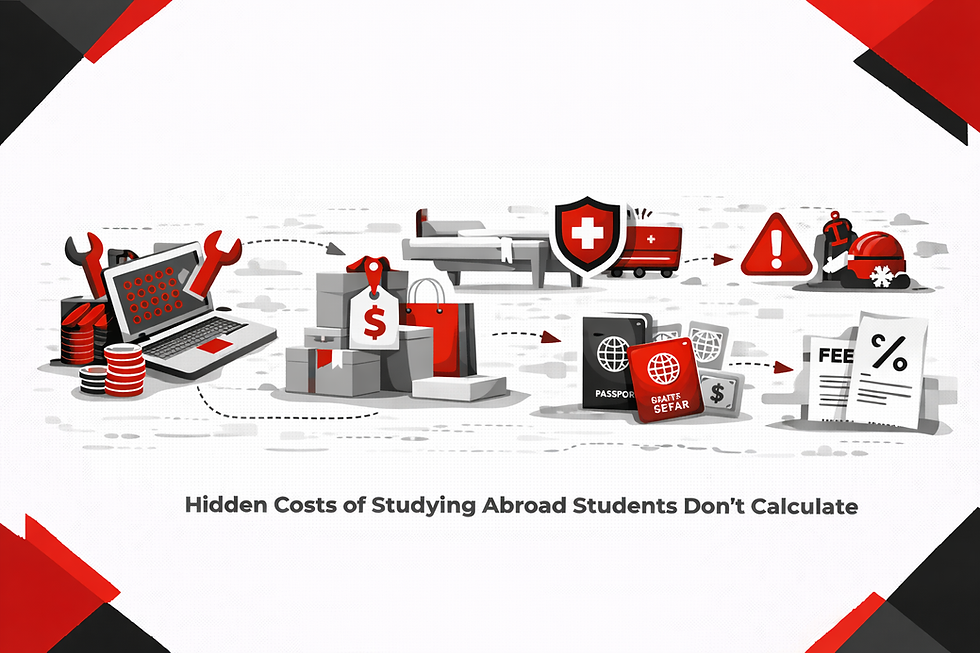
So, you’ve secured your admit for a Master’s in Engineering, your GMAT Focus Edition score is in the top percentile, and you’ve already started visualizing your life in a high-tech lab in Munich or Silicon Valley. You’ve likely budgeted for the "Big Two": tuition and rent. But as we move through 2026, many international students are finding that their bank balances are draining 20% to 30% faster than anticipated.
The reality of 2026 is that global inflation and "tech taxes" have introduced a new layer of expenses. For an engineer, being precise is part of the job description—so why leave your finances to guesswork? Understanding the Hidden Costs of Studying Abroad Students Don’t Calculate is the only way to ensure your focus stays on your sensors and circuits rather than your overdraft fees.
2026 Budget Breakdown: Beyond the Brochure
In 2026, the "sticker price" on university websites rarely reflects the true cost of living. This table provides a realistic look at the "Stealth Expenses" you’ll likely face in your first year abroad.
Expense Category | USA (Engineering) | UK (STEM) | Germany (Public) | Canada (Tech) |
Tech & Software Tax | $1,200 – $1,800 | £800 – £1,200 | €700 – €1,000 | CAD 1,400 – 2,000 |
Health Surcharges | $1,500 – $2,500 | £776 (Fixed Upfront) | €1,300 – €1,500 | CAD 600 – 1,000 |
Settle-In Surge | $2,000 – $3,500 | £1,500 – £2,500 | €1,800 – €2,500 | CAD 2,500 – 4,000 |
Forex & Banking Friction | 3% – 5% Markup | 2% – 4% Markup | 2% – 4% Markup | 3% – 4% Markup |
Visa & Compliance Fees | $535 (Visa + SEVIS) | £1,200 (Visa + IHS) | €200 (Admin + Res) | CAD 350 (Permit + Bio) |
The Engineering "Tech Tax": A Specialized Hidden Cost
One of the most significant Hidden Costs of Studying Abroad Students Don’t Calculate is what we call the "Tech Tax." In 2026, universities have largely shifted to "BYOD" (Bring Your Own Device) models, but for engineering students, a standard student laptop won't cut it.
High-Spec Hardware & Software
Whether you are running CAD software, training machine learning models, or simulating structural loads, you need a high-spec GPU and at least 32GB of RAM. In many countries, these hardware costs are 15-20% higher than in India or Southeast Asia due to local taxes. Additionally, while universities provide some software, specialized plugins or cloud computing credits (like AWS or Azure for data projects) often come out of the student's pocket.
Lab Kits and PPE
Mechanical and Civil Engineering students often face unexpected costs for "Lab Kits." These include everything from specialized calipers and safety gear (PPE) to proprietary microcontroller kits (like advanced Arduino or Raspberry Pi sets) required for specific modules. Expect an out-of-pocket expense of roughly $500–$800 in your first semester alone.
The "First 30 Days" Surge: Why Your Buffer Disappears
Most students calculate monthly rent, but they forget that the first month is actually 3x more expensive than any other month.
Security Deposits & Agency Fees
In 2026, housing scarcity in cities like London, Boston, and Toronto has driven security deposits to record highs. You often need to pay 1.5 to 3 months of rent upfront. If your rent is $1,500, you might need $4,500 in liquid cash the moment you land.
The "Empty Room" Reality
Unless you secure a furnished dorm, you will be landing in a room with four walls and a floor. Buying basic bedding, kitchenware, a desk lamp, and a winter-grade heater or fan is an immediate $600–$1,000 hit. In 2026, students are increasingly using "Community Swap" apps to mitigate this, but the initial "Settle-In Surge" is still a shock to most.
Health and Compliance: The Non-Negotiables
Mandatory Health Surcharges
In the UK, the Immigration Health Surcharge (IHS) has risen significantly for the 2026 intake. Unlike a monthly insurance premium, this must be paid upfront for the entire duration of your visa. For a two-year Master’s, this can be an immediate cost of over £1,500.
Currency Friction & Remittance Fees
This is the silent "leak" in your budget. When your family sends money from home, banks often charge a "markup" on the exchange rate. In 2026, using traditional wire transfers can lose you 3% to 5% of the value. On a $50,000 tuition payment, that is $2,500 lost simply to banking friction—a huge part of the Hidden Costs of Studying Abroad Students Don’t Calculate.
FAQ: Hidden Costs of Studying Abroad Students Don’t Calculate
Do the Hidden Costs of Studying Abroad Students Don’t Calculate include flight tickets? Yes. While students budget for the initial flight, many forget about the "Flexibility Fee." In 2026, last-minute flights for family emergencies or peak-season holiday travel can cost 3x the standard rate. It is wise to keep a $1,500 "Emergency Flight Fund" untouched.
Are textbooks still a major hidden cost in 2026? While many resources are digital, "Access Codes" for online lab portals and homework platforms are now mandatory for many engineering courses. These codes can cost $100 per subject and cannot be bought secondhand.
Does the GMAT help in reducing these costs? Indirectly, yes! A high GMAT Focus Edition score often qualifies you for "Merit-Based Stipends" or "Research Assistantships." These roles often include a "Tech Allowance" that covers your software and hardware costs, effectively neutralizing the "Tech Tax."
What is the "Winter Tax"? For students moving to Canada, Northern Europe, or the Northern US, specialized winter gear (parkas, thermal boots, and base layers) is a mandatory expense. A high-quality set that survives -20°C temperatures will cost at least $400–$600.
Take Control of Your 2026 Financial Journey
Precision in budgeting is just as important as precision in engineering. Don't let hidden expenses derail your academic success.
Get a 2026 "True Cost" Profile Evaluation: We help you calculate the exact expenses for your specific university and city, including the "stealth" costs.
Download the 2026 Engineering Student Budget Template: An Excel tool designed specifically to track lab fees, tech gear, and currency markups.
Compare Zero-Markup Forex Cards: Stop losing money to bank markups and save up to 4% on every transaction.


Comments