How AI Is Transforming Customer Support with Voice Agents: The 2026 Guide to AI Voice Customer Support
- 2 days ago
- 7 min read
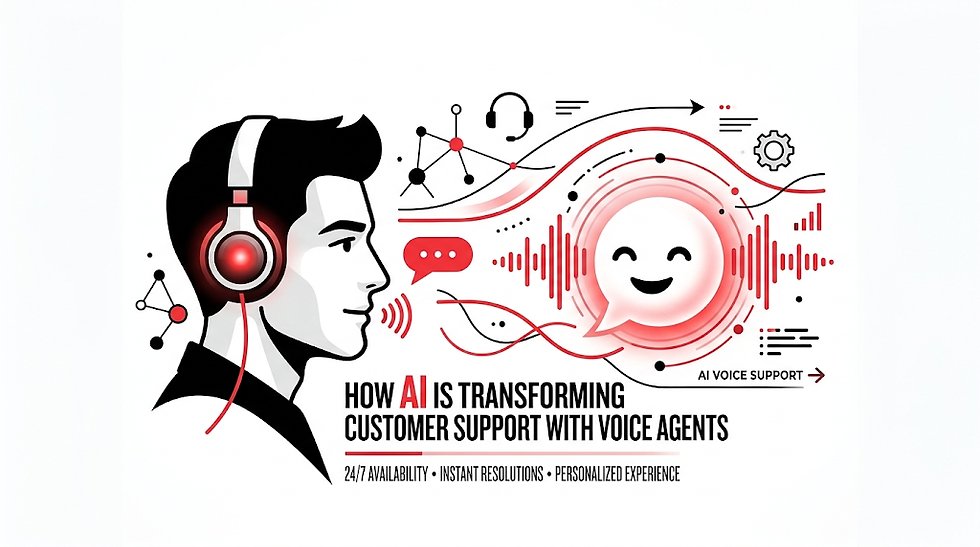
The landscape of enterprise customer engagement is undergoing a monumental shift. For decades, traditional phone support was defined by tedious Interactive Voice Response (IVR) menus, long hold times, and frustrated callers navigating rigid "press 1 for billing, press 2 for tech support" tree structures. However, recent breakthroughs in generative artificial intelligence, real-time speech synthesis, and natural language processing (NLP) have ushered in a new era.
Today, conversational AI voice agents are replacing rigid automated scripts with natural, human-like voice conversations. These intelligent autonomous voice agents can comprehend complex intent, detect vocal sentiment, retrieve background context from enterprise CRM systems in milliseconds, and execute multi-step workflows—all while holding fluid, zero-latency conversations.
ChatMaxima
As companies race to deliver instant, 24/7 personalized resolution, voice-based AI is proving to be the single fastest-growing enterprise automation channel. In this guide, we explore how conversational voice technology is redefining customer care, examine real-world performance metrics for 2026, and outline actionable strategies for implementing AI voice customer support within your contact center operations.
Brilo AI
The Voice Resurgence: Why Audio Is Leading CX Automation in 2026
While digital chat and messaging channels expanded rapidly over the past decade, voice remains the preferred choice for urgent, complex, or high-touch customer inquiries. According to research from Grand View Research, the global AI voice agents market has expanded from $2.5 billion in 2025 to an estimated $3.5 billion in 2026, on track to surpass $35 billion by 2033 at a compound annual growth rate (CAGR) of 39.0%. Interestingly, voice AI adoption is growing at nearly double the rate of text-based chatbot implementations.
Grand View Research+ 1
Several macroeconomic and technological catalysts explain why voice automation has become top-of-mind for Chief Customer Officers (CCOs) and Chief Information Officers (CIOs):
Elimination of Latency: Early conversational voice models suffered from noticeable pauses between speaker turns. Modern speech-to-speech architecture processes, translates, and responds in under 300 milliseconds, matching the natural cadence of human conversation.
Contact Center Cost Pressures: Gartner projections indicate that conversational AI implementation will save contact centers over $80 billion in global labor costs in 2026.
ChatMaxima
Consumer Demand for Instant Gratification: Industry benchmarks show that over 60% of customers prioritize immediate resolution over speaking to a human representative when handling standard transactional tasks like checking order status or rescheduling appointments.
Rather than acting as glorified call routing filters, modern AI voice agents function as knowledgeable digital workers capable of completing end-to-end task resolution on the very first call.
Behind the Technology: How Modern Voice AI Agents Work
Understanding how AI transforms voice interactions requires looking past basic keyword recognition. Legacy voice bots operated on strict rule-based decision trees. Modern generative voice agents combine four core architectural layers to manage complex interactions dynamically:
[ Customer Audio Input ]
           │
           ▼
1. Speech-to-Text (STT / ASR)  ──► Real-time transcription & noise suppression
           │
           ▼
2. Natural Language Understanding (NLU/LLM) ──► Intent extraction & context mapping
           │
           ▼
3. Agent Orchestration Layer  ──► API tool usage & CRM database retrieval
           │
           ▼
4. Text-to-Speech (TTS / Voice Synthesis) ──► Human-like, emotive voice output
1. Ultra-Low Latency Speech Synthesis (STT/TTS)
Advanced Automatic Speech Recognition (ASR) engines transcribe incoming acoustic signals into text in real time while filtering background noise, accent variations, and speech stutters. Simultaneously, next-generation Text-to-Speech (TTS) models inject realistic intonation, breathing pauses, and pitch modulation to sound indistinguishable from a human agent.
2. Large Language Models (LLMs) & Reasoning
At the center of the voice agent is a fine-tuned Large Language Model trained on specialized domain knowledge. The LLM parses user speech, determines context, maintains multi-turn memory, and decides what actions to take. If a customer interrupts mid-sentence, the model handles the conversational shift smoothly without resetting the prompt.
3. API Orchestration & System Integration
True utility comes from actionable backend integration. Voice agents connect directly to enterprise resource platforms—such as Salesforce, Zendesk, ServiceNow, and ERP databases—via secure APIs. This allows the AI agent to verify identity, look up live shipping status, process payment tokens, or rebook flight itineraries during the live audio stream.
4. Continuous Sentiment Analysis
Voice AI monitors acoustic biomarkers, pitch shifts, and vocabulary choices to gauge customer sentiment. If the system detects growing customer frustration or a scenario that exceeds its autonomous bounds, it executes a clean, warm handoff to a human representative, passing along full conversation transcripts and contextual summaries.
Key Business Benefits of Deploying AI Voice Customer Support
Implementing AI voice customer support provides quantifiable ROI across customer satisfaction (CSAT), operational agility, and agent retention.
       ┌────────────────────────────────────────────────────────┐
       │   Key ROI Drivers of Autonomous AI Voice Support       │
       └────────────────────────────────────────────────────────┘
                                    │
         ┌──────────────────────────┼──────────────────────────┐
         ▼                          ▼                          ▼
 24/7 Availability         20–35% Cost Cut          100% Data Accuracy
  Zero queue wait time     Net operational savings   Automated CRM logging
1. 24/7 Availability and Instant Resolution
Voice agents do not sleep, call in sick, or require break rotations. They provide instant first-contact resolution at 3:00 AM on a Sunday just as effectively as at 2:00 PM on a Tuesday. By absorbing high-volume routine inquiries—such as password resets, payment processing, or tracking updates—voice agents eliminate hold queues and drive immediate resolution rates up significantly.
ChatMaxima
2. Significant Cost Reduction and Scalability
Contact center scaling traditionally meant linearly increasing headcount, facilities, and licensing costs. With AI voice agents, organizations can handle sudden seasonal spikes or unexpected outage calls without purchasing additional telecom infrastructure or hiring temporary staffing. Data shows that enterprise deployments achieve a net cost reduction of 20% to 35% within the first 12 months of operation.
Coworker AI
3. Human Agent Augmentation and Reduced Burnout
When AI voice tools handle repetitive tier-1 support tickets, human agents are freed from monotonous tasks. Representatives can focus on high-value, nuanced, or highly empathetic cases that require human judgment. Furthermore, real-time AI agent copilots assist human staff during calls by popping up relevant knowledge base articles and summarizing transcripts automatically, boosting representative productivity by 14% to 34%.
Coworker AI
4. Hyper-Personalization and Emotional Intelligence
Equipped with instant CRM data lookup, an AI voice agent knows who is calling before answering. The agent can reference recent purchase history, past interaction tickets, and loyalty status instantly: "Hello Sarah, I see you recently ordered the wireless headphones that were delivered yesterday. Are you calling about that order?" This level of contextual awareness creates a frictionless customer experience that builds long-term loyalty.
Real-World Use Cases Across Key Industries
While voice AI offers universal applicability, three sectors are leading the enterprise deployment curve in 2026:
Industry Sector | Primary AI Voice Use Cases | Key Business Impact |
Banking & Financial Services (BFSI) | Account balance inquiries, card activation, fraud alert verification, loan application status. | 35% faster claims processing and reduced drop-off rates. |
Retail & E-Commerce | Order tracking, return authorization, exchange requests, localized inventory checks. | 25%+ reduction in cost-to-serve during peak holiday rushes. |
Healthcare & Insurance | Appointment scheduling, prescription refill requests, claims status updates, intake pre-screening. | Reduced missed appointment rates by up to 40% with proactive reminders. |
Travel & Hospitality | Flight rebooking, hotel reservation changes, baggage tracking inquiries, loyalty balance checks. | Instant handling of sudden flight delay or cancellation call surges. |
Overcoming Key Implementation Challenges
While the benefits are significant, transitioning to voice automation requires navigating potential pitfalls. Organizations that succeed follow clear governance frameworks:
Preventing "AI Hallucinations": Unconstrained generative AI models can generate inaccurate policies. Enterprise deployments mitigate this by utilizing Retrieval-Augmented Generation (RAG), restricting the AI agent to query only verified corporate knowledge bases and deterministic API workflows.
Managing Customer Acceptance: Survey data reveals that 79% of customers still want the clear option to speak to a human representative when desired. Implementing transparent fallback mechanisms ensures callers never feel trapped in an automated loop.
Brilo AI
Data Security & Regulatory Compliance: Voice interactions handle sensitive Personal Identifiable Information (PII) and financial details. Voice AI architectures must maintain compliance with global standards, including GDPR, HIPAA, PCI-DSS, and SOC 2 Type II, with end-to-end encryption and real-time redacting of sensitive audio sequences.
Strategic Roadmap: How to Deploy Voice AI in 4 Steps
To maximize ROI and safeguard customer trust, follow a phased deployment strategy:
Phase 1: High-Volume Audit and Intent Mapping
Analyze call logs and speech analytics to identify the top 5 to 10 repetitive, transactional inbound call reasons. Target simple inquiries with high volume for initial automation (e.g., balance inquiries or shipment tracking).
Coworker AI
Phase 2: Knowledge Base & API Integration
Structure your enterprise knowledge assets. Clean up unstructured documentation and build secure API connections between your telephony server (Twilio, Amazon Connect, Genesys) and your CRM/ERP core.
Phase 3: Controlled Pilot Testing
Launch the AI voice agent for a small percentage of incoming calls or within a specific department. Benchmark metrics including First Call Resolution (FCR), Average Handle Time (AHT), containment rate, and post-call CSAT scores.
Phase 4: Full Scale & Human-in-the-Loop Optimization
Expand deployment across main phone lines while instituting continuous quality assurance monitoring. Establish human-in-the-loop audit protocols where customer support leads review edge cases and continually fine-tune prompt instructions and agent workflows.
Frequently Asked Questions (FAQ)
How does AI voice customer support differ from traditional IVR systems?
Traditional IVR systems rely on static, pre-recorded audio menus where callers press buttons on a keypad. In contrast, AI voice customer support utilizes natural language understanding (NLU), generative speech synthesis, and real-time system integration to engage callers in fluid, open-ended conversations. The AI agent understands context, handles interruptions, retrieves data dynamically, and resolves inquiries autonomously without manual keypresses.
Coworker AI
Can AI voice agents integrate with existing CRM and helpdesk platforms?
Yes. Modern voice AI platforms connect natively via REST APIs or pre-built connectors to major CRM platforms like Salesforce, HubSpot, Zendesk, Microsoft Dynamics, and ServiceNow. This enables real-time data lookup, automated ticket creation, call transcript logging, and workflow triggers across your customer service ecosystem.
Itransition
What happens when an AI voice agent cannot resolve a customer's issue?
When faced with an unscripted edge case or heightened caller frustration, the voice agent initiates a seamless, warm transfer to a human support representative. The agent passes the full context, transcript, and verified customer identity details to the human agent's desktop, ensuring the customer never has to repeat themselves.
How accurate is voice AI in understanding accents and diverse speaking styles?
Next-generation Automatic Speech Recognition (ASR) engines are trained on massive multilingual and multi-dialect acoustic datasets. As a result, modern voice AI agents achieve over 95% word accuracy rates across diverse regional accents, background noise environments, and colloquial speech patterns.
Is AI voice customer support suitable for small and medium-sized businesses (SMBs)?
Absolutley. Cloud-based Voice AI platforms offer pay-per-minute or usage-based SaaS pricing models, eliminating the high upfront capital expenditure previously required for enterprise call center automation. Small and medium businesses can deploy AI voice agents to answer after-hours calls, schedule appointments, and capture leads without expanding full-time headcount.
Transform Your Customer Service Operations Today
The evolution from rigid telephone menus to empathetic, real-time voice intelligence is no longer a distant technology—it is a competitive necessity. By deploying conversational voice AI, forward-thinking enterprises reduce operational expenditure, boost first-contact resolution rates, and empower their human workforce to deliver higher-value service.
Ready to elevate your contact center operations and deliver frictionless support around the clock?
Explore leading conversational AI platforms by reviewing top enterprise frameworks on Gartner.
Discover how cloud contact centers integrate voice intelligence on Salesforce Service Cloud or Zendesk.
Contact our enterprise AI strategy team today to schedule a customized demo and calculate your contact center's prospective ROI.


Comments