How Smart Glasses Technology Process Is Shaping the Future of Computing in 2026
- Jul 26
- 6 min read
We are witnessing a monumental shift in human-computer interaction. For decades, the primary interface between human intent and digital data was mediated through flat screens—desktop monitors, laptops, and smartphones. Today, that paradigm is rapidly shifting toward spatial computing and hands-free wearable technology.
Smart glasses have evolved from clunky, experimental prototypes into sleek, highly capable devices powered by multimodal artificial intelligence, advanced optical waveguides, and high-density micro-OLED displays. With the global AI smart glasses market expanding toward $3.29 billion in 2026 and shipments forecasted to reach tens of millions of units worldwide, smart eyewear is no longer a futuristic concept—it is an active driver of enterprise productivity and personal computing.
In this comprehensive guide, we explore how the smart glasses technology process operates, the major technological breakthroughs driving the market in 2026, real-world industry applications, and what lies ahead for this transformative hardware category.
What Are Smart Glasses in 2026?
At their core, smart glasses are wearable visual and auditory computers integrated into a traditional spectacle frame form factor. Unlike virtual reality (VR) headsets that completely enclose the user's field of view, smart glasses blend digital information with the physical environment via augmented reality (AR) overlay or provide contextual audio assistance through bone-conduction and directional speaker arrays.
In 2026, smart eyewear generally falls into three main product architectures:
Audio-First AI Glasses: Lightweight frames equipped with micro-speakers, noise-canceling microphone arrays, and embedded AI assistants (such as Meta AI or Google Gemini). They process voice commands, capture media, and offer real-time language translation without any visual heads-up display (HUD).
Monocular & Binocular Heads-Up Displays (HUDs): Eyewear featuring compact optical engines that project high-contrast text, navigation cues, or micro-widgets into one or both lenses.
Full Spatial Augmented Reality (AR) Glasses: High-end smart eyewear boasting full-color waveguide displays, depth sensors, eye-tracking, and spatial audio to anchor 3D digital objects directly into physical environments.
The Core Components of the Smart Glasses Technology Process
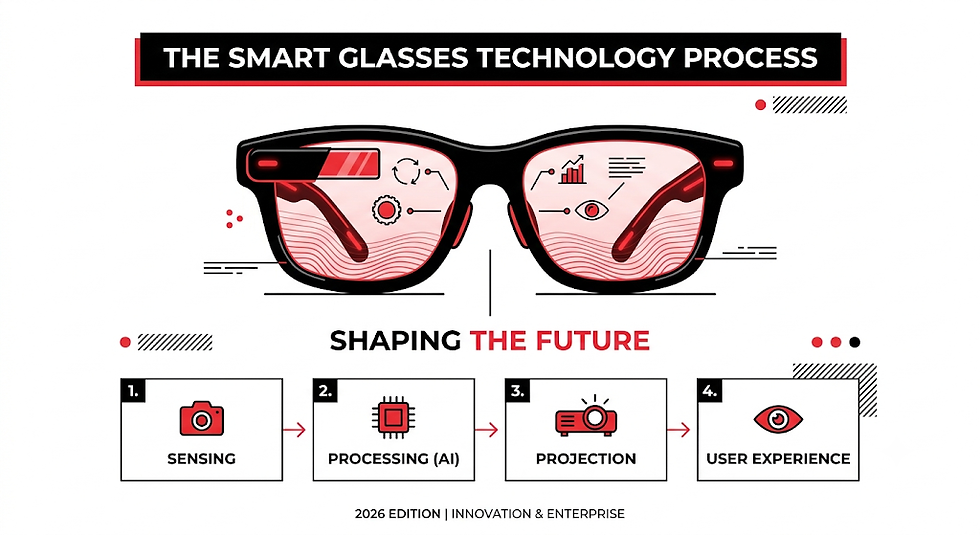
To understand how these modern wearables seamlessly merge real and digital realities, it is essential to examine the underlying smart glasses technology process. This process relies on a tightly integrated hardware-software loop designed to minimize weight, maximize thermal efficiency, and deliver ultra-low latency contextual awareness.
┌─────────────────────────────────────────────────────────────────────────┐
│              THE SMART GLASSES TECHNOLOGY PROCESS PIPELINE               │
├─────────────────────────────────────────────────────────────────────────┤
│ 1. DATA SENSING & CAPTURE  ──► Cameras, ToF Sensors, Microphones, IMUs  │
│ 2. CONTEXTUAL PROCESSING   ──► Edge AI Processors & Neural Engines       │
│ 3. OPTICAL DISPLAY ENGINE  ──► Micro-OLED / MicroLED & Waveguide Lenses  │
│ 4. HUMAN INTERACTION LOOP  ──► Voice, Eye Tracking, EMG & Hand Gestures │
└─────────────────────────────────────────────────────────────────────────┘
1. Data Sensing and Environmental Mapping
The process begins with continuous environmental sensing. Embedded miniature CMOS camera sensors, Time-of-Flight (ToF) depth sensors, and Inertial Measurement Units (IMUs) gather visual, spatial, and motion data in real time. Microphones pick up ambient acoustics and voice commands while filtering out background noise.
2. Edge AI and Spatial Computing Processing
Raw data captured by the sensors is immediately routed to dedicated low-power System-on-Chips (SoCs). Modern chipsets perform on-device computer vision tasks such as:
Simultaneous Localization and Mapping (SLAM)
Object recognition and facial detection
Natural Language Processing (NLP) for instant voice interaction
By processing critical tasks locally on the device (Edge Computing) and offloading heavy generative AI operations to cloud servers via Wi-Fi 7 or 5G/6G connections, smart glasses preserve battery life while maintaining responsive performance.
3. Optical Projection and Waveguide Transmission
The optical process determines how images reach the wearer's retina. Micro-OLED or MicroLED light engines emit high-brightness digital images through diffractive or reflective waveguide lenses. The waveguides bend and bounce light rays inside the lens glass, directing the digital image into the user’s pupil while allowing ambient natural light to pass through unimpeded.
4. Adaptive User Interaction
The final stage of the process involves the feedback loop. Users interact with displayed information using intuitive inputs:
Voice Commands: Hands-free natural speech interaction.
Eye-Tracking & Gaze Selection: Selecting digital elements simply by looking at them.
Micro-Gestures: Using wrist-worn Electromyography (EMG) bands or gesture-sensing cameras to pinch, tap, or scroll virtually.
Market Dynamics: Smart Glasses Industry Overview (2026)
Driven by massive investments from major tech giants and rising enterprise deployment, smart eyewear adoption is accelerating rapidly.
Metric / Parameter | 2026 Market Standard & Projections |
Global Market Valuation | Estimated $3.29 Billion – $5.0 Billion |
Compound Annual Growth Rate (CAGR) | ~22.5% to 24.2% (2026–2033) |
Dominant Region | North America (~34%–44% market share) |
Fastest Growing Region | Asia-Pacific (Driven by manufacturing & consumer tech adoption) |
Primary Interaction Type | Voice Interaction & Multimodal AI (>60% market share) |
Key Display Tech | Micro-OLED, MicroLED, and Electrochromic Smart Tinting |
Key Industries Transformed by Smart Glasses
Smart glasses have moved far beyond consumer novelty; they are actively re-engineering workflows across major industrial and commercial sectors.
┌─────────────────────────────────────────────────────────────────────────┐
│               ENTERPRISE USE CASES FOR SMART GLASSES                   │
├─────────────────────────────────────────────────────────────────────────┤
│ 🏭 MANUFACTURING & ASSEMBLY: Real-time CAD overlays & step-by-step guides│
│ 🏥 HEALTHCARE & SURGERY: Vital signs tracking & hands-free telementoring│
│ 📦 LOGISTICS & WAREHOUSING: Vision picking, barcode scanning & routing │
│ 🛠️ FIELD SERVICE & REPAIR: Remote expert support via live video feed     │
└─────────────────────────────────────────────────────────────────────────┘
1. Manufacturing and Assembly
On modern factory floors, technicians wearing industrial smart glasses receive step-by-step assembly instructions overlaid directly onto the machinery they are building. This hands-free workflow eliminates the need to consult paper manuals or handheld tablets, reducing error rates by up to 30% and speeding up training cycles for complex assembly lines.
2. Warehousing and Logistics
Logistics giants rely on "Vision Picking" technology implemented through smart eyewear. Warehouse workers are guided along optimized routes through aisles via HUD arrows, automatically scanning inventory barcodes through built-in cameras. This stream of real-time spatial navigation significantly improves pick rates and inventory tracking accuracy.
3. Healthcare and Medical Diagnostics
In healthcare, smart glasses provide surgeons with real-time vitals, 3D anatomical models, and fluoroscopy feeds directly in their field of view during surgical procedures. Remote specialists can also tune into live video streams captured by a attending physician's smart glasses, offering expert guidance during emergency procedures.
4. Field Services and Maintenance
When utility or telecom engineers inspect equipment in remote locations, smart glasses connect them with off-site experts. The remote expert can view the live feed, annotate digital diagrams onto the technician's view, and troubleshoot issues without requiring a secondary truck roll.
Major Trends Driving the Smart Glasses Ecosystem in 2026
Several key technological convergences have made smart eyewear comfortable, functional, and socially acceptable for everyday use.
Multimodal Artificial Intelligence Integration
The fusion of smart glasses with advanced Large Multimodal Models (LMMs) is the single biggest catalyst for adoption. Instead of searching for information manually, a user can look at an object, landmark, or foreign text and simply ask, "What am I looking at?" or "Translate this menu." The glasses capture the visual feed, process it via multimodal computer vision AI, and respond via contextual audio within seconds.
"Smart glasses have transformed AI from a tool you query on a screen into a continuous ambient assistant that sees what you see and hears what you hear."
Electrochromic Auto-Tinting Lenses
A historical challenge for outdoor smart glasses was display washout caused by bright sunlight. In 2026, electrochromic smart glass technology allows lenses to automatically tint or clear based on ambient light levels or user preference, maintaining vibrant visual contrast indoors and outdoors alike.
Miniaturization and Ergonomic Prescription Integration
Early head-mounted displays were heavy and prone to overheating. Through custom silicon engineering, low-power displays, and partnerships with leading eyewear optical houses, modern smart glasses now weigh under 50 grams—making them virtually indistinguishable from regular prescription eyewear.
Challenges Facing Widespread Smart Eyewear Adoption
Despite rapid advancement, several hurdles remain for developers and hardware manufacturers:
Battery Life Constraints: Balancing all-day battery performance with a lightweight frame (under 50 grams) remains an ongoing engineering tradeoff.
Thermal Management: Dissipating heat generated by continuous onboard camera recording, AI processing, and cellular connectivity without heating the frame temples against the user's head.
Privacy and Social Etiquette: Public concerns regarding stealth video recording and photo capture continue to prompt regulatory scrutiny and require visible LED recording indicators.
Frequently Asked Questions (FAQ)
Q1. How does the smart glasses technology process work?
The smart glasses technology process involves four key stages: continuous data capture via cameras, microphones, and spatial sensors; edge processing through low-power AI chipsets; visual or auditory output projection through waveguides or directional micro-speakers; and real-time user interaction controlled via voice, eye gaze, or gesture recognition.
Q2. What are the main benefits of using smart glasses in business?
Businesses benefit from hands-free data access, reduced operational error rates, faster employee onboarding, improved warehouse logistics efficiency, and seamless real-time remote expert assistance.
Q3. Can smart glasses accommodate prescription lenses?
Yes. Most leading consumer and enterprise smart glasses in 2026 offer custom prescription lens inserts or can be fitted directly with corrective lenses through partnered optical providers.
Q4. What display technology is most commonly used in 2026 AR smart glasses?
Micro-OLED and MicroLED display engines paired with diffractive optical waveguides are the primary standards for modern AR smart glasses, offering high pixel density, low power consumption, and excellent outdoor transparency.
Discover More & Explore Next-Gen Wearables
As smart eyewear continues to redefine how we work, communicate, and navigate our physical world, staying informed on hardware developments, spatial computing frameworks, and AI integration is vital.
Explore Industry Insights: Discover open-source spatial computing standards and enterprise deployment resources at the Khronos Group OpenXR Portal.
Follow Wearable Research: Stay updated on cutting-edge optics and wearable display research through the IEEE Computer Society.
Track Enterprise Standards: Learn more about enterprise augmented reality deployment protocols via the Augmented Reality Enterprise Alliance (AREA).


Comments