How to Choose the Right Engineering Branch After 12th in 2026
- Jun 20
- 4 min read
Choosing an engineering branch after Class 12 is one of the most important decisions in a student's academic journey. With numerous options such as Computer Engineering, Information Technology, Artificial Intelligence, Mechanical Engineering, Civil Engineering, and Electronics, students often feel overwhelmed.
Many students make the mistake of selecting a branch solely based on trends, placement statistics, or peer pressure. While these factors matter, the right choice should also align with your interests, strengths, and long-term career goals.
If you're preparing for MHT CET, JEE, or other engineering admissions, this guide will help you choose the engineering branch that best suits your future aspirations.
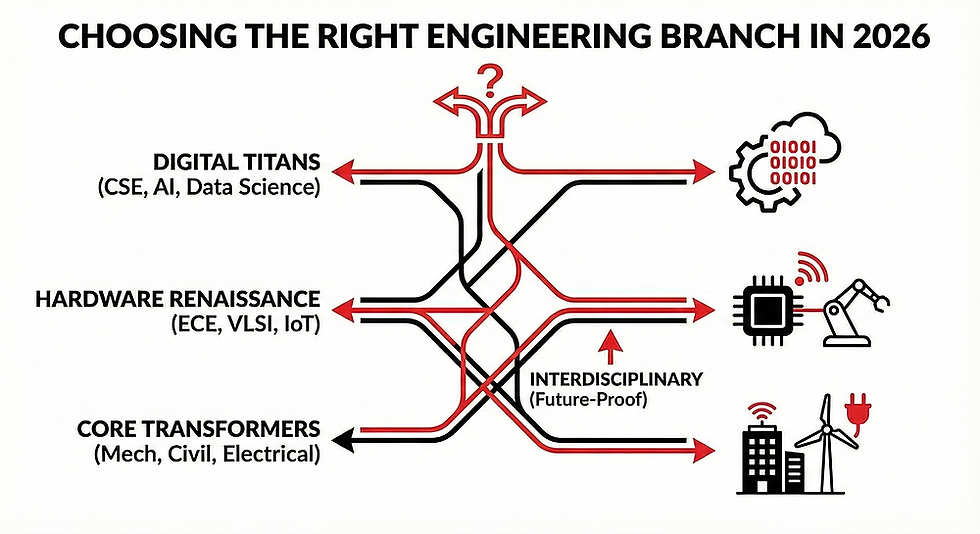
Why Choosing the Right Branch Matters
Your engineering branch influences:
Subjects you will study for four years
Internship opportunities
Career options after graduation
Placement opportunities
Higher education prospects
Although skills can help you switch careers later, choosing a branch that matches your interests can make your college journey more enjoyable and productive.
Step 1: Understand Your Interests
Before looking at placement records or salary packages, ask yourself:
Do you enjoy:
Coding and software development?
Mathematics and data analysis?
Machines and manufacturing?
Electronics and circuits?
Construction and infrastructure?
Artificial Intelligence and automation?
Your answers can help identify suitable engineering fields.
Interest-Based Branch Selection
Interest Area | Recommended Branch |
Coding & Software | Computer Engineering, IT |
AI & Machine Learning | AI & Data Science |
Electronics | Electronics & Telecommunication |
Machines & Design | Mechanical Engineering |
Infrastructure | Civil Engineering |
Energy Systems | Electrical Engineering |
Step 2: Research Future Career Opportunities
Technology is evolving rapidly, and some branches are expected to grow faster than others.
Engineering Branches with Strong Future Scope
Branch | Future Demand |
Computer Engineering | Very High |
AI & Data Science | Very High |
Information Technology | High |
Electronics & Telecommunication | High |
Electrical Engineering | High |
Mechanical Engineering | Moderate to High |
Civil Engineering | Moderate |
Fields related to AI, cloud computing, cybersecurity, and automation are expected to see significant growth over the next decade.
Step 3: Compare Placement Opportunities
Placements are often a major factor when selecting a branch.
Average Placement Comparison (2026)
Branch | Average Package |
AI & Data Science | ₹7–18 LPA |
Computer Engineering | ₹6–15 LPA |
Information Technology | ₹5–12 LPA |
Electronics & Telecommunication | ₹5–10 LPA |
Electrical Engineering | ₹4–9 LPA |
Mechanical Engineering | ₹4–8 LPA |
Civil Engineering | ₹3–7 LPA |
Remember that college reputation, skills, internships, and projects can significantly influence your package.
Step 4: Understand the Branch Curriculum
Many students choose a branch without understanding its syllabus.
Example
Computer Engineering
Programming
Data Structures
Artificial Intelligence
Database Management
Operating Systems
Mechanical Engineering
Thermodynamics
Manufacturing Processes
Machine Design
Fluid Mechanics
Civil Engineering
Structural Design
Surveying
Construction Technology
Reviewing the curriculum can help ensure that the subjects genuinely interest you.
Step 5: Consider Your Strengths
Ask yourself:
Are you good at:
Logical reasoning?
Mathematics?
Creativity?
Problem-solving?
Designing systems?
Communication?
Matching your strengths with a branch often leads to better academic performance and career satisfaction.
Popular Engineering Branches in 2026
Computer Engineering
Best for students interested in:
Coding
Software Development
Artificial Intelligence
Cybersecurity
Artificial Intelligence & Data Science
Ideal for students who enjoy:
Data Analysis
Machine Learning
AI Technologies
Predictive Modeling
Information Technology
Suitable for students interested in:
Networking
Cloud Computing
Cybersecurity
Software Systems
Mechanical Engineering
Best for those who enjoy:
Machines
Manufacturing
Robotics
Product Design
Civil Engineering
Recommended for students interested in:
Infrastructure
Construction
Urban Development
Common Mistakes Students Make
Choosing Only Based on Placements
High placement packages should not be the only deciding factor.
Following Friends
Your interests may be different from your friends .
Ignoring the Syllabus
A branch with good placements may not suit your interests.
Believing One Branch Guarantees Success
Success depends on skills, projects, and continuous learning, not just the branch name.
Engineering Branch Comparison Table
Factor | Computer | IT | AI & DS | Mechanical | Civil |
Placements | Excellent | Excellent | Excellent | Good | Moderate |
Coding | High | High | High | Low | Low |
AI Exposure | High | Moderate | Very High | Low | Low |
Core Engineering | Moderate | Low | Moderate | High | High |
Future Scope | Very High | High | Very High | High | Moderate |
Expert Advice for Students
If you're still confused:
Identify your interests.
Research the syllabus.
Check placement records.
Explore future industry trends.
Speak with seniors and professionals.
Focus on long-term career goals rather than short-term trends.
The best branch is not necessarily the one with the highest package—it's the one that aligns with your skills and ambitions.
Conclusion
Choosing the right engineering branch after 12th is a decision that can shape your academic and professional future. While Computer Engineering, AI & Data Science, and IT are among the most popular branches in 2026, every engineering field offers opportunities for growth and success.
The key is to choose a branch based on your interests, strengths, career goals, and industry trends rather than simply following popular opinions. Remember, skills, projects, internships, and continuous learning will ultimately determine your success, regardless of the branch you select.
Choose wisely, stay curious, and keep learning.
Frequently Asked Questions (FAQs)
1. Which engineering branch is best after 12th?
There is no single best branch. The right choice depends on your interests, strengths, and career goals.
2. Which engineering branch has the highest salary in 2026?
AI & Data Science and Computer Engineering often offer some of the highest salary packages.
3. Should I choose a branch based on placements?
Placements are important, but your interests and long-term goals should also be considered.
4. Is Computer Engineering better than IT?
Both offer excellent career opportunities. The choice depends on your preferences and interests.
5. Which branch has the best future scope?
AI & Data Science, Computer Engineering, Electronics, and Electrical Engineering are expected to have strong future demand.
6. Can I switch branches after the first year?
Many colleges allow branch changes after the first year based on CGPA and seat availability.
7. Is Mechanical Engineering still worth it?
Yes. Mechanical Engineering continues to offer opportunities in manufacturing, robotics, aerospace, and automation.
8. How can I know which branch suits me?
Evaluate your interests, strengths, career aspirations, and preferred subjects before making a decision.


Comments