HSC Physics Question Bank with Important Questions – Dual Nature of Radiation and Matter 2026
- Feb 12
- 4 min read

Preparing for the Maharashtra HSC Board Exam 2026 requires a strategic approach, especially for "Modern Physics" chapters. The HSC Physics Question Bank with Important Questions – Dual Nature of Radiation and Matter 2026 is designed to help students master the concept of wave-particle duality, which is a cornerstone of both board exams and medical entrance tests like NEET.
This chapter is historically known for being "high-yield" because it offers a perfect balance of theoretical definitions, neat diagrams, and straightforward numerical problems. In this guide, we provide a comprehensive breakdown of the most repeated questions, official resources, and the weightage you need to know to score full marks in this section.
HSC Physics Question Bank with Important Questions – Dual Nature of Radiation and Matter 2026: Chapter Weightage
According to the latest 2026 curriculum data from the Maharashtra State Board (MSBSHSE), the chapter Dual Nature of Radiation and Matter carries a weightage of:
Without Option: 4 Marks
With Option: 5 Marks
While 5 marks might seem small compared to chapters like Wave Optics, this unit is considered "scoring" because the questions are predictable and often repeated from the official question bank. For students aiming for medical careers, this chapter provides the foundational physics required to understand medical imaging and radiation therapy.
Official Question Bank and Previous Year Analysis
To align your preparation with official standards, students must refer to the state-authorized portals. The State Council of Educational Research and Training (SCERT) Maharashtra regularly updates the "Prashnapedhi" (Question Bank) to reflect the latest exam patterns.
Official Links for Maharashtra Board Question Banks
MSBSHSE Official Website: Access Previous Year Papers
SCERT Maharashtra Website: Download Official Question Bank (Maa.ac.in)
By analyzing papers from the last five years, it is evident that the board prioritizes Einstein's Photoelectric Equation and the de Broglie Hypothesis.
Top Important Questions for HSC Physics 2026
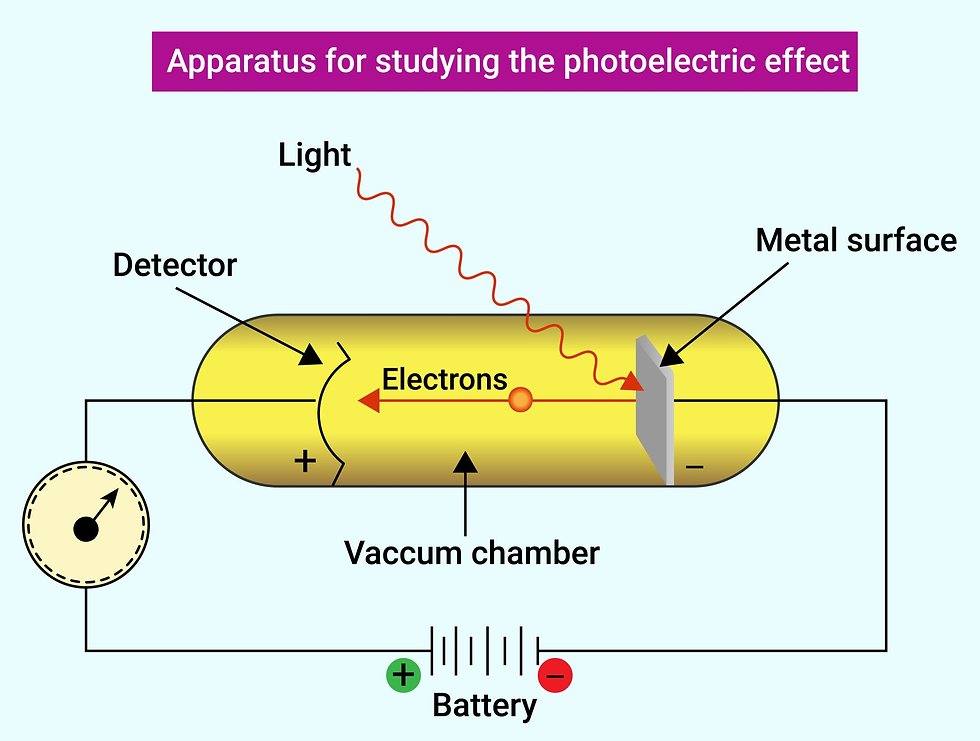
Below is a curated list of questions that have appeared most frequently in the HSC Board Exams.
Very Short Answer Questions (1 Mark)
Define the term "Threshold Frequency" in the context of the photoelectric effect.
What is "Stopping Potential"?
State the relation between the momentum of a particle and its associated de Broglie wavelength.
Define "Work Function" of a metal surface.
What is the effect of increasing the intensity of incident light on the photoelectric current?
Short Answer Questions (2 - 3 Marks)
Distinguish between: Wave Theory of Light and Photon Theory regarding the photoelectric effect.
State and explain the characteristics of the Photoelectric Effect.
Draw a neat labeled diagram of the experimental setup to study the Photoelectric Effect.
Describe the construction and working of a Photocell with a labeled diagram.
Derive an expression for the de Broglie wavelength of an electron accelerated through a potential difference.
Long Answer Questions (4 Marks)
State Einstein’s Photoelectric Equation. Explain how it accounts for the existence of threshold frequency and the independence of maximum kinetic energy on light intensity.
Explain the Davisson and Germer experiment with a neat diagram. What was the primary conclusion of this experiment regarding the nature of matter?
Essential Formula Names for Revision
In the HSC Physics Question Bank with Important Questions – Dual Nature of Radiation and Matter 2026, you don't need to memorize complex derivations for every small step, but you must know these formula names to solve numerical problems:
Energy of a Photon (Planck’s Relation)
Einstein’s Photoelectric Equation
Work Function and Threshold Frequency Relation
Stopping Potential and Maximum Kinetic Energy Relation
De Broglie Wavelength (for particles and accelerated electrons)
Photon Momentum Formula
Medical Relevance of Dual Nature of Radiation
For students interested in the medical field, this chapter is not just about marks. The principles of the Dual Nature of Radiation and Matter are applied in:
Electron Microscopy: Using the wave nature of electrons to visualize viruses at a scale impossible for light microscopes.
Radiation Therapy: Understanding how high-energy photons interact with matter to treat cancer cells.
Diagnostic Imaging: The photoelectric effect is the fundamental process behind X-ray absorption in human tissues.
Conclusion
Mastering the HSC Physics Question Bank with Important Questions – Dual Nature of Radiation and Matter 2026 is one of the smartest ways to secure easy marks in your board exams. By focusing on the definitions, Einstein’s equation, and the de Broglie hypothesis, you align yourself with both the board's expectations and the requirements of competitive medical entrance exams.
FAQ Section
Q1: Where can I download the official HSC Physics Question Bank with Important Questions – Dual Nature of Radiation and Matter 2026?
Ans: You can download the official question bank from the SCERT Maharashtra website at www.maa.ac.in. This "Prashnapedhi" is the most reliable source for board exam preparation.
Q2: Does the intensity of light affect the stopping potential?
Ans: No. The stopping potential depends only on the frequency of the incident radiation and the nature of the material, not on the intensity of light.
Q3: Is the Davisson and Germer experiment still important for 2026?
Ans: Yes, it is a frequently asked 3 or 4-mark question as it provides experimental proof for de Broglie’s hypothesis.
Q4: How much time should I spend on this chapter?
Ans: Given its 5-mark weightage and concise theory, a dedicated 4 to 6 hours of study (including numerical practice) is sufficient to master this chapter.


Comments