India’s ₹37,500-Crore Coal Gasification Push Attracts Adani and NTPC: What Happens Next?
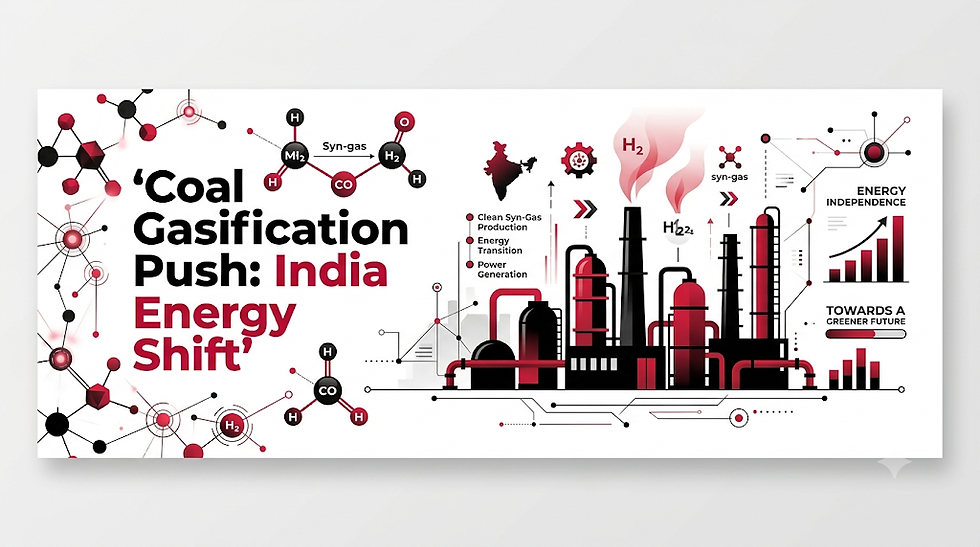
India is embarking on one of the most consequential energy and industrial transitions in its modern economic history. With the Union Government rolling out a massive ₹37,500-crore coal gasification push, the country is seeking to pivot away from burning raw thermal coal for electricity and move toward utilizing its vast domestic mineral reserves as high-value industrial feedstocks.
Following the initial round of competitive bidding under the Ministry of Coal's expanded surface gasification scheme, marquee conglomerates—most notably Gautam Adani’s Adani Enterprises Limited and state-owned power giant NTPC Limited—have officially submitted multi-billion-rupee bids. Joined by players like Talcher Fertilisers Limited, Gallantt Ispat, and Shyam Sel & Power, this initial cohort has silenced early industry skepticism.
What sparked this aggressive corporate interest? How does this massive capital subsidy operate, and what happens next as India races toward its ambitious 100-million-tonne (MT) gasification target by 2030?
The Strategic Urgency: Why Coal Gasification Matters for India
India holds the fourth-largest coal reserves in the world, with geological resources exceeding 389 billion tonnes—of which over 212 billion tonnes represent proven, economically extractable reserves. Yet, despite this abundance, India remains severely vulnerable to global geopolitical volatility, supply chain disruptions, and currency strain caused by massive commodity imports.
During FY 2024–25, India spent approximately ₹2.77 lakh crore ($33+ billion) importing four critical commodities:
Liquefied Natural Gas (LNG) for city gas distribution and heavy industry
Urea to subsidize the domestic agricultural sector
Ammonia for chemical and explosive manufacturing
Methanol for industrial solvents, blending, and petrochemical processing
┌────────────────────────────────────────────────────────────────────────┐
│               INDIA'S IMPORT SUBSTITUTION OPPORTUNITY                  │
│                                                                        │
│   Total Imports (FY25): ~₹2.77 Lakh Crore across 4 Key Commodities     │
│   ├── LNG (Import Dependency: ~50%)                                    │
│   ├── Urea (~7.5-9 MT imported annually)                               │
│   ├── Ammonia (Crucial precursor for fertilizers & chemicals)          │
│   └── Methanol (Feedstock for formaldehyde, acetic acid, fuels)        │
│                                                                        │
│   Strategic Solution: Convert Domestic Coal ──► Syngas ──► Feedstocks  │
└────────────────────────────────────────────────────────────────────────┘
Traditional combustion of coal produces severe fly ash loads and heavy greenhouse gas emissions while capturing only thermal energy. In contrast, coal gasification is a thermochemical process where coal is subjected to controlled amounts of oxygen and steam under elevated temperatures and pressures. Instead of burning, the coal undergoes partial oxidation to produce syngas (synthesis gas)—a versatile mixture of carbon monoxide (CO), hydrogen (H₂), and methane (CH₄).
By refining syngas, domestic plants can synthesize Synthetic Natural Gas (SNG), green/blue ammonia, urea, and clean hydrogen without importing a single barrel of oil or cargo of LNG.
Decoding the ₹37,500-Crore Coal Gasification Push
The ₹37,500-crore coal gasification push builds upon the foundation laid by the National Coal Gasification Mission and an earlier ₹8,500-crore Viability Gap Funding (VGF) scheme approved in January 2024 (under which eight pilot and commercial projects are currently under execution).
Approved by the Union Cabinet in May and opened for competitive Request for Proposals (RFP) on July 7, the new ₹37,500-crore outlay is structured to catalyze an estimated ₹2.5 to ₹3.0 lakh crore ($30–36 billion) in cumulative private and public capital expenditure.
Key Financial Pillars of the Scheme:
Capital Subsidy Structure: The government offers financial assistance capped at up to 20% of the total cost of plant and machinery, disbursed across four milestone-linked tranches.
Project Caps: To prevent monopolization and encourage diverse technological approaches, financial support is capped at ₹5,000 crore for any single project.
Product & Entity Thresholds: The incentive for any single commodity class (with exemptions for Synthetic Natural Gas and Urea due to their capital intensity) is limited to ₹9,000 crore, while any single business group is capped at a maximum of ₹12,000 crore across all rounds.
Volume Target: The scheme aims to develop 75 million tonnes of annual surface gasification capacity across roughly 25 commercial installations, directly underpinning India’s national 2030 target of gasifying 100 MT of coal.
Meet the First-Round Contenders: Adani, NTPC, and Industrial Heavyweights
When the Ministry of Coal closed Round 1 on September 7, five companies submitted seven formal project proposals, validating long-term corporate appetite for clean-coal technologies.
┌─────────────────────────────┬───────────┬──────────────────────────────┐
│ Applicant Company           │ Proposals │ Targeted Downstream Product  │
├─────────────────────────────┼───────────┼──────────────────────────────┤
│ Adani Enterprises Ltd (AEL) │ 3         │ Coal-to-Urea                 │
│ NTPC Limited                │ 1         │ Synthetic Natural Gas (SNG)  │
│ Talcher Fertilisers Ltd     │ 1         │ Coal-to-Urea                 │
│ Gallantt Ispat Limited      │ 1         │ Direct Reduced Iron (DRI) &  │
│                             │           │ Syngas                       │
│ Shyam Sel & Power Limited   │ 1         │ Industrial Syngas            │
└─────────────────────────────┴───────────┴──────────────────────────────┘
1. Adani Enterprises: Aggressive Bet on Agricultural Self-Reliance
Adani Enterprises emerged as the most aggressive private bidder, submitting three separate proposals dedicated to coal-to-urea production. India consumes over 35 million tonnes of urea annually, relying heavily on subsidized imported natural gas or imported finished prills. By securing coal blocks and leveraging gasification incentives, Adani aims to integrate downstream chemical manufacturing with its existing mining and logistics footprint.
2. NTPC Limited: Shifting Thermal Baselines to Synthetic Natural Gas
As India's largest power utility, NTPC is actively diversifying its energy portfolio. Its bid focuses on producing Synthetic Natural Gas (SNG). Rather than simply routing coal into supercritical boilers, NTPC seeks to inject pipeline-quality SNG directly into India's national gas grid, supporting GAIL's cross-country pipelines and local City Gas Distribution (CGD) networks.
3. Talcher Fertilisers: Revitalizing Odisha's Historic Complex
Talcher Fertilisers Limited (TFL)—a high-profile joint venture between Coal India Limited (CIL), GAIL, Rashtriya Chemicals and Fertilizers (RCF), and FCIL—has applied for support to reinforce its flagship coal-to-urea complex in Odisha, which serves as a technological bellwether for gasifying high-ash domestic coal.
4. Steel and Syngas Entrants: Gallantt Ispat & Shyam Sel & Power
Reflecting demand from the domestic metallurgy and metals sector, Gallantt Ispat's bid targets Direct Reduced Iron (DRI) and syngas. Using syngas to reduce iron ore offers an immediate decarbonization lever for secondary steelmakers who currently depend on imported coking coal or costly furnace oil.
The Technology Bottleneck: Overcoming Indian Coal’s High Ash Content
While the commercial prospects are vast, gasifying Indian coal presents unique chemical and thermodynamic hurdles:
High Ash Concentration (35% to 50%): Unlike low-ash anthracites found in Australia or the US, Indian non-coking coal contains dense mineral matter, silica, and alumina. In standard entrained-flow gasifiers, this high ash volume accelerates refractory lining erosion and creates slag-handling complications.
Low Ash Fusion Temperatures: Indian coal ash has a refractory nature with variable ash-softening temperatures, necessitating specialized Fluidized Bed Gasifiers (such as Circulating Fluidized Bed or High-Ash Transport Bed reactors) rather than off-the-shelf entrained systems.
Capital Intensity & Gestation Lags: A full-scale commercial gasification-cum-chemical complex requires 42 to 54 months to construct and commission, demanding rigorous pre-feasibility analysis, technology licensing agreements, and water-allocation clearances.
However, modern fluidized bed reactors—combined with advancements in pre-gasification coal beneficiation (washing) and air-separation units—have demonstrated consistent operational metrics, giving project developers confidence to deploy capital.
What Happens Next? The Road Ahead for Round 2 and Beyond
With Round 1 bids now under technical scrutiny, the momentum shifts toward institutional evaluation, continuous procurement, and project financing.
┌────────────────────────────────────────────────────────────────────────┐
│                  ROADMAP: WHAT HAPPENS NEXT?                           │
│                                                                        │
│   Q3-Q4 2026: Technical Scrutiny & Financial Evaluation of Round 1     │
│   ├── Inter-Ministerial Committee reviews DPRs and technology tie-ups  │
│   └── Formal sanction and Letter of Award (LoA) issuances              │
│                                                                        │
│   Continuous Procurement: Rolling 2-Month Bidding Windows              │
│   ├── Round 2 open (Closing early November 2026)                       │
│   └── Ongoing rounds to allocate remaining outlay across 25 projects   │
│                                                                        │
│   2027–2028: EPC Contracting & Groundbreaking                          │
│   ├── Finalization of Technology Licensors (Shell, Air Products, etc.) │
│   └── Civil construction and procurement of heavy pressure vessels     │
│                                                                        │
│   2029–2030: Commissioning & Commercial Ramp-up                        │
│   └── Delivery toward India's 100 MT National Gasification Goal        │
└────────────────────────────────────────────────────────────────────────┘
1. Rigorous Technical & Financial Evaluation (Late 2026)
The Ministry of Coal’s project screening committee will evaluate the seven Round 1 applications against strict benchmarks: technology licensor viability, coal linkage allocations, environmental impact assessments, and equity closure capabilities. Initial subsidy allocations are expected before the close of the financial year.
2. Rolling Two-Month Application Cycles (Round 2 Now Live)
Recognizing that large-scale industrial proposals require extended preparation, the government opened Round 2 immediately following Round 1. New application windows will open at two-month intervals throughout 2026 and 2027. Multiple public and private entities—including Coal India subsidiaries, private steel majors, and international chemical conglomerates—are finalizing feasibility studies for upcoming rounds.
3. EPC Mobilization and Technology Partnerships (2027)
Winning bidders will enter detailed engineering, procurement, and construction (EPC) phases. Securing global technology tie-ups with leading gasification licensors (such as Air Liquide, Shell, Casale, and Topsoe) and placing orders for cryogenic air separation units and heavy gasification vessels will set the industrial cadence for 2027.
4. Integration with Carbon Capture, Utilization, and Storage (CCUS)
Because syngas synthesis concentrates CO₂ into pure process streams (unlike post-combustion thermal flue gas), gasification plants are prime candidates for Carbon Capture, Utilization, and Storage (CCUS). Developers that co-locate carbon mineralization, urea synthesis, or enhanced oil recovery (EOR) will position these assets comfortably within India’s long-term decarbonization pathway toward Net Zero 2070.
Frequently Asked Questions (FAQs)
What is India's ₹37,500-crore coal gasification push?
India's ₹37,500-crore coal gasification push is a landmark Union Cabinet-approved financial incentive framework designed to promote surface coal and lignite gasification. It provides capital subsidies of up to 20% on plant and machinery (capped at ₹5,000 crore per project) to establish approximately 25 commercial-scale gasification plants by 2030, targeting 75 million tonnes of domestic coal processing.
Why did Adani Enterprises and NTPC submit bids under this initiative?
Adani Enterprises applied for three coal-to-urea projects to capture India's expanding agricultural fertilizer market and reduce import dependence. NTPC submitted a proposal for Synthetic Natural Gas (SNG) to diversify its baseload generation assets, supply natural gas networks, and transition beyond direct coal combustion.
How does coal gasification help India reduce import bills?
By converting domestic coal into syngas, plants can manufacture urea, methanol, ammonia, and synthetic methane locally. In FY 2024–25, India spent roughly ₹2.77 lakh crore on importing these four commodities. Gasification enables substantial import substitution, conserving foreign exchange reserves.
How does this scheme differ from the earlier ₹8,500-crore scheme?
The earlier ₹8,500-crore viability gap funding (VGF) scheme, announced in January 2024, supported eight initial demonstration and public-sector projects. The new ₹37,500-crore program is an expanded, multi-round commercial framework designed to scale total capacity to 75 MT, engaging both public and private sectors through rolling bidding windows.
Is coal gasification environmentally cleaner than coal combustion?
Yes. Rather than releasing particulate matter, sulfur oxides (SOx), and nitrous oxides (NOx) into the atmosphere through open combustion, gasification occurs in a sealed, pressurized reactor. Pollutants like sulfur and particulate ash are captured before chemical synthesis. Moreover, the resulting CO₂ stream is highly concentrated, making carbon capture and utilization (CCU) significantly more cost-effective.
Conclusion & Strategic Outlook
The convergence of government capital subsidies and private-public balance sheet strength marks a transformative chapter in India's resource management. India’s ₹37,500-crore coal gasification push does not merely offer a lifeline for domestic coal mining—it reimagines coal as an industrial building block for food security (urea), industrial heating (SNG), and domestic manufacturing (syngas and chemicals).
As Round 1 evaluations progress and Round 2 bids open, India is taking decisive steps toward transforming its fossil fuel endowment into clean, high-value economic resilience.
Stay Ahead of India's Clean Energy & Industrial Transition
Are you tracking major energy infrastructure, mining, and industrial decarbonization developments across South Asia?
Explore Policy Updates: Stay informed on official circulars directly via the Ministry of Coal, Government of India.
Track Clean Power Initiatives: Review ongoing transition projects on the NTPC Official Portal.
Stay Updated on National Gas Grid Milestones: Follow grid developments through the Petroleum and Natural Gas Regulatory Board (PNGRB).
Subscribe to our industrial energy brief to receive in-depth analyses on India's evolving clean technology landscape.


Comments