Indian Founders Guide: Winning Early Stage Startup Funding 2026
The Indian startup ecosystem in 2026 has reached a pivotal maturation phase. Gone are the days when loose total addressable market (TAM) slides and grand hyper-growth promises could unlock multi-million dollar term sheets overnight. As the mid-year funding figures settle, a clear pattern has emerged across Bengaluru, Gurugram, Mumbai, and tier-2 innovation hubs: venture capital is flowing again, but with unprecedented selectivity.
According to H1 2026 ecosystem reports from Tracxn, Indian technology startups raised $7.2 billion across 652 rounds in the first half of 2026. While total funding expanded by 12% compared to H1 2025, overall deal volume plummeted by 43% year-over-year. Investors are trading breadth for depth, writing substantially larger cheques to a far tighter cohort of disciplined, execution-oriented companies.
Intriguingly, early-stage capital has proven to be the brightest spark in this environment. Seed and pre-seed rounds saw a 58% year-on-year surge in capital deployment during early 2026, crossing $1 billion. However, venture firms like Peak XV, Accel India, Blume Ventures, and Elevation Capital are holding a higher bar than ever before.
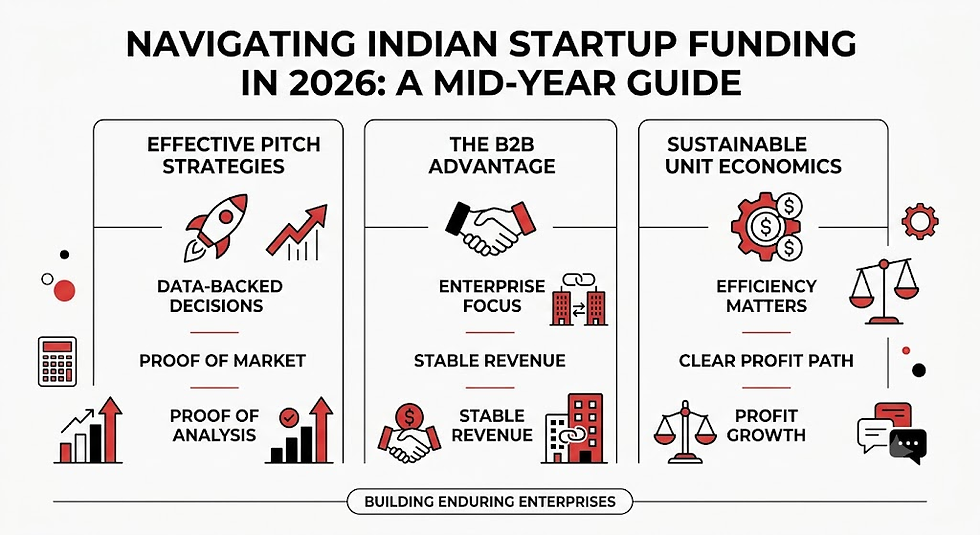
To succeed in securing capital today, early-stage founders must navigate three essential pillars: evidence-led pitch strategies, B2B business models, and bulletproof unit economics.
1. The 2026 Investment Landscape: Selective Confidence & Capital Realism
To understand how to raise funds in 2026, founders must first analyze where investor capital is actually concentrating. The venture market has firmly moved past the post-2021 correction and entered a phase of selective confidence.
The data reflects a structural shift in investor behavior. While growth and late-stage capital are concentrated in category leaders—evidenced by massive mega-rounds in fintech and AI infrastructure like CRED, Neysa, and Sarvam—early-stage investors are looking for startups that can reach profitability without requiring endless bridge rounds.
Furthermore, the public market exit path for Indian startups has widened significantly. With 13 tech startups completing domestic IPOs in H1 2026 alone (including Fractal Analytics, Amagi, and Shadowfax), the average timeline from first funding to IPO has compressed from 14.5 years down to 8.1 years. Venture capital funds are actively seeking early-stage investments that fit this streamlined, governance-first trajectory.
2. Redefining Pitch Strategies for Early Stage Startup Funding 2026
The classic 10-slide pitch deck centered primarily on founder pedigree and expansive market estimates is no longer sufficient. In 2026, Indian founders who successfully close oversubscribed rounds build their pitch around a fundraising proof stack.
Moving from Narrative-Led to Evidence-Led Presentations
Investors in 2026 evaluate risk through proof points rather than projection spreadsheets. A winning pitch stack covers six distinct layers of operational reality:
Customer Proof: Demonstrable pilot usage, letter-of-intent (LOI) conversions, organic retention cohorts, and net expansion metrics.
Product Proof: High product interaction frequency, low time-to-value, clear IP/technical moat, and architecture built for scalability.
Commercial Proof: Transparent pricing logic, realistic customer acquisition cost (CAC) assumptions, and shrinking sales cycle durations.
Operating Proof: A lean burn model, disciplined headcount planning, and at least 18–24 months of operational runway post-investment.
Governance & Compliance Proof: Clean cap tables, reverse-flip completions (for startups restructuring back to India), clean tax filings, and strict IP ownership assignments.
Market Timing Wedge: Clear justification of why this solution is necessary now—often tied to enterprise digital maturity, AI implementation, or regulatory shifts.
Pitching Artificial Intelligence & DeepTech Realistically
Because AI-native startups like Neysa and Sarvam reached unicorn status in under 2.5 years during H1 2026, many early-stage pitch decks attempt to append "GenAI" to their narrative. VCs have developed sharp filters for this. Merely wrapping a public LLM API with a thin user interface is a red flag.
When pitching AI or deeptech solutions, founders must answer:
Does the software replace existing enterprise software spend or demand an entirely new budget item?
Do you possess proprietary data rights or vertical domain workflows that prevent easy replication by incumbent platforms?
How do your inference costs scale relative to contract value as client usage expands?
3. The B2B Advantage: Why Enterprise Digitization Captures Capital
One of the most defining shifts in the 2026 funding ecosystem is the capital migration from capital-intensive consumer internet to cash-efficient B2B models. While consumer tech startups face escalating customer acquisition costs on digital ad platforms, B2B ventures offer predictable recurring revenues and higher contract stickiness.
Navigating the "India-for-India" vs. "India-for-Global" B2B Playbook
Indian B2B founders navigating mid-year funding in 2026 generally follow one of two fundable pathways:
The Global B2B SaaS Model: Building in India to sell globally (primarily North America, Europe, and SEA). Early-stage VCs look for startups that capitalize on the Indian talent arbitrage to deliver product iteration speeds while maintaining dollar-denominated average revenue per user (ARPU).
The Domestic Enterprise Digitization Model: Targeting India's rapidly modernizing mid-market and enterprise landscape. With government digital infrastructure (UPI, Account Aggregators, ONDC) operating at scale, B2B platforms solving supply chain bottlenecks, tax/compliance automation, and industrial workflow digitization are unlocking massive value.
In both pathways, contract stability, low churn rates, and high net revenue retention (NRR above 110%) serve as major capital magnets.
4. Masterclassing Early Stage Startup Funding 2026: Sustainable Unit Economics
In 2026, the mandate for early-stage startups is simple: demonstrate a clear route to positive unit economics before attempting to scale distribution. Investors no longer fund growth that relies on subsidized unit margins.
The Core Metrics Indian VCs Scrutinize
To pass investor due diligence in 2026, founders must have complete command over five non-negotiable financial metrics:
1. LTV to CAC Ratio
The lifetime value (LTV) of a customer relative to customer acquisition cost (CAC) must comfortably exceed 3:1 for early-stage companies. In B2B SaaS, top-tier metrics push toward 4:1 or 5:1, driven by organic expansion and land-and-expand sales strategies.
2. CAC Payback Period
How long does it take for a paying customer to return the capital spent acquiring them? In the current market, investors expect a CAC payback period of under 12 months for SMB SaaS and under 18 months for enterprise accounts.
3. Contribution Margin
Startups must demonstrate positive Contribution Margin 2 (CM2)—meaning revenue covers direct variable costs, payment processing, cloud hosting, onboarding, and direct customer support—before allocating capital toward aggressive sales and marketing.
4. Gross Margin Profile
Software and B2B SaaS startups are expected to maintain gross margins between 70% and 80%. For B2B marketplaces or hardware-enabled software, gross margins should clear 20% to 35%, proving that gross transaction value (GTV) yields real gross profit.
5. Capital Efficiency / Net Burn Multiple
Investors calculate your Net Burn Multiple (Net Burn ÷ Net New ARR). A burn multiple below 1.5x is considered healthy for early-stage companies in 2026; anything above 2.5x indicates inefficient sales or bloated operations.
5. Playbook for Founders: Actionable Steps for H2 2026 & Beyond
For Indian founders planning their next capital raise in late 2026 or early 2027, execution discipline in the mid-year window determines success. Here is a step-by-step roadmap:
Step 1: Extend Your Runway to 18–24 Months
Venture deal cycles in 2026 take longer due to deep technical and financial due diligence. Raising capital with less than 6 months of runway compromises your negotiation power. Rationalize non-essential software subscriptions, streamline low-performing marketing channels, and preserve capital to ensure runway extends through partner meetings.
Step 2: Formalize Your Governance Early
Clean up your legal structure early. Ensure all co-founder equity is on a standard four-year vesting schedule with a one-year cliff. Obtain proper intellectual property (IP) assignment agreements for all employees and contractors, and resolve tax or compliance filings under Indian corporate law.
Step 3: Run a Targeted, Multi-Tiered Investor Pipeline
Do not rely on cold emails to generic inbox addresses. Map institutional seed funds, micro-VCs, and strategic angels into three distinct tiers:
Tier 1: High-conviction leads with direct sector expertise.
Tier 2: Well-regarded institutional funds writing active seed cheques.
Tier 3: Value-add angel syndicates and founder-investors.
Utilize warm introductions from existing portfolio founders to secure initial introductory calls.
Frequently Asked Questions (FAQs)
What is the state of early stage startup funding 2026 in India?
Early stage startup funding 2026 in India is experiencing a strong resurgence in capital volume despite fewer overall deals. Seed-stage investments grew over 58% year-on-year in early 2026, with investors concentrating capital into well-governed startups that show clear customer retention, high gross margins, and sustainable unit economics.
What average cheque sizes are seed-stage VCs writing in 2026?
Typical seed-stage cheque sizes in India for 2026 range between $1 million and $3 million for institutional seed rounds, while pre-seed rounds generally range from $300,000 to $1 million. Top tier funds like Peak XV, Accel, Blume, and Elevation Capital often lead these rounds with larger institutional participation.
Why are B2B SaaS and enterprise tech receiving more funding than B2C in 2026?
Investors favor B2B SaaS and enterprise technology due to higher revenue predictability, sticky customer contracts, clearer paths to profitability, and lower customer acquisition costs compared to consumer-facing startups. Furthermore, ongoing enterprise digitization across global markets creates immediate, high-margin demand.
How long does a fundraising cycle take for early-stage Indian startups in 2026?
On average, an early-stage fundraising process in 2026 takes between 3 to 5 months from the initial pitch meeting to term sheet signing and wire transfer. Because VCs conduct deeper due diligence on unit economics and legal compliance, founders are advised to maintain at least 18 months of operational runway prior to launching a raise.
Key Takeaways & Strategic Resources
The mid-year 2026 funding landscape rewards discipline, clarity, and structural resilience. By anchoring your startup in sustainable unit economics, targeting sticky B2B workflows, and delivering evidence-backed pitch stacks, Indian founders can successfully secure the capital required to build enduring, market-leading companies.
Connect with Ecosystem Resources & Capital Support
Explore government schemes, tax exemptions, and seed funding assistance through the official Startup India Portal.
Analyze national trade opportunities, foreign direct investment updates, and market intelligence at Invest India.
Track verified startup intelligence and industry metrics via market data platforms like Tracxn.


Comments