Job vs M.Tech After GATE 2026: Which Is Better for Salary, Career Growth & Future?
- Mar 21
- 3 min read
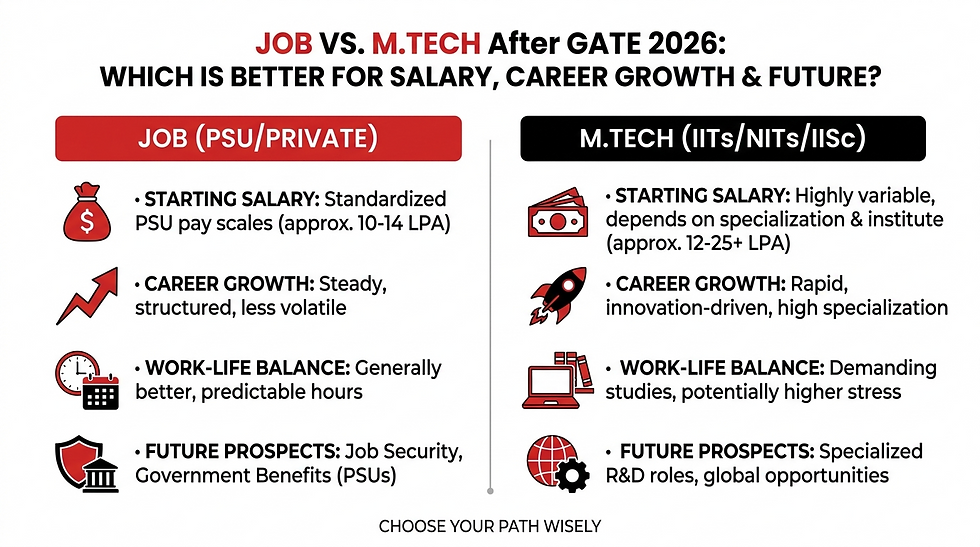
Choosing between a job and M.Tech after GATE 2026 is one of the most critical career decisions for engineering graduates. With evolving industry demands, rising salaries, and increasing competition, this decision is no longer straightforward.
In this detailed guide, we will compare Job vs M.Tech After GATE 2026 based on salary, career growth, job stability, long-term benefits, and real 2026 data—so you can make a clear and informed decision.
Understanding Your Two Options After GATE 2026
After clearing GATE, you mainly have two paths:
1. Job After GATE
PSU jobs (through GATE score)
Private sector jobs (core + IT roles)
Government technical roles (like NIC, DRDO, etc.)
2. M.Tech After GATE
Admission to IITs, NITs, IISc
Specialization in core or emerging fields (AI, Data Science, VLSI, etc.)
Research or academic career
Salary Comparison: Job vs M.Tech After GATE 2026
Job Salary After GATE 2026
Average salary: ₹7–8 LPA
High performers: ₹9–32 LPA
PSU salary range: ₹12–20 LPA (plus perks)
Government jobs: ₹35,400 – ₹1,12,400/month (example: NIC 2026 recruitment)
Key Insight: PSU jobs offer stable income with perks like HRA, DA, and job security.
M.Tech Salary After GATE 2026
IIT median salary: ₹18–24 LPA
Top branches (CSE): ₹28–32 LPA average
Highest packages: ₹40 LPA+ (even ₹46 LPA reported)
NIT average: ~₹11–13 LPA
Key Insight: M.Tech from top IITs can significantly boost salary potential.
Job vs M.Tech After GATE 2026: Detailed Comparison
1. Career Growth
Job Path:
Early industry exposure
Faster financial independence
Growth depends on skills and company switching
M.Tech Path:
Strong technical foundation
Better roles in R&D, AI, core engineering
Easier entry into high-paying product companies
Verdict: If you aim for deep specialization and high-end roles → M.Tech wins If you want early career growth → Job wins
2. Financial Perspective
Job:
Start earning immediately
No additional education cost
Can support family early
M.Tech:
2 years opportunity cost
Stipend (~₹12,400/month in IITs)
Higher salary after completion
Verdict: Short-term → Job Long-term → M.Tech
3. Job Stability
Job (PSU):
Extremely stable
Fixed promotions
Government benefits
Private Job:
Performance-based growth
M.Tech:
Leads to better long-term stability in high-skill roles
Verdict: PSU job offers highest stability.
4. Skill Development
Job:
Practical skills
Industry exposure
Limited theoretical depth
M.Tech:
Advanced technical knowledge
Research exposure
Strong domain expertise
Verdict: M.Tech is better for technical mastery.
5. Flexibility & Future Options
After Job:
Can still pursue M.Tech later
Can switch domains
After M.Tech:
Can go for PhD, research, abroad studies
Better global opportunities
Best Choice Based on Your Situation
Choose Job If:
You need financial support immediately
You got a good PSU or private offer
You prefer practical work over academics
Choose M.Tech If:
You have a good GATE rank (especially for IITs)
You want high-paying roles (AI, Data Science, etc.)
You are interested in research or teaching
You want long-term salary growth
Trending M.Tech Specializations in 2026
Artificial Intelligence & Machine Learning
Data Science & Big Data
Cyber Security
VLSI & Embedded Systems
These fields are seeing massive demand and high salary growth.
Real Insight from Students (2026 Perspective)
From community discussions, many students believe:
“With experience, salary can grow without M.Tech, but top IIT M.Tech increases chances of 20+ LPA roles.”
This highlights an important point: M.Tech is not mandatory—but it accelerates growth significantly if done from top institutes.
Job vs M.Tech After GATE 2026: Final Verdict
There is no one-size-fits-all answer.
Top IIT/NIT + Good Rank → Go for M.Tech
Decent Job Offer or PSU → Take the Job
Smart Strategy (2026):Many students now:
Take a job
Prepare again for GATE
Upgrade later with M.Tech
FAQs (Job vs M.Tech After GATE 2026)
Q1. Job vs M.Tech After GATE 2026: Which is better for salary?
If you get into IITs, M.Tech offers higher long-term salary (₹18–30 LPA), while jobs provide immediate income (₹7–15 LPA initially).
Q2. Job vs M.Tech After GATE 2026: Is M.Tech worth it?
Yes, especially if done from top IITs/NITs, as it significantly improves career opportunities and salary potential.
Q3. Can I do M.Tech after working?
Yes, many professionals pursue M.Tech after 1–3 years of experience for better growth.
Q4. Is PSU better than M.Tech?
PSU is better for stability, while M.Tech is better for high growth and specialization.
Conclusion
The decision between Job vs M.Tech After GATE 2026 depends on your priorities:
Want money now → Choose Job
Want higher salary later → Choose M.Tech
Want stability → PSU Job
Want top tech roles → M.Tech from IIT
The smartest approach is not just choosing one—but aligning your choice with your long-term vision.
Before making your final decision:
Check PSU recruitment updates: https://www.iocl.com / https://www.ntpc.co.in
Explore IIT admissions: https://joaps.iitd.ac.in
Analyze placement reports of IITs/NITs
Talk to seniors and mentors
Still confused?Make a comparison sheet of your GATE rank, job offers, and career goals—this will give you clarity instantly.


Comments