Maharashtra vs Karnataka vs Tamil Nadu Engineering Admissions — Why More MHT CET Students Are Considering Leaving the State
For years, the default plan for Maharashtra students was simple: give MHT CET, participate in CAP counselling, and join a college somewhere in Mumbai, Pune, or Nashik. In 2026, that assumption is starting to change.
As an admission counsellor who has spent years tracking seat matrices, cutoff trends, and placement data across India, I am witnessing a distinct shift in student psychology. The classic mindset of "state-board-to-local-college" is fracturing. Today’s engineering aspirants are highly analytical, digital-native decision-makers. They are realizing that restricting their engineering journey to state borders might mean compromising on their dream branches or sacrificing exposure.
With the tech landscape evolving rapidly around Artificial Intelligence, Data Science, and product engineering, the question isn't just “Which college am I getting through MHT CET?” It has become “Is staying in Maharashtra giving me the best return on my four-year investment, or should I book a ticket to Bengaluru or Chennai?”
Let’s tear down the borders and look at the hard realities of engineering admissions across Maharashtra, Karnataka, and Tamil Nadu.
1. The Traditional Maharashtra Route
Historically, the Engineering Admissions Comparison for a Maharashtra student began and ended with the State Common Entrance Test Cell. The MHT CET is a high-stakes, high-pressure exam that funnels hundreds of thousands of students into the Centralized Admission Process (CAP).
For generations, the CAP system has been highly attractive due to the massive State Quota Advantage, where 85% of seats in state-level colleges are reserved for Maharashtra home-state candidates. This created a secure ecosystem featuring legendary institutions:
The Heritage Elite: College of Engineering Pune (COEP) and Veermata Jijabai Technological Institute (VJTI), Mumbai.
The Mumbai Heavyweights: Sardar Patel Institute of Technology (SPIT), D.J. Sanghvi, and Thadomal Shahani Engineering College.
The Pune Tech Hubs: Pune Institute of Computer Technology (PICT) and Vishwakarma Institute of Technology (VIT).
The Regional Powerhouses: Walchand College of Engineering (Sangli) and Shri Ramdeobaba College of Engineering and Management (Nagpur).

This ecosystem was self-sustaining. The fees were highly regulated (especially in government and aided colleges), the culture was familiar, and the local industry—ranging from Pune’s automobile belt to Mumbai’s financial tech sectors—absorbed graduates seamlessly.
2. Why Students Are Looking Beyond Maharashtra
If the system works, why are students packing their bags? The answer lies in a combination of hyper-competition, rigid branch choices, and a massive democratization of information.
The competition for a Computer Science or IT seat in Maharashtra's top-tier colleges has reached a boiling point. A student scoring a phenomenal 98 percentile in MHT CET might still find themselves locked out of a pure CSE seat at VJTI, COEP, or SPIT. Instead of settling for a minor or core branch at a premier state institute, or paying premium institutional quota fees at a mid-tier private college in Pune, students are exploring external horizons.
Furthermore, the rise of YouTube education channels, student-led online communities, and transparent college comparison platforms has broken down regional biases. A student sitting in Nagpur can now view vlog tours of Bengaluru campuses or read verified placement reports from Chennai colleges in real-time.
Reason | Why Students Consider Other States |
The Percentile Trap | Extreme competition means 97–99 percentiles no longer guarantee top-tier CSE/IT seats in Maharashtra. |
Branch Flexibility | Other states offer premium tech branches (AI, Machine Learning, Data Science) at comparable cutoffs. |
The Bengaluru Magnet | Unmatched startup exposure and product-company ecosystems that regional cities cannot replicate. |
Institutional Fee Parity | The cost of Management/Institutional seats in top private Maharashtra colleges often equals or exceeds merit seats via exams like COMEDK. |
3. Karnataka: The State Quietly Attracting Maharashtra Students
When Maharashtra students look south, their first stop is almost always Karnataka, driven primarily by the COMEDK pathway (Consortium of Medical, Engineering and Dental Colleges of Karnataka).
Karnataka’s engineering powerhouse is structurally built around Visvesvaraya Technological University (VTU) and several highly prestigious autonomous private universities. The crown jewel of this ecosystem is Bengaluru, a city that provides an industrial and startup exposure that no city in Maharashtra can fully match.
Key Institutions:
RV College of Engineering (RVCE), Bengaluru
BMS College of Engineering (BMSCE), Bengaluru
M.S. Ramaiah Institute of Technology (MSRIT), Bengaluru
Dayananda Sagar College of Engineering (DSCE)
Nitte Meenakshi Institute of Technology (NMIT)
Placements & Industry Exposure
Bengaluru is the Silicon Valley of India. For an engineering student, this means tech giants like Google, Microsoft, Amazon, and Uber are not distant entities—they are down the street. The volume of product-based companies conducting pool campus drives or offering third-year internships is staggering.
Campus Culture & Fees
The campus culture in top Karnataka colleges is intensely cosmopolitan. Students from Delhi, Mumbai, Kolkata, and Hyderabad study together, creating a hyper-competitive peer group. While COMEDK fees are higher than Maharashtra's government-aided rates (averaging around ₹2.5 to ₹2.8 Lakhs per year in tuition alone), the return on investment (ROI) for tech branches often justifies the expense.
4. Tamil Nadu: The Underrated Engineering Powerhouse
If Karnataka is the glamorous tech hub, Tamil Nadu is the disciplined, academically rigorous manufacturing and IT engine. Driven by the massive Anna University ecosystem and autonomous private universities, Tamil Nadu produces some of India’s finest technical minds.
For Maharashtra students, entry here usually happens via national merit, institutional entrance exams (like VITEEE or SRMJEEE), or specific general-category quotas in top autonomous choices.
Key Institutions:
College of Engineering, Guindy (CEG), Chennai
PSG College of Technology, Coimbatore
Thiagarajar College of Engineering (TCE), Madurai
SSN College of Engineering, Chennai
Placements & Research Culture
Tamil Nadu's engineering institutions possess a deeply rooted research culture. If you want to publish papers, work on deep-tech patents, or pursue higher education (MS/PhD) abroad, Tamil Nadu colleges offer unparalleled academic backing.
Chennai is also a massive hub for the automotive sector (the "Detroit of South
Asia") and host to expansive IT corridors (OMR) holding massive campuses for companies like CTS, TCS, and HCL, alongside growing product centers like Zoho and Freshworks.
Fees & Infrastructure
State-affiliated colleges like SSN or PSG Tech offer phenomenal infrastructure at surprisingly sustainable fee structures compared to private universities, making them highly lucrative for students seeking a balance between top-tier placements and moderate academic costs.
5. Maharashtra Still Has Major Advantages in Admissions
Despite the allure of neighboring states, it would be a critical mistake to dismiss Maharashtra entirely. Leaving your home state is not a magical cure-all, and Maharashtra holds structural benefits that are hard to beat:
The Home University Advantage: The regional and state-level quotas protect local students, making it easier to get a great college within Maharashtra with a score that wouldn’t even pass the initial screening of an out-of-state open merit quota.
Drastically Lower Relocation Costs: Staying in Pune or Mumbai means avoiding hefty out-of-state hostel fees, recurring cross-country train/flight tickets, and the friction of settling into a brand-new environment.
Massive Local Alumni Networks: VJTI, COEP, and Walchand alumni rule the corporate ladders of India’s top conglomerates. This historical network ensures that companies return to these campuses year after year, irrespective of market cycles.
6. The Placement Comparison Everyone Cares About
Let's break down how these states actually stack up when it comes to landing that crucial job offer.
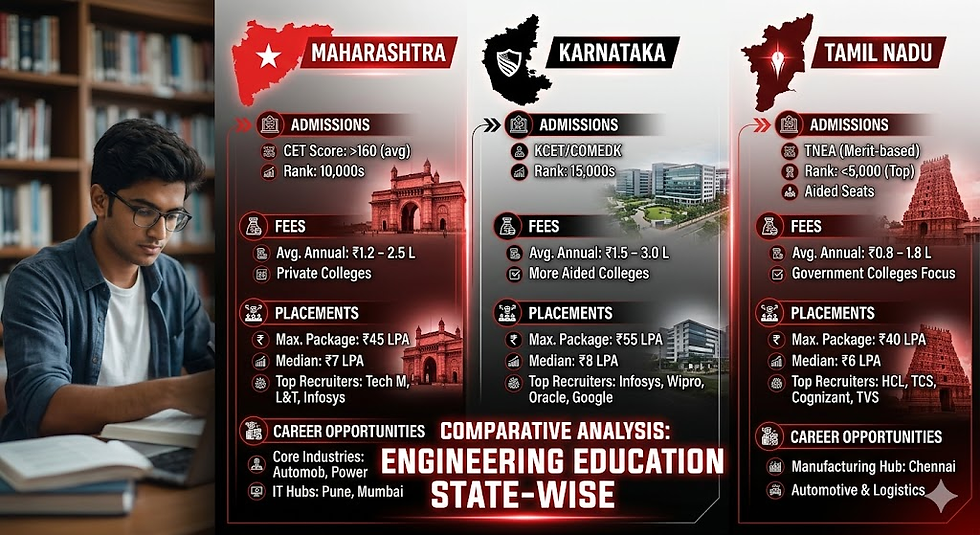
State | Top Colleges | Placement Strength | Industry Access | Cost of Living |
Maharashtra | VJTI, COEP, SPIT, PICT | Outstanding for core, IT services, and fintech. | High (Mumbai/Pune financial & auto hubs). | Moderate to High (Mumbai is expensive). |
Karnataka | RVCE, BMSCE, MSRIT | Exceptional for product dev, startups, and R&D. | Unmatched (Bengaluru tech ecosystem). | High (Bengaluru rental/hostel spikes). |
Tamil Nadu | CEG, PSG Tech, SSN | Strong in core engineering, IT services, and deep-tech. | High (Chennai auto & SaaS hubs). | Moderate (Relatively affordable student living). |
The Reality Check: Placements vary vastly more by individual college quality than by the state itself. A mid-tier college in Bengaluru will not outperform VJTI or PICT just because it is in Bengaluru. Never generalize an entire state based on its capital city's reputation.
7. The Fees Comparison
An objective Engineering Admissions Comparison is incomplete without analyzing the financial hit your family will take.
Factor | Maharashtra (CAP Route) | Karnataka (COMEDK Route) | Tamil Nadu (Private/Govt-Aided) |
Average Annual Tuition | ₹80,000 – ₹1,60,000 | ₹2,40,000 – ₹2,80,000 | ₹1,50,000 – ₹2,50,000 |
Hostel & Mess (Annual) | ₹40,000 – ₹1,20,000 | ₹1,00,000 – ₹1,80,000 | ₹80,000 – ₹1,50,000 |
Hidden / Travel Costs | Minimal | Moderate (Inter-state travel) | Moderate to High |
Overall 4-Year ROI | High (Low cost, good package) | Moderate to High (Higher cost, high package) | High (Balanced costs) |
8. What About Computer Science?
If your absolute priority is Computer Science Engineering (CSE) or its modern offshoots (AI-ML, Data Science, IT), the state choice matters.
Let's take a common dilemma: A mid-tier Bengaluru college (e.g., Dayananda Sagar) vs. a mid-tier Pune college (e.g., a newer private institute).
For CSE, Bengaluru offers a distinct edge because of networking opportunity gravity. In Bengaluru, tech meetups, hackathons, and internship openings happen continuously outside the college campus. If you are an aggressive self-learner, the Bengaluru ecosystem acts as a catalyst. However, if you are looking at top-tier colleges (e.g., PICT Pune vs. MSRIT Bengaluru), the placement metrics for CSE are remarkably close.
9. What About Core Engineering?
If you want to study Mechanical, Civil, Electrical, or Electronics & Telecommunication (ENTC), the narrative flips completely.
Do not leave Maharashtra for a core branch unless you are getting into an elite national institute like an IIT or NIT. Maharashtra's industrial belts (Chakan, Bhosari, Nashik, Aurangabad) provide phenomenal, deep-rooted training and placement infrastructure for core fields. Similarly, Tamil Nadu's PSG Tech or CEG Guindy are global benchmarks for mechanical and textile engineering. Karnataka, outside of electronics, tilts heavily toward software, making it less optimal for pure core pursuits.
10. The Hidden Costs of Leaving Your State
Before you fill out that out-of-state counselling form, consider the friction factors that don't show up on a placement brochure:
Language & Cultural Adaptation: Moving to rural Karnataka or Tamil Nadu requires adapting to new linguistic environments. While Bengaluru is largely multilingual, local day-to-day life, local transport, or industrial internships might require learning basic Kannada or Tamil.
The Food Shock: The shift from Maharashtrian cuisine to daily South Indian mess food can be a real psychological hurdle for an 18-year-old moving away from home for the first time.
The Emotional Distance: Being a train or flight ride away means you cannot simply go home for a long weekend when academic burnout strikes.
11. Real Student Scenarios
Let's look at how engineering admissions in 2026 apply to real-world percentiles:
Student A: The 99+ Percentiler
Profile: Wants top-tier exposure, budget is moderate.
Strategy: Stay in Maharashtra. Lock down VJTI, COEP, or SPIT. The ROI and local brand value are too high to pass up for a private out-of-state alternative.
Student B: The 96-98 Percentiler (The Split Road)
Profile: Wants pure CSE/IT, but is missing out on top-tier Maharashtra choices.
Strategy: Write COMEDK. If you land a CSE seat at RVCE, BMSCE, or MSRIT, it is absolutely worth moving out of Maharashtra.
Student C: The 90-95 Percentiler
Profile: Looking for strong placements, open to relocating.
Strategy: Compare mid-tier Pune choices (VIT/MIT-WPU) with top autonomous Tamil Nadu/Karnataka options. If budget permits, the exposure of a capital city down south can elevate a mid-tier student's profile significantly.
Student D: The Aspiring Founder / Product Engineer
Profile: Cares less about degrees, highly driven by hackathons, VC networks, and startups.
Strategy: Target Bengaluru aggressively. The proximity to India's startup epicenter provides an intangible value that no textbook or local placement cell can simulate.
12. The Counselling Strategy Most Students Never Consider
The biggest mistake students make during engineering admissions is tunnel vision. They wait for MHT CET results, see a percentile, and then try to fit their dreams into that single box.
The elite strategy is to run parallel tracks. You should simultaneously participate in Maharashtra CAP counselling, keep tabs on COMEDK rounds, and check private autonomous institution applications. Treat these admissions like an investment portfolio: gather your offers dynamically and evaluate them objectively based on branch, overall cost, and location value.
To execute this strategy seamlessly, utilizing digital tools can give you a massive advantage. You don't have to parse through thousands of pages of PDF cutoffs manually. The AI Counselling Platform allows you to map your percentiles, compare multi-state colleges side-by-side, analyze historic cutoffs, and project your exact ROI before you lock in your choices.
13. When Professional Guidance Can Help
Navigating the complex matrix of state quotas, minority seats, institutional rounds, and inter-state choices can get overwhelming very quickly. One wrong choice option filled in your CAP form can slip you down from an elite college to a sub-par institute.
If you are looking for guided, stress-free assistance tailored specifically to the regional landscape, the SIMPLIFIED PRO | Maharashtra Engineering Admission Counselling 2026 course provides structured strategies to master the state's CAP process.
For students looking to maximize their choices nationally—balancing MHT CET choices against COMEDK allocations and private university offers—the SIMPLIFIED PREMIUM 1:1 | All India Engineering Admission Counselling 2026 program connects you with seasoned experts to evaluate your branch-versus-college trade-offs objectively.
14. So Is Leaving Maharashtra Actually Worth It?
There is no singular, universal answer.
Reasons to Stay:
You have a top-10 state college seat in a branch you like.
You are aiming for core sectors or want a highly affordable education.
You want to leverage a local family business or existing regional networks.
Reasons to Leave:
You are getting a significantly better tech branch (e.g., pure CSE instead of Civil) in a top-tier Bengaluru or Chennai institution.
You want to break out of your comfort zone and experience a highly competitive, cosmopolitan ecosystem.
Your long-term career goals tilt heavily toward VC funding, modern tech startups, or immediate global employment.
Conclusion
Ultimately, the engineering landscape in 2026 has rewritten the rulebook. The best engineering college isn't necessarily in your state. But it also isn't necessarily outside it. College quality matters, the branch matters, your career goals matter, and your personal financial circumstances matter. The right decision depends entirely on you—not on the geographical line on a map.
FAQs
1. Is COMEDK better than MHT CET?
Neither is inherently "better." MHT CET provides access to excellent government and private colleges within Maharashtra with a heavy home-state quota advantage. COMEDK opens doors to top-tier private institutions in Karnataka (primarily Bengaluru) for students nationwide, making it a fantastic alternative route for tech branches.
2. Are Karnataka engineering colleges better than Maharashtra colleges?
Top-tier institutes in both states (like VJTI/COEP in Maharashtra and RVCE/BMSCE in Karnataka) are evenly matched regarding reputation and placements. However, for software roles and startup exposure, Bengaluru colleges hold a regional edge, while Maharashtra leads in core industrial and financial sector connections.
3. Is Tamil Nadu good for Computer Science?
Yes, Tamil Nadu boasts exceptional institutions like SSN, PSG Tech, and Anna University campuses which offer phenomenal academic structures, robust coding cultures, and strong placements in top tier software companies located along Chennai's IT corridors.
4. Should Maharashtra students leave the state for engineering?
Only if there is a distinct advantage—such as securing a premier branch (CSE/IT) in an elite out-of-state college when your MHT CET percentile restricts you to lower-tier options or less desirable branches within Maharashtra.
5. Which state offers the best ROI?
Maharashtra generally offers the highest ROI for home-state students due to low tuition fees in government-aided institutions (COEP, VJTI, Walchand) combined with great domestic placements. Out-of-state routes like COMEDK carry higher tuition costs, requiring a premium tech placement to match that initial ROI speed.
6. Are placements better in Bengaluru?
For product development roles, startups, and niche technology fields (AI, data engineering), Bengaluru provides a higher density of campus hiring opportunities compared to most Indian cities.
7. Is living in another state worth the added cost?
If the move helps you jump up an entire tier in college quality or shifts you from a non-tech branch to a core tech branch that aligns with your career goals, the long-term career dividends will far outweigh the short-term living expenses.
8. Can I apply through multiple counselling processes simultaneously?
Yes. You can participate in Maharashtra CAP counselling, Karnataka's COMEDK counselling, and independent private university admissions at the same time, choosing your final destination based on the best offer received.
9. Which colleges are best outside Maharashtra for an MHT CET student?
Look towards highly reputed entries via COMEDK (RVCE, BMSCE, MSRIT) or prominent institutional entries in Tamil Nadu (PSG Tech, SSN, VIT, SRM).
10. How should I compare colleges objectively?
Avoid flashy marketing brochures. Look at the median salary package (not the highest package), the percentage of students placed in your specific branch, the active alumni network strength, and the total fee structure including hostel and mess costs.


Comments