Master Your Future: A 2026 Engineering Student's Guide to PG Study Abroad with GMAT
- Jan 10
- 4 min read
Updated: Jan 11

In the rapidly evolving landscape of 2026, the intersection of engineering and management has never been more lucrative. For engineering graduates looking to pivot into leadership roles, the Graduate Management Admission Test (GMAT) remains a cornerstone of the application process for elite international programs.
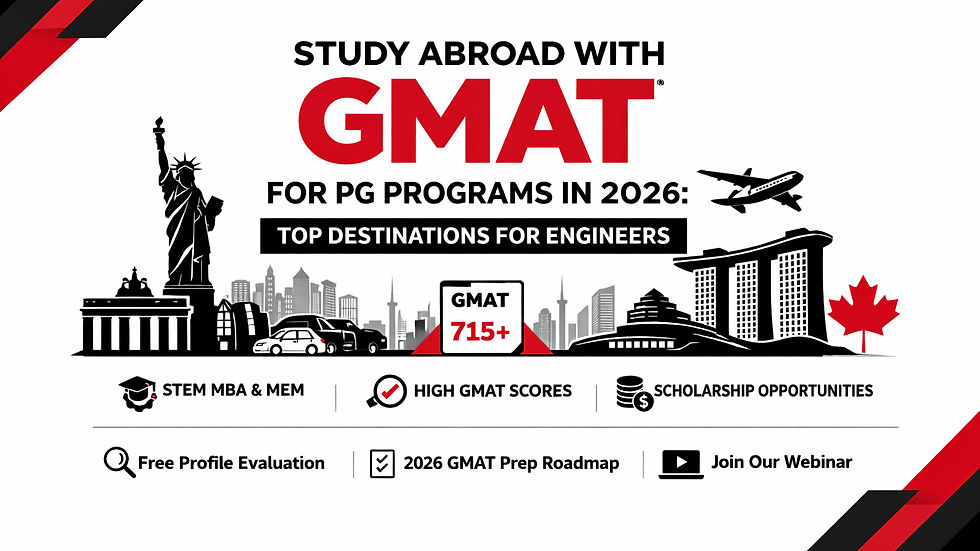
This comprehensive guide explores why and how you should navigate your journey to study abroad with GMAT for PG programs in 2026, specifically tailored for the engineering mindset.
1. The Rise of the GMAT Focus Edition
The updated GMAT Focus Edition is now the industry standard. For engineers, this is good news. The removal of the "Sentence Correction" and "Geometry" sections in favor of Data Insights plays directly into the analytical strengths of a STEM background. The test now focuses on:
Quantitative Reasoning: Arithmetic and Algebra (no Geometry).
Verbal Reasoning: Critical Thinking and Reading Comprehension.
Data Insights: Multi-source reasoning and data interpretation—skills engineers use daily.
2. Strategic Diversification
Beyond a traditional MBA, the GMAT is now the golden ticket for specialized post-graduate (PG) programs like:
Master of Engineering Management (MEM): Often called the "Engineer’s MBA."
MS in Business Analytics: Perfect for CS and IT engineers.
Supply Chain Management: A high-growth sector in 2026.
Top Destinations to Study Abroad with GMAT for PG Programs
Choosing the right country is as vital as choosing the right course. In 2026, visa policies and post-study work opportunities have shifted significantly.
The United States: The Innovation Hub
The US remains the top choice due to STEM-designated MBA and MEM programs, which allow engineering students to stay for up to 36 months on an OPT (Optional Practical Training) extension.
Top Schools: MIT (Sloan), Stanford GSB, Harvard Business School.
Average GMAT Requirement: 675–735 (Focus Edition scale).
Singapore: The Asian Powerhouse
For those looking closer to home, Singapore offers world-class education with a focus on Asian market dynamics.
Top Schools: National University of Singapore (NUS), Nanyang Technological University (NTU).
Average GMAT Requirement: 665–715.
Germany: The Engineering Heartland
Germany has become a magnet for engineers due to its low-to-zero tuition fees at public universities and a strong 18-month post-study job-seeker visa.
Top Schools: ESMT Berlin, TUM (Technical University of Munich).
GMAT Score Targets for 2026 Admissions
Understanding the new scoring system is crucial. Scores now range from 205 to 805. For engineering students aiming for top-tier PG programs, here is a breakdown of competitive scores:
Program Type | Target Percentile | GMAT Focus Score Range |
Elite MBA (M7/Ivy League) | 98th - 99th | 705 - 755+ |
Top 20 Global MBA | 90th - 95th | 665 - 695 |
Masters in Engineering Management (MEM) | 80th - 90th | 615 - 655 |
Specialized Master's (MSBA/Finance) | 75th - 85th | 595 - 635 |
Note: Since engineers often have high Quant scores, a balanced Verbal score is what truly differentiates candidates in 2026.
Step-by-Step Guide for Engineering Students
If you are planning to study abroad with GMAT for PG programs, follow this timeline for the 2026-2027 intake:
Phase 1 (Diagnostic): Take a mock GMAT Focus Edition test to identify your baseline. Leverage your engineering background to ace the Data Insights section early.
Phase 2 (Preparation): Spend 3–4 months focusing on Verbal Reasoning. Most engineers struggle here, and in 2026, communication skills are weighted heavily by admissions committees.
Phase 3 (Applications): Research "STEM-certified" management programs. These allow you to leverage your technical background while gaining business acumen.
Phase 4 (Funding): High GMAT scores (705+) are often the primary criteria for merit-based scholarships in 2026, sometimes covering 50–100% of tuition.
Frequently Asked Questions (FAQs)
1. Is the GMAT necessary for an MS in Engineering?
Typically, no. Most MS in Engineering programs require the GRE. However, if you are applying for a Master of Engineering Management (MEM) or an MBA, you should definitely study abroad with GMAT for PG programs to keep your management options open at top-tier business schools.
2. How long is the GMAT score valid in 2026?
Your GMAT score remains valid for five years. This allows engineering students to take the exam during their final year of B.Tech and use it after gaining 2–3 years of work experience.
3. Can I get a GMAT waiver in 2026?
Some universities offer waivers for candidates with 5+ years of significant professional experience or those with high GPAs from prestigious engineering colleges. However, submitting a score is still recommended to stay competitive for scholarships.
4. What is the difference between GMAT and GRE for engineers?
The GMAT is designed specifically for business schools and emphasizes logic and data interpretation. The GRE is more academic and vocabulary-heavy. In 2026, most business schools prefer the GMAT as it demonstrates a specific commitment to management.
Final Thoughts: Bridging the Gap
For an engineer, the GMAT is not just a test; it’s a rebranding tool. It signals to international universities that you possess the analytical rigor of a scientist and the strategic mindset of a business leader. As we move through 2026, the demand for this dual-competency profile is at an all-time high.


Comments