NEET 2026 New Rules & Changes by NTA Explained in Detail: Updated Eligibility, Exam Pattern, Syllabus, Reservation Policy
- Jan 30
- 5 min read

NEET 2026 New Rules & Changes by NTA Explained in Detail: Updated Eligibility, Exam Pattern, Syllabus, Reservation Policy
INTRODUCTION:
The NEET 2026 New Rules have become one of the hottest topics among medical aspirants across India. With the National Testing Agency (NTA) at the helm of conducting the National Eligibility-cum-Entrance Test (NEET) for admission to MBBS, BDS, and allied health programs, every shift in policy sparks discussions, clarifications, and strategy changes. This detailed blog is crafted to give you a complete and up-to-date understanding of the eligibility criteria, exam pattern, syllabus, reservation policy, potential CBT (Computer-Based Test) considerations, and other critical updates for NEET 2026. All information combines official notifications, credible exam insights, and the latest confirmed practices for the year 2026.
NEET 2026 New Rules & Changes by NTA Explained in Detail: Updated Eligibility, Exam Pattern, Syllabus, Reservation Policy
What Is NEET 2026 and Why the “New Rules” Matter?
The National Eligibility-cum-Entrance Test (NEET UG) 2026 is the qualifying entrance test for admission into undergraduate medical (MBBS), dental (BDS), AYUSH, veterinary, and other related professional courses in India. Conducted by NTA, NEET is one of the most competitive exams with over 15 lakh aspirants every year vying for approximately 1 lakh medical seats.(MockX)
The NEET 2026 New Rules signify key changes and clarifications in how the exam will be conducted, who can apply, the structure of the test, reservation frameworks, and speculations on technology-driven modes like CBT. These changes impact aspirants’ preparation strategy and application planning.
Updated NEET 2026 Eligibility Criteria
Understanding eligibility is the first step in exam planning. The NTA and regulatory bodies have clearly defined who can sit for NEET 2026.
Age Limit
The minimum age to appear for NEET 2026 is 17 years on or before 31st December 2026.
There is no upper age limit to apply for NEET 2026, a continuation of the policy that allows aspirants of any age to appear for the exam, provided they meet academic qualifications.(MockX)
Educational Qualifications
Applicants must have passed Class 12 or equivalent with Physics, Chemistry, Biology/Biotechnology, and English as core subjects.
Minimum rubric for qualifying marks:
General/EWS: 50% aggregate in PCB
SC/ST/OBC: 40% aggregate
PwD (Persons with Disabilities): 40% aggregate
Students from open schooling (NIOS) or other boards with equivalent qualifications are similarly eligible, provided they meet the subject and marks criteria.(MockX)
Nationality
Indian nationals, Non-Resident Indians (NRIs), Overseas Citizens of India (OCIs), and foreign nationals are eligible to apply.
Attempts
Currently, there is no limit on the number of attempts for NEET 2026. Candidates can appear as many times as they wish, subject to meeting eligibility. Official attempts limit proposals (such as “maximum three attempts”) have been discussed widely but are not implemented by the NTA until further notice.
NEET 2026 Exam Pattern — What Has Changed
The NEET 2026 exam pattern has seen one of the most straightforward updates in recent years, focused on returning to a traditional format.
Paper Structure
Total Questions: 180 questions
Physics: 45
Chemistry: 45
Biology (Botany + Zoology): 90
Medium: Available in multiple languages including Hindi, English, Marathi, Bengali, Tamil, Telugu, Kannada, Gujarati, Assamese, Punjabi, Urdu, and more.
All questions are compulsory — NTA has removed optional questions and Section B variants that were temporarily introduced during the COVID-19 period.(CollegeDekho)
Duration & Marking
Duration: 3 hours (180 minutes)
Marking Scheme:
+4 for each correct answer
−1 for each incorrect answer
0 for unattempted questionsThere is no negative marking for unanswered items, but unattempted questions receive no credit.(CollegeDekho)
Mode of Conduct
NEET 2026 continues to be conducted in offline (pen-and-paper) mode. Although discussions have circulated online about shifting to CBT like JEE Main, no official NTA notification has confirmed NEET moving to fully online mode for 2026. Any updates in this direction will be officially published on neet.nta.nic.in.(CollegeDekho)
NEET 2026 Syllabus — What to Prepare
The NEET syllabus for 2026 remains rooted in the NCERT framework for Classes 11 and 12 in Physics, Chemistry, and Biology. Most topics reflect board syllabus content. Candidates should focus comprehensively on NCERT textbooks, as NTA heavily aligns the question paper with these books.
While community discussions suggest nuanced content adjustments, the core remains stable. The officially released syllabus draws from both classes:
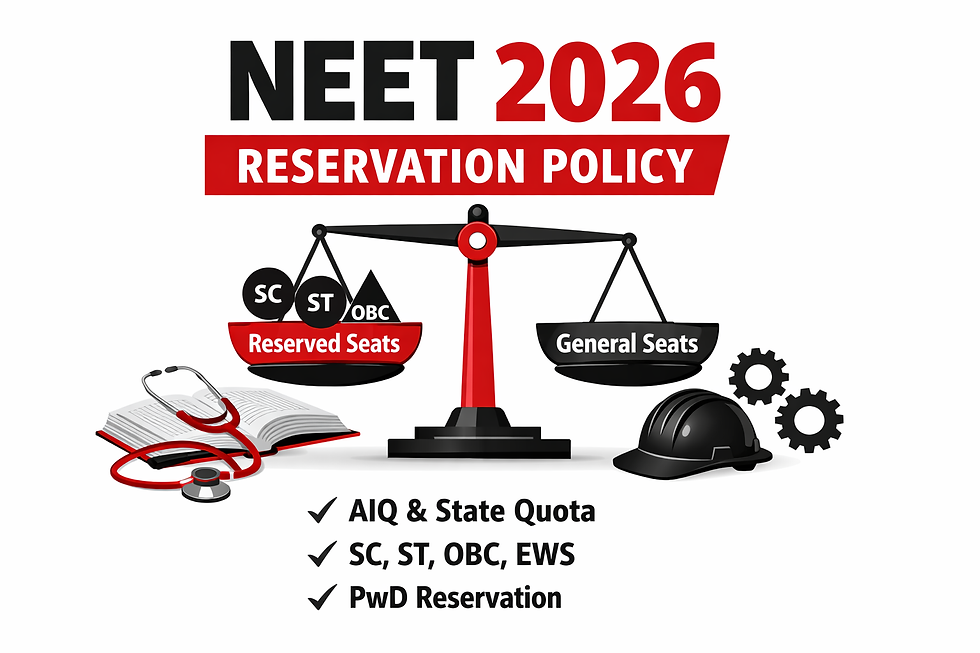
Reservation Policy for NEET 2026
Reservation in NEET seats follows Government of India mandates, divided across All India Quota (AIQ) and State Quotas.
All India Quota (15%)
Under AIQ, reservation percentages are:
OBC-NCL: 27%
SC: 15%
ST: 7.5%
EWS: 10%
PwD (horizontal): 5%This ensures representation but also intense competition within each category.(MBBS Admission Abroad.in)
State Quotas (85%)
Each state conducts its counseling and applies its reservation policies for state seats.
Exam Center & Application Changes for 2026
For 2026, NTA has introduced a rule that candidates may not be allowed to choose preferred exam cities. Instead, cities will be allocated based on the address mentioned on the candidate’s Aadhaar card. This aims to curb malpractices and align exam administration with identity verification policies.(KollegeApply News)
NEET 2026 in CBT Mode — Possibility or Not?
There is ongoing speculation about NEET 2026 being conducted in CBT mode, similar to JEE Main’s computer-based format. While online discussions and third-party platforms mention CBT practice trends, no official NTA notification has finalized a transition to CBT for NEET 2026 at the time of writing. Aspirants should prioritize preparation for the confirmed offline mode and monitor official channels for any confirmed shifts.
FAQs — NEET 2026 New Rules
What are the NEET 2026 New Rules for exam pattern?
The NEET 2026 New Rules include reverting to the pre-COVID paper pattern with 180 compulsory questions in 3 hours and no optional section.(CollegeDekho)
Is there an age limit for NEET 2026?
Yes, candidates must be at least 17 years old by 31st December 2026, with no upper age limit.(MockX)
How many questions are there in NEET 2026?
There are 180 compulsory questions — 45 each from Physics and Chemistry, and 90 from Biology.(CollegeDekho)
Will NEET 2026 be in CBT mode?
As of the latest official guidance, NEET 2026 is conducted in offline pen-and-paper mode. No confirmed CBT switch has been published by NTA.(CollegeDekho)
What is the reservation policy in NEET 2026?
Reservation under the 15% All India Quota includes OBC (27%), SC (15%), ST (7.5%), EWS (10%), and PwD (5%), with distinct state quota rules for the remaining 85%.(MBBS Admission Abroad.in)
Can candidates choose exam cities for NEET 2026?
Exam cities may now be allocated based on Aadhaar address, reducing city preference flexibility.(KollegeApply News)
Final Thoughts on NEET 2026 Preparation
Understanding the NEET 2026 New Rules is critical to building an effective preparation roadmap. Focus on mastering the NCERT syllabus, develop strong time management skills for the 3-hour exam, and stay updated on official releases from NTA. With the right strategy and clarity on eligibility, pattern, and reservation policies, aspirants can approach NEET 2026 with confidence.
If you’d like access to the official NEET 2026 brochure or mock papers designed to reflect the revised pattern, I can help you find those next.
CTA:
more related topic


Comments