PLC, ROS, or Python: What Should You Learn First?
- Feb 12
- 4 min read
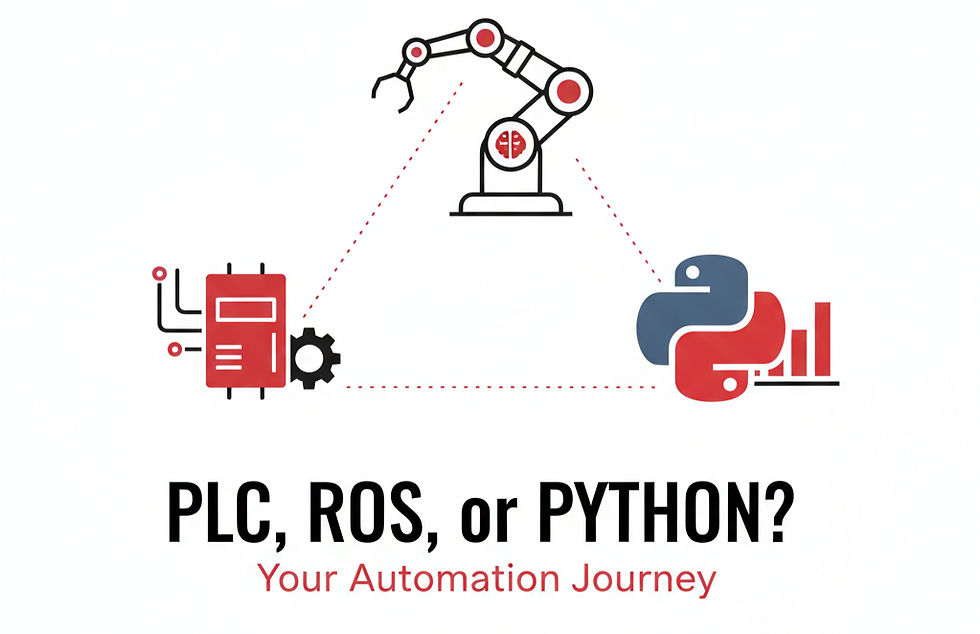
PLC ROS or Python:
The year 2026 marks a turning point where "knowing how to code" is no longer optional for industrial engineers. However, the path you take depends entirely on where you want to spend your workday: on a high-stakes factory floor, in a high-tech R&D lab, or behind a desk building the brains of the next generation of AI robots.
If you want to learn automation engineering 2026 effectively, you need a strategy that balances immediate job security with long-term career growth.
1. The Heavyweight Champion: PLC (Programmable Logic Controllers)
If you want to walk into a factory today and be the person who keeps the assembly line moving, PLC is your starting point.
Why PLCs are still King in 2026
Despite the rise of AI, the global PLC market has reached a staggering $13.33 billion in 2026. Factories prioritize reliability above all else. A PLC is built to run for 20 years without a reboot, surviving heat, dust, and electrical noise that would fry a standard computer.
Primary Language: Ladder Logic (LD). It looks like electrical diagrams and is the industry standard.
Job Roles: Controls Engineer, Automation Technician, Maintenance Engineer.
The 2026 Edge: Modern PLCs from Siemens (TIA Portal) and Rockwell (Studio 5000) now support "Soft PLCs" and edge computing, allowing them to talk directly to the cloud.
Pro-Tip: If you enjoy physical hardware, wiring sensors, and seeing machines move in real-time, start here.
2. The Brain of the Future: ROS (Robot Operating System)
If you dream of working on autonomous mobile robots (AMRs), delivery drones, or humanoid assistants, ROS (specifically ROS 2) is non-negotiable.
The Rise of Agentic AI in Robotics
By 2026, the robotics industry has shifted from rigid, pre-programmed routines to Agentic AI—robots that can make independent decisions. ROS 2 is the middleware that allows different parts of a robot (the "eyes" or cameras, the "legs" or motors, and the "brain" or AI) to talk to each other.
What you’ll learn: SLAM (Simultaneous Localization and Mapping), navigation stacks, and sensor fusion.
Market Growth: The ROS-based robot market is growing at an 8.8% CAGR, fueled by massive deployments in logistics (warehousing) and healthcare.
3. The Swiss Army Knife: Python
Python is the glue that holds modern automation together. In 2026, it is the most requested "plus-one" skill for any engineer.
Why Python is the Ultimate "First Step"
Python is the primary language for AI/ML (Artificial Intelligence and Machine Learning). While you might not use Python to control a safety-critical emergency stop on a press, you will use it to:
Analyze factory data for predictive maintenance.
Bridge the gap between a PLC and a SQL database.
Write scripts for ROS 2 nodes.
Comparison Table: Which One Fits Your Goal?
Feature | PLC (Programmable Logic) | ROS (Robot Operating System) | Python (General Purpose) |
Primary Environment | Industrial Factories | R&D, Logistics, Startups | Everywhere (Data, AI, Web) |
Learning Curve | Moderate (Logic-based) | Steep (Requires Linux/C++) | Easy (Readable syntax) |
Reliability | Extremely High (Deterministic) | High (with ROS 2) | Medium (Script-dependent) |
2026 Demand | High (Critical Infrastructure) | Exploding (AMRs & AI) | Universal |
The Verdict: What Should You Learn First?
To learn automation engineering 2026 in a way that makes you "un-fireable," follow this roadmap:
Step 1: Learn Python (The Foundation)
Spend 4 weeks mastering Python basics. It will make learning ROS significantly easier and give you the tools to automate your own paperwork once you get a job.
Step 2: Learn PLC (The Money-Maker)
If you want a job now, learn Ladder Logic. Focus on Siemens or Allen-Bradley depending on your region. Industrial companies are desperate for people who can troubleshoot existing lines.
Step 3: Learn ROS (The Specialization)
Once you understand how a machine works (PLC) and how to code (Python), dive into ROS. This is where the $100k+ salaries live, particularly in specialized fields like "AI Infrastructure" and "Physical AI."
FAQ: Navigating Your Career Path
Q: Is it better to learn Python before I try to learn automation engineering 2026?
A: Yes. In 2026, most modern automation platforms—including SCADA systems like Ignition and even some high-end PLCs—use Python (or Jython) for advanced scripting. Starting with Python gives you a "mental framework" for logic that applies to both PLCs and ROS.
Q: Do I need a degree to work with PLCs in 2026?
A: Not necessarily. While many large firms require an Engineering degree, the "skilled labor shortage" of 2026 means that certifications in specific platforms (like Siemens TIA Portal) and hands-on experience are often enough to get your foot in the door as a technician.
Q: Will AI replace PLC programmers?
A: No. AI is currently being used to generate PLC code (saving you time on documentation), but a human is still required to verify safety protocols and physical timing. In 2026, AI is a tool, not a replacement.
Ready to Start Your Journey?
The gap between IT and OT is closing fast. Whether you choose the stability of PLCs or the innovation of ROS, your success in 2026 depends on your ability to speak both the language of the machine and the language of the data.
Key Action Items:
Download: Get a free version of OpenPLC to practice Ladder Logic.
Install: Set up Ubuntu and ROS 2 Humble (or the latest LTS) to explore robotics.
Script: Write a simple Python script to log data from a simulated sensor.


Comments