Profile Building Myths: Certificates vs Impact – What Really Matters for UG Admissions in 2026
- Jan 12
- 4 min read
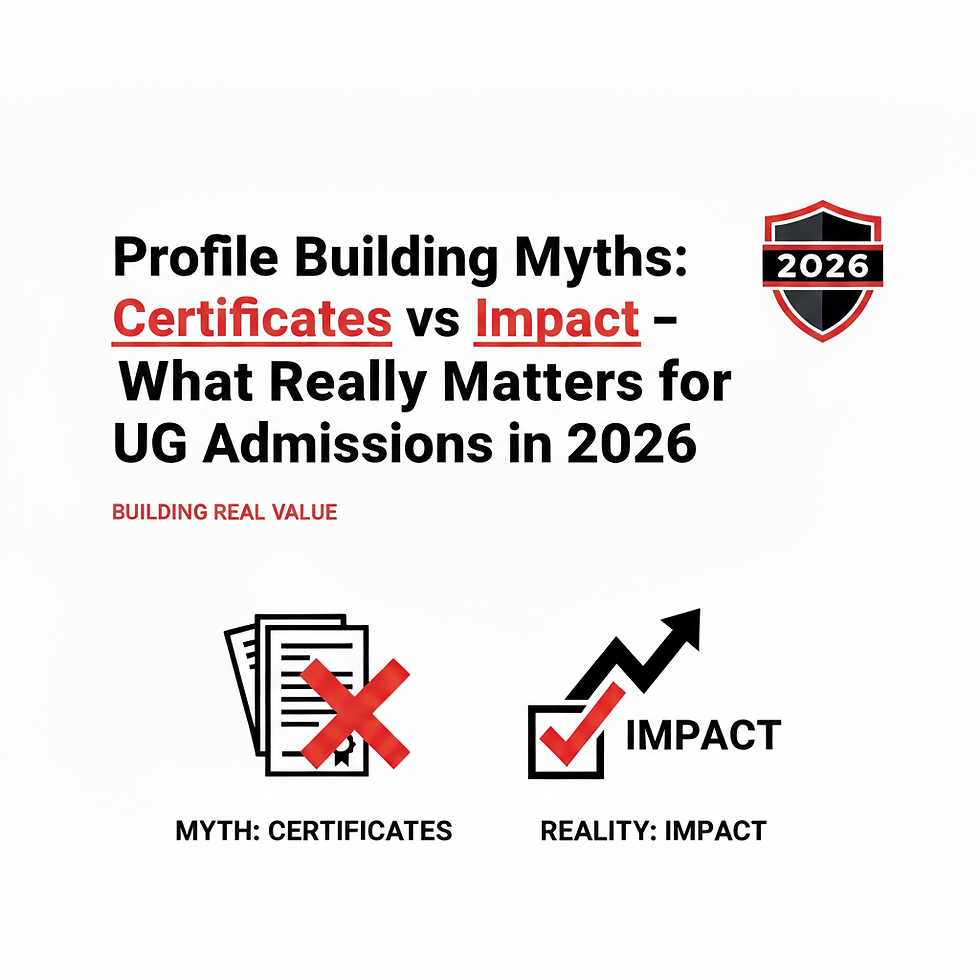
Profile building myths often confuse students and parents preparing for undergraduate admissions in 2026. One of the most common misconceptions is that collecting certificates guarantees admission to top universities. In reality, universities today focus far more on the impact, depth, and learning behind activities than on the number of certificates a student holds.
This blog breaks down the biggest profile building myths, explains the difference between certificates and real impact, and clarifies what universities actually look for in UG admissions.
Point | Details |
Main topic | Profile building myths |
Common confusion | Certificates vs real impact |
Target audience | UG aspirants & parents |
Evaluation style | Holistic admissions |
Key focus | Depth, relevance, reflection |
Relevant year | UG Admissions 2026 |
What Is Profile Building in UG Admissions?
Profile building refers to all the academic and non-academic elements that show who a student is beyond exam scores.
It includes:
Extracurricular activities
Leadership roles
Research and internships
Community service
Personal projects
Essays and reflections
Universities use profile building to understand a student’s interests, values, and long-term potential.
The Biggest Profile Building Myth: More Certificates = Better Profile
One of the most damaging profile building myths is the belief that more certificates automatically mean a stronger application.
Many students collect:
Workshop certificates
Short online course certificates
Participation certificates
However, universities do not count certificates. They evaluate what the student actually did and learned.
Certificates vs Impact: What Is the Real Difference?
What Certificates Show
Certificates usually show:
Participation
Completion
Attendance
They rarely explain:
Skill development
Depth of involvement
Personal growth
Certificates alone do not communicate impact.
What Impact Shows
Impact focuses on:
What the student learned
How the experience changed the student
Skills gained and applied
Outcomes or results
Impact helps universities see growth, initiative, and maturity.
Why Universities Care More About Impact Than Certificates
Universities receive thousands of applications with similar certificates. To differentiate applicants, they focus on impact.
They ask:
Did the student take initiative?
Was the activity meaningful and sustained?
Did the student contribute or lead?
Can the student reflect clearly on learning?
Impact answers these questions, certificates do not.
Common Profile Building Myths Students Believe
Myth 1: Doing Many Activities Is Better Than Doing One Well
Universities prefer depth over quantity. One long-term, meaningful activity is more valuable than ten short ones.
Myth 2: Only Paid Programs Matter
Paid programs do not guarantee quality or impact. Free or school-led initiatives can be equally powerful if done well.
Myth 3: Online Certificates Add Major Value
Online courses add value only if students can show application of learning.
Myth 4: Leadership Means Being a Club President
Leadership also includes initiative, problem-solving, and responsibility, not just
titles.
How Universities Actually Evaluate Student Profiles
Universities evaluate profiles holistically.
They focus on:
Consistency of interests
Progression over time
Skill development
Reflection in essays and interviews
A profile with clear direction and impact stands out more than one with scattered certificates.
What Counts as Real Impact in Profile Building?
Impact can be academic, personal, or social.
Examples include:
Conducting a research project
Starting a community initiative
Leading a long-term CAS project
Developing a personal portfolio or product
Applying learning in real-world contexts
Impact does not need to be large-scale. It needs to be genuine.
Certificates That Do Add Value:
Not all certificates are useless. Some add value when supported by learning and reflection.
These include:
Research program completion certificates
Academic summer school certificates
Internship completion letters
The key is explaining what was learned and achieved.
How to Convert Certificates into Impact
Students often already have certificates. The key is presenting them correctly.
They should:
Explain why they chose the activity
Describe their role clearly
Highlight skills gained
Reflect on outcomes
Universities care more about the story than the document.
Profile Building Myths for IB and IGCSE Students
IB and IGCSE students often believe:
CAS completion alone is enough
All CAS activities are equal
Short-term activities fulfill profile needs
In reality, universities look at:
Quality of CAS experiences
Reflection and learning
Alignment with academic goals
CAS is about growth, not ticking boxes.
Certificates vs Impact in Scholarships
Scholarships are even more impact-focused.
Scholarship committees look for:
Leadership
Initiative
Community contribution
Clear purpose
Certificates without impact rarely help scholarship applications.
Country-Wise Perspective on Profile Building Myths
United States
US universities strongly value impact, leadership, and reflection. Certificates alone carry little weight.
United Kingdom
UK universities focus on academics but still value meaningful subject-related activities.
Canada and Europe
These systems prefer structured profiles with clear academic alignment and depth.
Across countries, impact consistently matters more than certificates.
Common Mistakes Students Make in Profile Building
Students often:
Chase certificates instead of skills
Join activities only for resumes
Stop activities too early
Fail to reflect on learning
These mistakes weaken applications despite many achievements.
How to Build a High-Impact Profile the Right Way
Students should focus on:
Long-term involvement
Clear academic alignment
Skill development
Honest reflection
Quality experiences lead to strong profiles naturally.
Frequently Asked Questions ( FAQs)
What are the biggest profile building myths?
The biggest myth is that collecting certificates guarantees admission.
Do universities check certificates?
Universities care more about impact and reflection than documents.
Are certificates completely useless?
No, but they must be supported by learning and outcomes.
What matters more: certificates or impact?
Impact matters more than certificates in UG admissions.
How many activities are enough for a strong profile?
There is no fixed number. Depth and consistency matter most.
Does impact matter more than exam scores?
Impact complements exam scores but cannot replace academic readiness.
Do online certificates help?
Only if students can clearly explain how they applied the learning.
When should profile building start?
Ideally from Grade 9 or 10 with consistent effort.
Profile building myths often mislead students into focusing on certificates instead of real learning. In UG admissions for 2026, universities care far more about impact, depth, and reflection than the number of certificates collected.
Students who focus on meaningful experiences, sustained involvement, and personal growth build profiles that truly stand out.
Preparing your UG application for 2026?
Focus on impact, not certificates
Choose activities with meaning
Reflect clearly on learning and growth
Official Resources:
Build impact. Not just paperwork. Strengthen your UG profile.


Comments