RBI Grade B 2026: Comprehensive Guide to Course Streams & Selection Details
- Jan 10
- 4 min read
INTRODUCTION
The Reserve Bank of India (RBI) remains the most prestigious destination for finance and economics enthusiasts in India. As we look toward the RBI Grade B 2026 recruitment cycle, the competition has evolved from mere rote learning to a demand for high-level analytical competency. To succeed in 2026, candidates must move beyond "surface-level" preparation and embrace a curriculum-heavy approach that aligns with the Central Bank's shifting priorities.
Whether you are targeting the General (DR), DEPR, or DSIM stream, understanding the specific course requirements and the 2026 exam architecture is the first step toward your cabin in Mumbai’s Mint Road.
RBI Grade B 2026: Understanding the Three Specialized Streams
The 2026 recruitment is expected to offer approximately 100–120 vacancies across three distinct professional streams. Each stream requires a unique academic background and follows a specialized selection course.
1. Officers in Grade 'B' (DR) – General
This is the most popular stream, open to graduates from any discipline.
Academic Course Requirement: A Bachelor’s degree with a minimum of 60% marks (50% for SC/ST/PwBD) or a Post-Graduate degree with 55% marks.
2026 Trend: The General stream now integrates heavy descriptive writing in Phase 2, requiring candidates to act as "policy commentators" rather than just test-takers.
2. Officers in Grade 'B' (DR) – DEPR (Dept. of Economic and Policy Research)
This is a niche stream for pure economists.
Academic Course Requirement: Master's Degree in Economics, Econometrics, Quantitative Economics, or Finance with 55% marks.
Focus Areas: For RBI Grade B 2026, the DEPR syllabus focuses heavily on Mathematical Economics, International Trade, and Green GDP metrics.
3. Officers in Grade 'B' (DR) – DSIM (Dept. of Statistics and Information Management)
The stream for data scientists and statisticians.
Academic Course Requirement: Master’s in Statistics, Mathematical Statistics, or Data Science.
Focus Areas: The 2026 curriculum emphasizes Big Data Analytics, Machine Learning (ML), and Artificial Intelligence (AI) applications in central banking.
Before diving into the syllabus, ensure you check your eligibility on collegesimplified.in to see if your specific degree matches the 2026 criteria.
Detailed RBI Grade B 2026 Syllabus & Selection Pattern
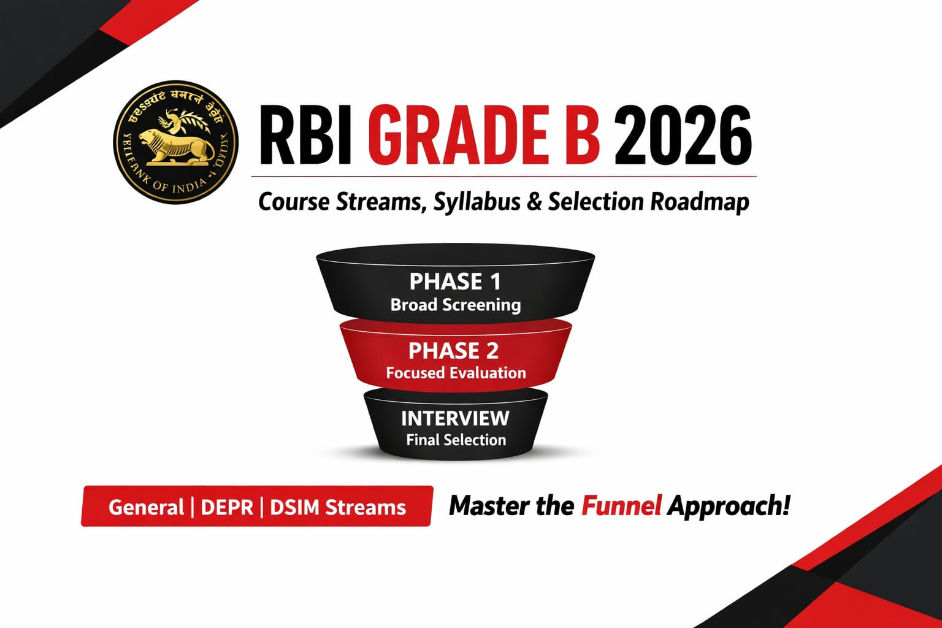
The selection process for 2026 follows a rigorous three-phase structure. The "Funnel Approach" is highly recommended here: starting with broad conceptual clarity and narrowing down to specific data-driven answers.
Phase 1: The Eliminator (Objective)
The Phase 1 exam for RBI Grade B 2026 is expected to be conducted in the latter half of 2026 (July–September). It consists of 200 marks and 120 minutes of sectional timing.
Section | Questions | Marks | Duration |
General Awareness (GA) | 80 | 80 | 25 Mins |
Reasoning Ability | 60 | 60 | 45 Mins |
English Language | 30 | 30 | 25 Mins |
Quantitative Aptitude | 30 | 30 | 25 Mins |
Phase 2: The Decider (Objective + Descriptive)
Phase 2 is where your deep-dive preparation for RBI Grade B 2026 truly matters.
Paper I: Economic & Social Issues (ESI): 50% Objective, 50% Descriptive. Focus on Sustainable Development, Poverty Alleviation, and the 2025-26 Economic Survey.
Paper II: English (Writing Skills): 100% Descriptive. Candidates must type an Essay, Précis, and Reading Comprehension.
Paper III: Finance & Management (FM): 50% Objective, 50% Descriptive. The 2026 syllabus includes "Nudge Theory," Digital Payments evolution, and Fintech regulations.
Note: For the descriptive sections, you must practice typing on a keyboard, as the speed of thought must match the speed of typing.
The "Funnel Approach" to Cracking RBI Grade B 2026
To master the RBI Grade B 2026 curriculum, we recommend the Funnel Strategy:
Top of Funnel (Basics): Master the fundamentals of Macroeconomics (NCERT Class 11-12) and Financial Markets.
Middle of Funnel (Application): Read the RBI Bulletin and PIB (Press Information Bureau) daily. Connect static concepts (like Inflation) with current news (like CPI data).
Bottom of Funnel (Execution): Practice writing 400-600 word descriptive answers. Focus on structure: Intro -> Body (Data/Analysis) -> Conclusion.
CTA: Ready to start your journey? Read our detailed guide on How to Choose the Right Banking Course in 2026.
Expected RBI Grade B 2026 Notification & Dates
Based on historical trends and the 9–12 month gap typically maintained by the Reserve Bank, here is the tentative schedule for RBI Grade B 2026:
Notification Release: July – September 2026
Phase 1 Exam: August – October 2026
Phase 2 Exam: September – November 2026
Final Interviews: December 2026 – January 2027
Note: These dates are based on current 2025-26 cycle trends and are subject to official confirmation by the Reserve Bank of India.
FAQs on RBI Grade B 2026 Course & Eligibility
Q1: What is the age limit for the RBI Grade B 2026 exam?
A: For RBI Grade B 2026, candidates must generally be between 21 and 30 years old. As of September 1, 2026, you should not have been born earlier than Sept 2, 1996.
Q2: Can a final year student apply for the RBI Grade B 2026 recruitment?
A: Usually, the RBI Grade B 2026 eligibility requires you to have your final marksheet/degree at the time of filling the application. If your results are declared before the notification deadline in 2026, you are eligible.
Q3: Is there a change in the RBI Grade B 2026 syllabus for Finance?
A: While the core topics remain the same, the RBI Grade B 2026 syllabus has increased focus on recent financial technologies (CBDC, UPI Global), Risk Management, and Ethics in Banking.
Q4: How many attempts are allowed for RBI Grade B 2026?
A: For the General category, there is a limit of 6 attempts for the Phase 1 exam. No such limit exists for SC/ST/OBC candidates for RBI Grade B 2026.
Q5: What is the best resource for RBI Grade B 2026 descriptive writing?
A: For RBI Grade B 2026, the best resources are the RBI's "Monthly Bulletin," editorials from The Hindu or Live Mint, and practicing previous year's descriptive questions.
Conclusion
The road to becoming an RBI Grade B Officer in 2026 is paved with consistent effort and a structured course of action. By mastering the General, DEPR, or DSIM stream requirements and utilizing the Funnel Approach for your ESI and Finance preparation, you can navigate the toughest banking exam in the country.
Stay updated with the latest exam notifications and academic roadmaps at collegesimplified.in.
CTA: Want a personalized 2026 study plan? Subscribe to our newsletter at collegesimplified.in for the latest updates on banking and finance courses!



Comments