SST Study Plan 2026: Complete Strategy, Timetable & Smart Preparation Guide for 90+ Marks
- Apr 24
- 3 min read
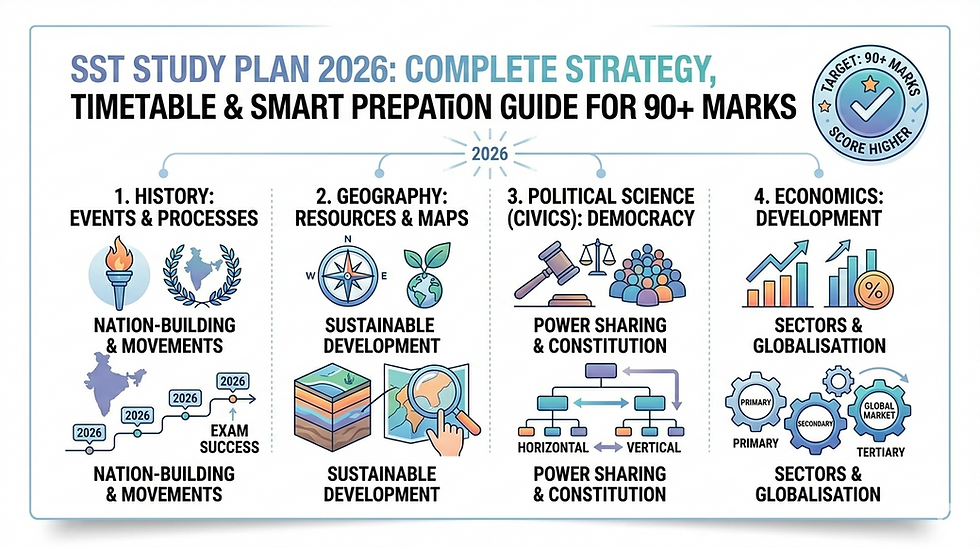
Why You Need an SST Study Plan in 2026
Social Science is a combination of four subjects:
History
Geography
Political Science
Economics
The CBSE syllabus is designed to develop analytical thinking and real-world understanding, not just memorization.
Without a proper plan:
You may miss important chapters
Revision becomes difficult
Time management suffers
A structured SST Study Plan helps you:
Cover the full syllabus
Focus on high-weightage topics
Improve answer writing
SST Study Plan 2026 Based on Latest Syllabus
According to the latest CBSE syllabus, SST includes key topics such as:
The Rise of Nationalism in Europe (History)
Resources and Development (Geography)
Political Parties (Civics)
Development (Economics)
Understanding the syllabus is the first step toward building an effective SST Study Plan.
SST Study Plan 2026: Section-Wise Strategy
1. History Study Plan
History requires understanding + storytelling.
How to study:
Read NCERT line by line
Focus on timelines and events
Learn causes, effects, and outcomes
Important tip:
Make short notes chapter-wise.
2. Geography Study Plan
Geography is scoring but needs practice.
Strategy:
Focus on diagrams and maps
Practice map work regularly
Understand concepts, don’t just memorize
3. Political Science Study Plan
This section is concept-based and easy to score.
Strategy:
Learn definitions and examples
Understand real-life applications
Practice case-based questions
4. Economics Study Plan
Economics is logical and short.
Strategy:
Focus on key terms
Learn graphs and examples
Revise frequently
30-Day SST Study Plan 2026
Here’s a practical plan you can follow:
Week 1–2: Syllabus Completion
Cover 2 chapters daily
Mix subjects (History + Geography)
Focus on understanding
Week 3: First Revision
Revise all chapters
Make short notes
Practice questions
Week 4: Practice & Mock Tests
Solve sample papers
Practice map work
Analyze mistakes
A structured plan with revision cycles is proven to improve retention and performance.
Daily SST Study Plan Routine
Time | Task |
1–2 hrs | Theory (NCERT reading) |
1 hr | Notes making |
1 hr | Question practice |
30 mins | Revision |
Consistency matters more than long study hours.
Smart Techniques to Improve SST Preparation
1. Use Active Recall
Instead of reading again and again, try recalling answers without looking.
2. Practice Answer Writing
CBSE exams focus on structured answers:
2 marks → 2–3 points
5 marks → 5–6 points
3. Focus on Map Work
Map questions carry marks and are easy to score.
4. Solve Previous Year Papers
PYQs help understand:
Question patterns
Important topics
Common Mistakes in SST Preparation
Relying only on reading
Skipping revision
Ignoring map work
Not practicing answers
Avoiding these mistakes can significantly improve your score.
Last 7 Days SST Study Plan 2026
Day 1–3: Full Revision
Revise all subjects
Focus on weak areas
Day 4–5: Practice Papers
Solve 2–3 full papers
Analyze mistakes
Day 6: Quick Revision
Revise maps, dates, keywords
Day 7: Light Study
Avoid stress
Sleep well
Many students follow a similar revision approach close to exams, focusing on NCERT and PYQs.
SST Study Plan for 90+ Marks
To score above 90:
Learn keywords
Write structured answers
Use headings and points
Revise regularly
Also, presentation matters:
Underline keywords
Keep answers neat
SST Study Plan vs Smart Strategy
Traditional Method | Smart SST Study Plan |
Only reading | Active recall |
No revision | Weekly revision |
No practice | PYQs + mock tests |
Random study | Structured plan |
Latest Trends in SST Exams (2026)
Case-based questions increasing
Focus on conceptual clarity
Map-based questions important
Internal assessment weightage
CBSE emphasizes analytical and application-based learning.
FAQ Section (SST Study Plan)
Q1. What is the best SST Study Plan for 2026?
The best SST Study Plan includes completing the syllabus in 2 weeks, revising in week 3, and practicing mock tests in week 4.
Q2. How many hours should I study SST daily?
For an effective SST Study Plan, 3–4 hours daily is enough with proper focus and consistency.
Q3. Can I score 90+ using SST Study Plan?
Yes, following a structured SST Study Plan with revision and practice can help you score above 90.
Q4. Is NCERT enough for SST Study Plan?
Yes, NCERT is the most important resource for any SST Study Plan, especially for CBSE exams.
Final Thoughts
SST is one of the most scoring subjects if prepared properly. You don’t need to study for long hours, you just need a smart plan.
A well-structured SST Study Plan 2026 will help you:
Stay consistent
Revise effectively
Perform confidently
Focus on understanding, practice regularly, and keep revising.
CTA – Official Resources for SST Study Plan 2026
Stay updated and prepare using official CBSE resources:
CBSE Official Website: https://www.cbse.gov.in/
CBSE Academic Portal: https://cbseacademic.nic.in/
NCERT Books (Official): https://ncert.nic.in/
Apply here: https://scalerschooloftech.com/4ruflJ5
Use Coupon Code CS500


Comments